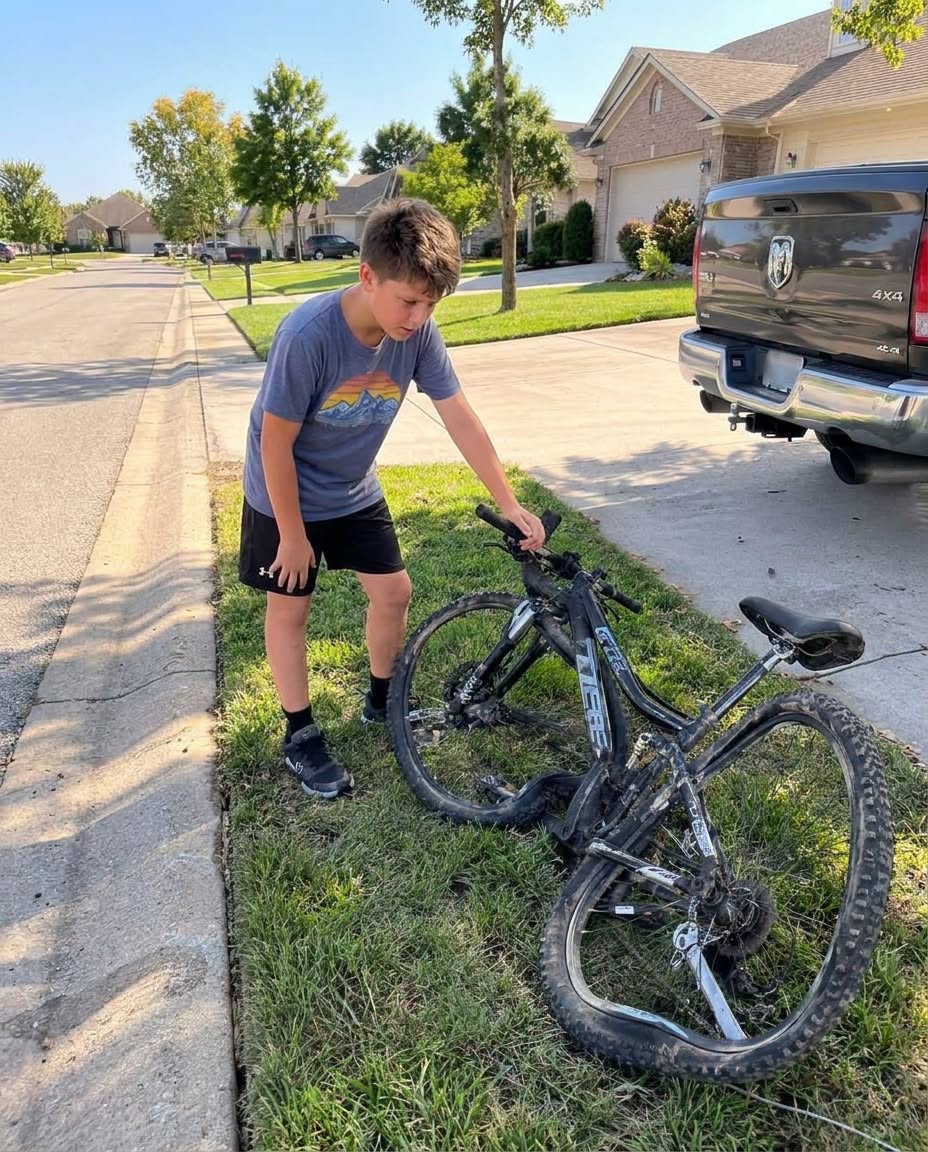
The sound came from outside just before dinner—metal twisting under something heavy, followed by my twelve-year-old son saying one stunned word: “Hey.” I ran into the yard and found Gary’s pickup in the street and Jake standing beside the mountain bike he had spent eleven months and three weeks saving to buy. The frame was bent, the front wheel twisted sideways, and the derailleur lay against the grass. Gary had backed over it while pulling out of his driveway, even though the bike had been sitting on our lawn for nearly twenty minutes. When I told him what the bike had cost and how long Jake had worked for it, Gary shrugged and said it should not have been parked so close to the road. I argued with him for ten minutes about the property line, the security-camera footage, and basic responsibility. He went inside without offering a dollar.
Jake had earned that bike by mowing five neighborhood lawns at fifteen dollars apiece, keeping every payment in a spiral notebook and updating his running total each Saturday night. Before buying anything, he had compared three models in a spreadsheet, weighted features such as trail durability and derailleur quality, read reviews, and watched videos until he knew exactly why he wanted the matte-green Diamondback Atroz priced at $420. He washed it after rides, maintained the chain, checked tire pressure, and turned the original savings notebook into a maintenance log. The bike mattered because it represented something larger than a purchase: almost a year of choosing a long-term goal over whatever he might have wanted that week. I spent the weekend considering small-claims court and legal advice, but on Saturday morning Jake walked into the kitchen and announced that he had another plan. “I’ve got it handled,” he said, then carried his notebook next door.
Forty-five minutes later, he came home with a handwritten apology and an envelope containing $420. Jake explained that he had not argued with Gary about fault. Instead, he sat at the man’s kitchen table and asked when he bought his truck, how long he had worked for it, and whether he knew what it felt like to care about something enough to spend hours maintaining it. Then Jake opened his notebook and showed him eleven months of lawn-mowing dates, payments, and the entry from the day he finally bought the bike. “I’m not asking you to pay because I can force you to admit you were wrong,” Jake had told him. “I’m asking you to do it because it’s the right thing to do.” He even reminded Gary that he had once watched him spend three hours working on the truck’s engine, because that meant he probably understood what effort made an object valuable. Gary went quiet, disappeared into another room, and returned with the money. Jake had done something I had failed to do: he gave a defensive man a way to take responsibility without first humiliating him into surrender.
We drove back to the bike shop that afternoon, where Jake bought the same model, this time with an updated derailleur. He had already called ahead to confirm that one remained in stock and had brought two dollars from his own pocket after realizing the original $420 did not include tax. At home he opened the notebook again, wrote “Bike 2, same model,” recorded the date, adjusted the seat, checked the tire pressure, and asked me to verify the recommended handlebar torque. That evening Sarah and I kept returning to what he had said about Gary: there was a difference between forcing someone to admit they were wrong and giving them room to decide to do the right thing. At twelve, Jake understood that legal leverage and moral persuasion were not the same tool. He had known enough to try the quieter one first.
Later, I found him at his desk writing notes about the conversation—what had worked and what he might do differently next time. He said he wanted to remember that “talking to someone like they can do the right thing is different from accusing them of doing the wrong thing.” Then, almost as an afterthought, he told me Gary had asked whether anyone had taught him to think that way. Jake had answered, “My dad thinks like that. I’ve watched him.” I wanted to accept the compliment, but standing there I understood that parenting rarely offers such clean lines of cause and effect. Maybe he had learned something from watching me; maybe he had worked most of it out himself; probably both were true. The bike sat in the garage, matte green and new again, but that was no longer the part of the story I kept thinking about. What stayed with me was the notebook, the preparation, and a twelve-year-old boy discovering that sometimes the strongest way to hold someone accountable is to leave them enough dignity to choose accountability for themselves.