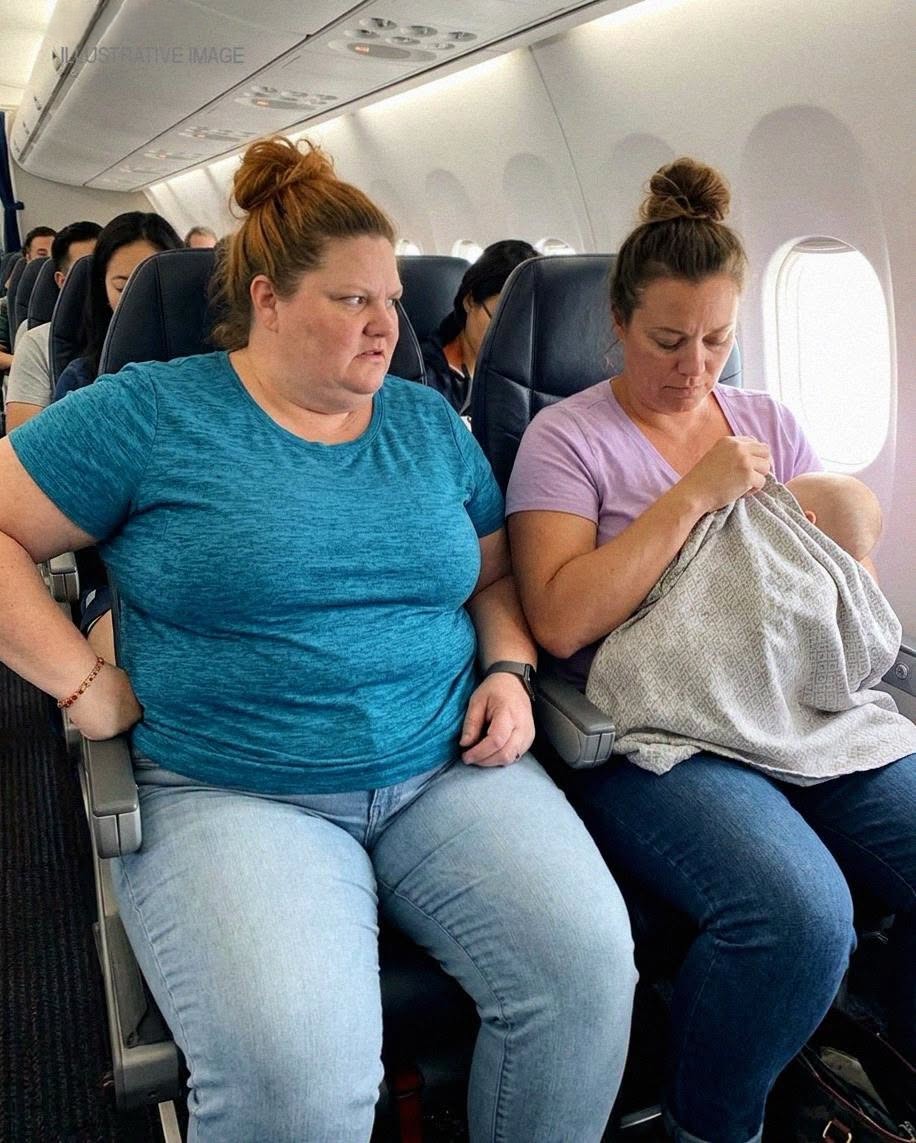
A month after burying my husband, I boarded a six-hour flight with my two children.
I thought the hardest part would be traveling alone with a five-month-old baby and an eight-year-old daughter.
I was wrong.
The hardest part was sitting beside a stranger who decided, before the plane had even taken off, that she had the right to judge me.
My husband, Mark, had died only a month earlier.
He was thirty-seven.
Cancer had taken him in less than a year, leaving behind a house that suddenly felt too quiet and two children who were still trying to understand why their father wasn’t coming home.
Louise was eight.
Noah was five months old.
Louise had stopped asking when Daddy would return.
Somehow, that hurt more than when she used to ask every day.
My mother had invited us to stay with her for a while, hoping that getting away from our home would give us some room to breathe.
So I packed our bags.
I packed diapers, bottles, clothes and everything Noah needed.
I also packed the blue sweater Mark had worn during his final winter.
I didn’t know why.
I just couldn’t leave it behind.
The flight was completely full.
Because of the seating arrangement, Louise was placed one row behind me while I sat in the aisle seat with Noah.
The woman beside me looked annoyed before we had even left the gate.
She glanced at Noah and then at me.
“If your baby starts screaming, I’m not going to sit here and listen to it,” she said.
I tried to remain polite.
“We’ll do our best.”
She gave me a cold look.
“People always say that.”
Louise leaned forward from the row behind us.
“My brother is usually quiet,” she said.
The woman ignored her.
I gave Louise a warning look, and she quietly opened her tablet.
For the first two hours, everything was fine.
Noah slept peacefully against my chest.
I watched the clouds through the window and tried not to think about the empty seat Mark would have occupied if he were still alive.
Then Noah woke up.
He began crying.
I tried his pacifier.
I rocked him.
I checked his diaper.
Nothing worked.
Then I realized what he needed.
He was hungry.
I took out my nursing cover and began breastfeeding him.
Within seconds, the woman beside me noticed.
Her expression changed.
“Oh, great,” she said.
I looked at her.
“I paid for this seat to hear someone else’s baby scream, and now I have to watch you feed him?”
My face became hot.
“He needs to eat.”
She shook her head.
“How shameless.”
I couldn’t believe what I was hearing.
“He’s five months old,” I said quietly.
“That doesn’t mean I want to see this.”
I looked down at my son.
He was finally calm.
He wasn’t crying anymore.
He was simply eating.
But she continued.
“People with babies like that should stay home.”
Then she said something I’ll never forget.
“Why don’t you lock yourself in the toilet?”
I stared at her.
“A bathroom isn’t where babies eat,” I replied.
She reached toward the call button.
Before she could press it, Louise appeared beside us.
“Mom,” she said, “why don’t you take my seat?”
I shook my head.
“No, Louise.”
“It’s okay.”
She sat beside the woman.
The woman gave me a satisfied look, as though my eight-year-old daughter had finally corrected my behavior.
I stood carefully and moved into Louise’s seat.
As I passed her, she whispered something.
“She dropped something.”
“What?”
“I’ll show you later.”
I didn’t understand.
Then I noticed Louise staring at the floor.
She had found a small photograph.
She picked it up.
It had fallen near the woman’s feet.
Louise looked at it.
Then she looked at the woman.
The woman’s face suddenly changed.
She reached for the photograph.
“Where did you get that?”
“You dropped it,” Louise answered.
The woman grabbed it.
But Louise wasn’t finished.
She opened her tablet and turned the screen toward the woman.
On it was a recent photograph of me holding Noah while Louise stood beside us.
The woman stared at the screen.
Then she stared at the photograph in her hand.
Her anger disappeared.
Something else replaced it.
Fear.
She suddenly stood up and asked a flight attendant if she could move seats.
The flight attendant explained that the plane was full.
The woman eventually returned.
She looked at Louise.
“Would you repeat what you asked me?”
Louise looked at me.
I gave her a small nod.
Then she said:
“I asked whether you would want someone to speak to your daughter the way you spoke to my mom.”
The woman went silent.
Then she looked down at the photograph.
“No,” she finally said.
Louise waited.
“No, I wouldn’t want that.”
“Then don’t,” Louise said.
The cabin became strangely quiet.
Even another passenger lowered his newspaper and looked over.
The woman sat down.
For several minutes, she didn’t say anything.
Then she looked at me.
“My name is Evelyn.”
I nodded.
She held the photograph in her hands.
“I’ve never met him.”
“Your grandson?”
She nodded.
She explained that the baby in the photograph belonged to her daughter, Jenna.
She had been traveling to finally meet him.
But there was something I didn’t know.
She had been planning to criticize her daughter the entire trip.
She disapproved of Jenna’s home.
Her partner.
Her schedule.
Even the way Jenna breastfed her baby during family gatherings.
“I haven’t even met my grandson,” Evelyn admitted, “and I’ve already decided everything his mother is doing wrong.”
I looked at her.
“My husband died a month ago,” I said.
“You didn’t know anything about me either.”
She lowered her eyes.
“No.”
“You looked at me for five minutes and decided I was a bad mother.”
Her eyes filled with tears.
“I’m sorry.”
I believed that she meant it.
But an apology wasn’t enough.
“Don’t apologize because Louise embarrassed you,” I told her.
“Apologize because you understand why you were wrong.”
Evelyn nodded.
She took out her phone.
“I need to write to Jenna.”
I told her to tell the truth.
“Say what you did. Don’t explain it away. Then tell her what you’re going to change.”
She began typing.
She admitted that she had judged her daughter from a distance.
She admitted that she had been preparing to criticize instead of support.
Then she wrote that she wanted to meet her grandson and learn what Jenna actually needed from her.
She pressed send.
Ten minutes later, her phone buzzed.
Jenna had replied.
Evelyn showed me the message.
“You may still come,” it said, “but only if you mean every word you wrote.”
Evelyn read it several times.
For the first time, I saw something change in her expression.
She wasn’t simply relieved.
She understood that she now had a responsibility.
When we landed, we walked toward baggage claim.
Evelyn was holding the photograph.
A few moments later, we saw Jenna.
She was standing near the carousel with a baby in a green carrier.
Evelyn stopped several feet away.
“May I hug you?” she asked.
Jenna hesitated.
Then she nodded.
They hugged.
It wasn’t a perfect movie moment.
There were no dramatic tears or instant forgiveness.
Just two people standing there, trying to find a way forward.
Several weeks later, a card arrived at my mother’s house.
Inside was a photograph of Evelyn sitting beside Jenna on a sofa.
She was holding her grandson.
Jenna had one hand resting on the baby’s back.
Nobody looked completely comfortable.
But nobody looked like they wanted to leave either.
Louise pinned the photograph to the kitchen notice board.
I asked her why.
She smiled.
“Because speaking up doesn’t only stop a bad moment.”
She looked at the picture.
“Sometimes it helps someone choose a better next one.”
She was right.
That day, Louise didn’t just defend her mother.
She forced a stranger to look at her own behavior.
And sometimes, that’s all it takes to change the direction of a relationship.
The woman who had once told me to hide in a bathroom eventually learned something much more important:
**A mother feeding her hungry baby isn’t something shameful.**
And judging someone you know nothing about can hurt far more than you realize.
Sometimes the person sitting quietly beside you has survived something you can’t see.
Sometimes a crying baby isn’t an inconvenience.
Sometimes it’s simply a baby who needs his mother.
And sometimes, the smallest voice in the room is the one brave enough to say what everyone else is afraid to say.