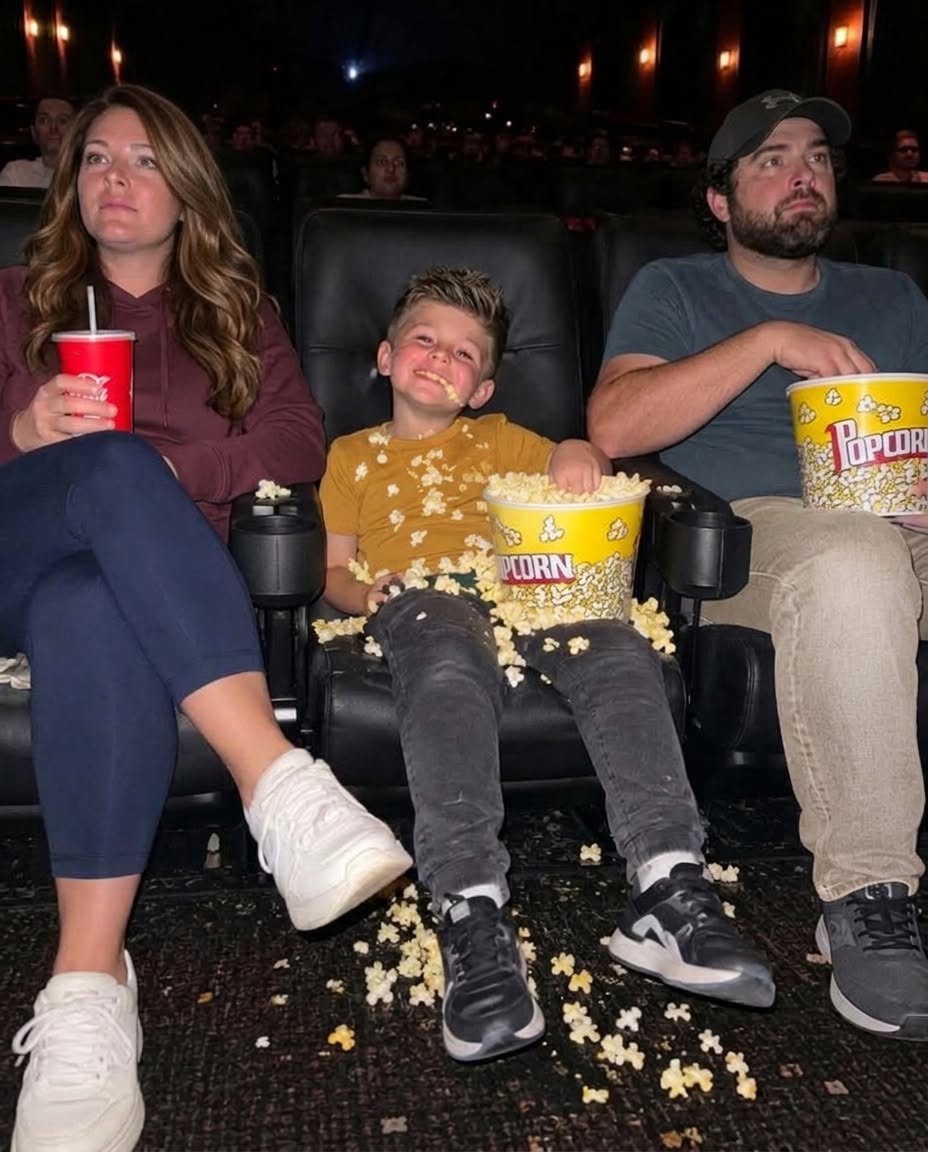
### A Kid Kept Kicking My Seat and Throwing Popcorn in My Hair — Then My Husband Finally Did Something About It
I had been looking forward to that movie for weeks.
My husband and I rarely got an evening alone, so when we finally found someone to watch our kids, we decided to go to the cinema.
We bought our tickets, grabbed a large popcorn, and settled into our seats.
For the first fifteen minutes, everything was perfect.
Then someone kicked the back of my seat.
I turned around.
A little boy, probably around eight years old, was sitting directly behind me.
He smiled.
I assumed it had been an accident.
Then he kicked my seat again.
And again.
I turned around and politely said, “Could you please stop kicking my seat?”
The boy’s mother glanced at me.
“He’s just a kid,” she said.
I smiled awkwardly and turned back toward the screen.
A few minutes later, something landed in my hair.
Popcorn.
I slowly turned around.
The boy was laughing.
His mother was watching the movie as if nothing had happened.
I brushed the popcorn from my hair and whispered, “Please don’t throw things.”
The boy laughed again.
Then another piece landed on my shoulder.
My husband noticed.
“Are you okay?” he whispered.
“I’ll be fine,” I said.
I didn’t want to ruin our evening.
But the kicking continued.
Every few minutes, the back of my chair shook.
Then the boy started putting his feet against my seat and pushing.
I finally turned around again.
“Could you please ask him to stop?”
His mother sighed.
“You’re making a big deal out of nothing.”
That sentence changed everything.
My husband looked at her.
“She’s asked politely three times.”
The woman shrugged.
“He’s bored.”
My husband stood up.
For a moment, I thought he was going to argue.
Instead, he calmly walked toward the aisle and spoke to an employee.
A few minutes later, a manager came over.
He listened to our explanation and then spoke privately with the boy’s mother.
She became angry.
“You’re kicking us out over popcorn?”
The manager calmly explained that other guests had complained and that the child needed to stop disturbing the people around him.
The woman grabbed her son’s hand.
“This is ridiculous.”
They moved to different seats.
I thought that was the end of it.
But my husband sat down beside me and said something I’ll never forget.
“You kept trying to make yourself smaller so they wouldn’t be uncomfortable.”
I looked at him.
“What do you mean?”
“You shouldn’t have to sit there quietly while someone keeps bothering you just because you don’t want to cause a scene.”
I hadn’t realized how true that was.
For years, I had been the person who avoided confrontation.
At restaurants, I wouldn’t complain if my order was wrong.
At work, I’d stay quiet when someone interrupted me.
Even with family, I’d often apologize first just to keep the peace.
My husband had noticed.
That night, he wasn’t angry because of the popcorn.
He was angry because I thought I had to tolerate disrespect to avoid being called difficult.
After the movie ended, we walked outside.
I laughed about the whole thing.
“Imagine getting kicked in the back for two hours over a children’s movie.”
He smiled.
“At least you didn’t have popcorn in your hair anymore.”
Then he became serious.
“You don’t have to be rude to people. But you also don’t have to accept bad behavior just because you’re afraid of upsetting someone.”
Those words stayed with me.
A few weeks later, something similar happened at a restaurant.
A family at the next table was letting their children run between the tables.
One of the kids nearly knocked over my drink.
Normally, I would have moved my glass and said nothing.
Instead, I calmly asked the parents to keep the children away from our table.
No argument.
No shouting.
Just a simple request.
And surprisingly, they apologized.
That night at home, I told my husband what had happened.
He smiled.
“See?”
I nodded.
The movie night taught me something I probably should have learned years earlier.
Being polite doesn’t mean allowing people to treat you however they want.
You can be kind and still have boundaries.
Sometimes, standing up for yourself doesn’t require yelling or creating a scene.
Sometimes, all it takes is saying:
**“That’s not okay. Please stop.”**
And realizing that you have every right to say it.