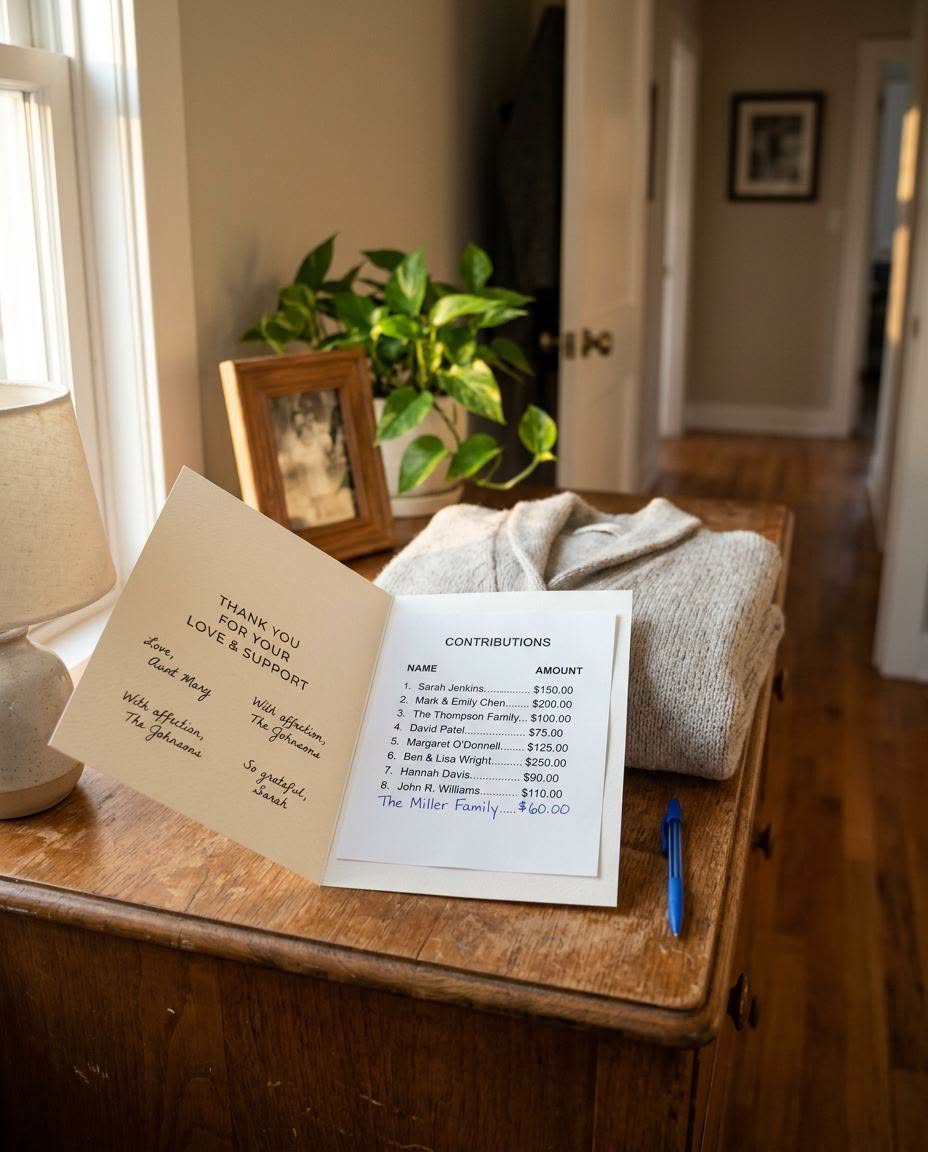
At ten past four on a Sunday afternoon in August, my daughter-in-law carried a card and a white envelope around her dining room table, and when she reached my chair she lifted them both over my head and kept walking. There were nineteen of us. Her parents’ fiftieth anniversary was coming in October and the plan was a cruise out of Galveston, four hundred dollars a household, and Lina had been organizing it since June. She did not skip me quietly, either. She stopped. She put her hand on my shoulder. And she said it to the whole table. “Oh — don’t worry about Del. We’d never ask her.” And then, warmly, the way you’d say it about a child: “We know you’re counting pennies, hon.” People laughed. Not cruelly. That is the part I keep coming back to, months later. They laughed the way people laugh when somebody has been thoughtful, because it sounded thoughtful, because Lina has always been very good at sounding thoughtful. My name is Delphine Raskin and everybody has called me Del since I was nine. I am sixty-six years old. I work twenty-four hours a week behind the pharmacy counter at Bayard Drug on Route 4, and for four years I had been putting nine hundred dollars a month into my son’s mortgage. Forty-three thousand two hundred dollars. Not one person at that table knew it. I looked over at my son Perry, who was standing by the sliding door with a beer sweating in his hand, and Perry looked at the floor. The envelope went on around the table without me, and I sat there and I smiled, and I asked Lina’s aunt about her hip.
Milo and I were married forty-one years and he died in February of 2021, in the recliner, between one breath and the next, and the doctor told me that was a mercy and I have decided to believe him. Since then I live on two thousand two hundred and ten dollars a month between his pension from the water department and my Social Security, plus about nine hundred and sixty from the pharmacy, which I took partly for the money and mostly for the talking. Perry and Lina bought their house on Delacroix in 2019 for two hundred sixty-eight thousand dollars. Lina’s event business folded in the fall of 2021 and in the spring of 2022 my son sat at my kitchen table and asked me, with his hands around a coffee cup, whether I could help with the gap. Just until she’s back on her feet, he said. Nine hundred a month. I set it up as an automatic transfer on the second so I would never have to be asked twice, and in four years I never missed one, and he never once said the word loan and neither did I. The money came out of the sixty-one thousand Milo left me in life insurance, which was supposed to be the thing that made sure I never had to ask anybody for anything. The warning signs came so gradually that I sanded each one smooth as it arrived. At Thanksgiving of 2023 my place card was at the kitchen island with the children. Lina began saying “Del’s on a fixed income” to decline things on my behalf, invitations included. My daughter in Toledo mentioned on the phone that Perry had told her he was “keeping an eye on Mom’s finances.” And in May, Arlene Pichette from church came through my line at the pharmacy with her blood pressure refill and patted my hand across the counter and said, “It’s so good of Perry and Lina, taking care of you like that.” I said thank you. Then I went in the back and stood by the loading door for ten minutes until I could come out again.
Around five I went down the hall to get my sweater off the bed in the spare room, and the anniversary card was lying open on the dresser where Lina had been working on it. It was one of those big ones, the size of a dinner plate, and tucked inside was a printed sheet she had run off the computer. A contributor list. Nineteen households down the left side and the amounts down the right, and a line at the bottom for the total, which was six thousand eight hundred dollars. My name was on that list. Raskin, D. And in the amount column beside it, not printed but written in by hand, in ballpoint, in handwriting I taught at a kitchen table in 1989 with a fat red pencil: N/A — we carry her. I stood there in my son’s spare bedroom holding my own sweater and I read those four words maybe nine or ten times. Not because I didn’t understand them. Because I did, and because understanding them meant understanding four years all at once. It was not that they thought I was poor. It was that he had been telling them I was. Every month I sent nine hundred dollars into that house, and every month my son spent some portion of it buying himself the better story, the one where he is a good man looking after his mother. I took a photograph of the sheet with my phone. I was still holding the phone when I heard the floorboard behind me, and my granddaughter Emery was standing in the doorway in her socks, twelve years old, looking past me at the dresser. And she said, “Grandma, why does it say that about you?”
I told her it was a grown-up thing written down carelessly and that it was not hers to carry, which was the truth and also not the truth, and then I went out and ate a piece of cake and told Lina the frosting was lovely. I did not say one word to my son that night or the next day. On Tuesday I took a shift off and drove forty minutes to an attorney named Noelle Agyeman-Duah, who charged me two hundred and eighty dollars and did not once speak to me as though I were confused. I asked her first whether four years of payments gave me any interest in that house. She told me the truth, which was no. My name is on no deed. There is no note, no written agreement, no recorded mortgage, and money moved from a parent to an adult child without documentation is presumed in this state to be a gift, which means that forty-three thousand two hundred dollars of Milo’s life insurance now lives inside somebody else’s walls and is never coming back out. She said if I had wanted it protected, it would have taken one page and a notary, and that she tells people this twenty times a year and is ignored nineteen. Then she asked what I wanted to do going forward, and I surprised us both, because what came out of my mouth was a question. I asked her how a person gives money away so that it is on the record. Not loudly. Just on the record. So we did that instead. Milo’s estate had cleared probate back in 2021 and what remained was mine outright, and we opened a small named fund at the county community foundation — the Milo Raskin Fund — which takes contributions, reports publicly, and cannot be quietly attributed to anybody else. Its first act, on the twenty-ninth of August, was to clear every negative lunch balance at Hollins Elementary and Hollins Middle School. Four thousand one hundred and eighty dollars. One hundred and sixty-one children. Then, on the second of September, for the first time in four years, I did not make the transfer. I did not call to warn anyone. I did not leave a note. I simply did not do it, and I went to work, and I counted out Arlene Pichette’s blood pressure refill, and at 6:40 that evening my son called me for the first time in eleven days.
He did not find out about the fund from me. He found out three weeks later, at the fall assembly in the elementary school gymnasium, because Emery is in the sixth grade and the principal stood up and thanked the Milo Raskin Fund by name in front of four hundred children and however many parents, and my granddaughter sat on a folding chair and heard her grandfather’s name read out loud. She came home and told her mother. Perry was on my porch within the hour. I let him in and I put coffee on, because forty-one years of marriage and sixty-six years of being raised right do not come off in an afternoon. He said he hadn’t known about the lunch thing. I said I know. He said the nine hundred had been hard to explain to people. I said I know that too, and then I put my phone on the table with the photograph of that contributor sheet on the screen, and I left it there while he looked at it. He said, “Mom, it wasn’t like that.” And I said, “Perry, it was exactly like that. You wrote it down.” We are not repaired. I want to be honest with you, because I have read stories where everyone weeps and embraces on the last page and that is not what happened in my kitchen in Hollins, Ohio. Lina has not spoken to me since August and I have stopped arranging my face for the day she does. They refinanced in October and they kept the house, which I am glad about, and which I had nothing to do with. Perry calls on Sundays and we talk about the Guardians and about nothing, and twice now he has said something true, and I am counting those. Emery comes Thursdays after school and does her algebra at Milo’s table and eats everything in my refrigerator. The fund has eleven thousand four hundred dollars in it now, because people in this town started adding to it once it had a name. So here is what I know at sixty-six that I did not know at sixty-two. There are two ways to give money to your children. One of them makes you family. The other one makes you a line item, and you will not be able to tell which one you are until something is written down. If you are giving quietly so as not to embarrass anybody, stop and ask yourself whose embarrassment you are actually managing. For four years I believed I was protecting my son. What I was really doing was paying, every single month, to keep a story about me in circulation — and it was not even a story I would have recognized as mine.