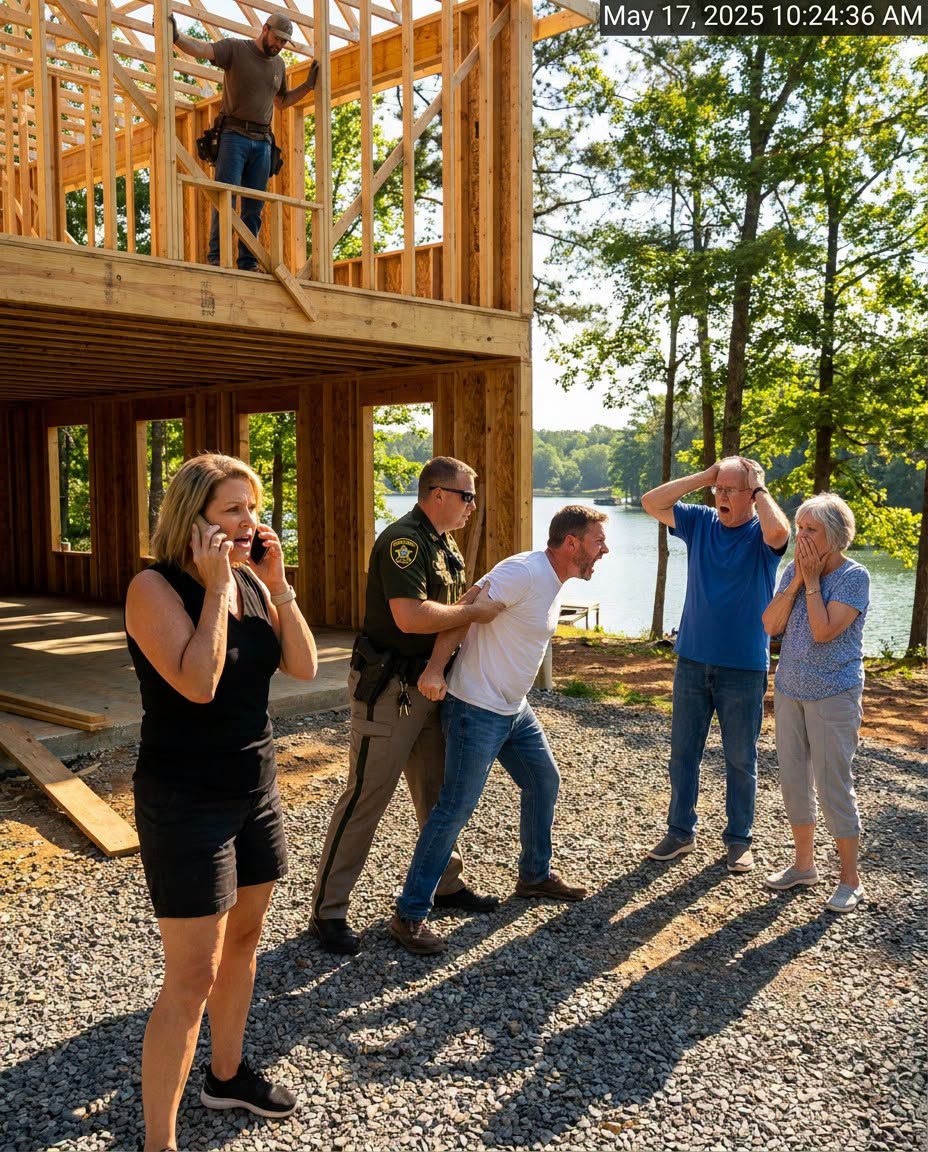
The first thing I saw was my grandmother’s blue-and-yellow quilt hanging from a construction dumpster, its hand-stitched edges fluttering in the scorching Texas wind. I slammed on the brakes, sending gravel scattering beneath my SUV, and stared at the moving truck crushing the hydrangeas beside my lake house. From inside came the shriek of a power saw, followed by the unmistakable crash of something heavy breaking. I ran through the open front door and nearly choked on a cloud of drywall dust. My beautiful living room had been stripped to its wooden studs, my custom kitchen cabinets were gone, and electrical wires dangled from the ceiling. Standing amid the destruction was my sister-in-law, Victoria, wearing a spotless white sundress and casually tossing my grandmother’s handwritten recipes into a garbage bag. When I demanded to know what she was doing, she smiled nervously and said, “Bella, we didn’t think you’d be here this weekend.” Before I could answer, my mother walked through the doorway and announced that they were renovating the house so my brother could move in.Track Pregnancy
My name is Isabella Prescott, and at the time, I was a commercial real estate broker living in Austin, Texas. Five years earlier, I had purchased that lake house with my own savings, refinished its oak floors, and carefully restored every room. I paid the $2,400 monthly mortgage, property taxes, and insurance, and my name alone appeared on the deed. I had driven there that Friday in June hoping to celebrate the biggest achievement of my career: closing a commercial acquisition that earned me a $212,000 commission after six exhausting months. Instead, my parents, Eleanor and Arthur, informed me that my brother Jacob needed the property for his supposedly expanding marketing business. They believed that because I visited only occasionally, he deserved to live there permanently. Victoria even offered to let me stay in the guest room whenever I wanted. Their entitlement was painfully familiar. Throughout childhood, Jacob had been the favored son whose mistakes were excused and whose ambitions took priority, while my own achievements were treated as obligations to the family. But this was different. They had entered my property without permission, discarded irreplaceable belongings, and authorized extensive demolition. I ordered everyone out and threatened to contact the sheriff. After my family left, the contractor, Patricia Hollis, approached me with a clipboard. She explained that my parents had supplied a signed, notarized power of attorney giving them authority to renovate the house. Then she handed me a photocopy that made my hands tremble. The signature was a clumsy imitation of mine, but beside it was something far more alarming: my own official Texas notary seal.
I had been a commissioned notary for six years, and I knew immediately that the document was fraudulent. I had never signed that power of attorney, authorized my parents to represent me, or notarized my own signature. Then a memory surfaced from three weeks earlier. During Sunday dinner at my parents’ home in Westlake, my mother had accidentally spilled red wine across my white silk blouse, sending me upstairs to scrub away the stain. My work tote, containing my notary stamp and journal, had remained unattended beside the dining table. Suddenly, the timing seemed less accidental. I photographed the destruction, rescued my grandmother’s quilt and recipe box, and checked into a nearby inn before calling my attorney, Gregory Lin. He immediately began preparing legal action to protect my property and professional credentials. Within days, my family retaliated by filing a complaint with the Texas Real Estate Commission, accusing me of misusing family money and committing real estate fraud. They even appeared at my brokerage demanding that my employer take action. Fortunately, managing partner Sarah Wilkins knew my work and recognized the weaknesses in their allegations. She supported me, promoted me to Senior Broker, and instructed security to remove them. Gregory filed a civil lawsuit while I arranged private security and paid $87,400 to restore the house. Weeks later, financial discovery exposed the real motive: Jacob’s marketing firm had accumulated approximately $842,000 in debt, and he was under federal investigation for suspected misuse of client funds. More disturbing still, an investigator uncovered an application for a $500,000 loan secured against my lake house, submitted using the forged power of attorney. The proposed renovations had merely been part of an effort to establish the appearance of control over the property before an appraisal. My parents had not been trying to give their son a comfortable office. They had been preparing to risk my home, my equity, and my professional reputation to rescue him from financial ruin. And the most devastating evidence against them would come from the very son they were desperate to protect.Track Pregnancy
Eight months later, I sat beside Gregory in a Travis County courtroom, clutching one of my grandmother’s peach cobbler recipe cards beneath the table. The evidence had already been damaging. Patricia testified that my parents misrepresented their authority over the property, while a forensic document examiner identified signs that my signature had been traced. My notary journal contained no corresponding entry, and the dates connected the questionable document to the evening of the spilled wine. But the case changed dramatically when Gregory questioned Jacob about his finances. Confronted with records showing his enormous debts and messages expressing fear of criminal prosecution, Jacob began to unravel. He admitted that his mother had taken my notary stamp and that his father had traced my signature. Then, desperate to protect himself, he revealed that he had secretly recorded his mother discussing the scheme. The courtroom erupted, and the judge called a recess. The civil trial ended in a negotiated settlement rather than a jury verdict. My parents agreed to reimburse $87,400 in restoration expenses, $64,000 in attorney’s fees, and another $23,000 in security costs and lost belongings. They also accepted restrictions against future claims to my property and signed sworn admissions acknowledging the forgery, unauthorized use of my notary seal, and false allegations against me. Those admissions helped clear my professional record. The fallout continued long after the settlement. My parents exhausted their finances, lost their longtime home, and faced criminal proceedings. My mother received probation and community service, while my father accepted a probationary plea agreement. Jacob’s business collapsed, Victoria divorced him, and a federal grand jury eventually indicted him on six counts of wire fraud. His recorded evidence had helped expose the forgery, but it had not erased his separate legal troubles. A year after that terrible Friday, my lake house was finally restored. The sea-glass-blue walls, gleaming oak floors, and farmhouse sink were back, and my grandmother’s repaired quilt once again rested at the foot of my bed. My professional life had recovered as well, with a growing brokerage team and my notary commission intact.Shop Lawn & Garden
On a cool autumn morning, I stood barefoot on the rebuilt deck, holding a cup of coffee as mist lifted from the lake. A heron waited motionless beside the dock, and behind me, sunlight reached through the open doors into the home I had fought to keep. My parents were living in a small rental apartment, my brother was awaiting trial, and the family gatherings that had shaped much of my life were gone. I did not celebrate their suffering. There were mornings when I remembered my mother sewing Halloween costumes and my father teaching me to ride a bicycle, and I grieved for the family I wished we had been. But grief did not make their choices mine to carry. My best friend Jessica once asked whether I regretted taking legal action. I told her I regretted what had happened, but not protecting myself, and I still believe that distinction matters. Last weekend, I opened my grandmother’s wooden recipe box and made her peach cobbler for the first time in my restored kitchen. At the bottom of the worn card, beneath her familiar slanting handwriting, she had written three small words: Don’t rush it. I followed her instructions, watched the afternoon light move across the blue walls, and let the house fill with the scent of warm peaches and butter. For the first time in a long while, the silence around me felt neither lonely nor uncertain. It felt like home.Track Pregnancy