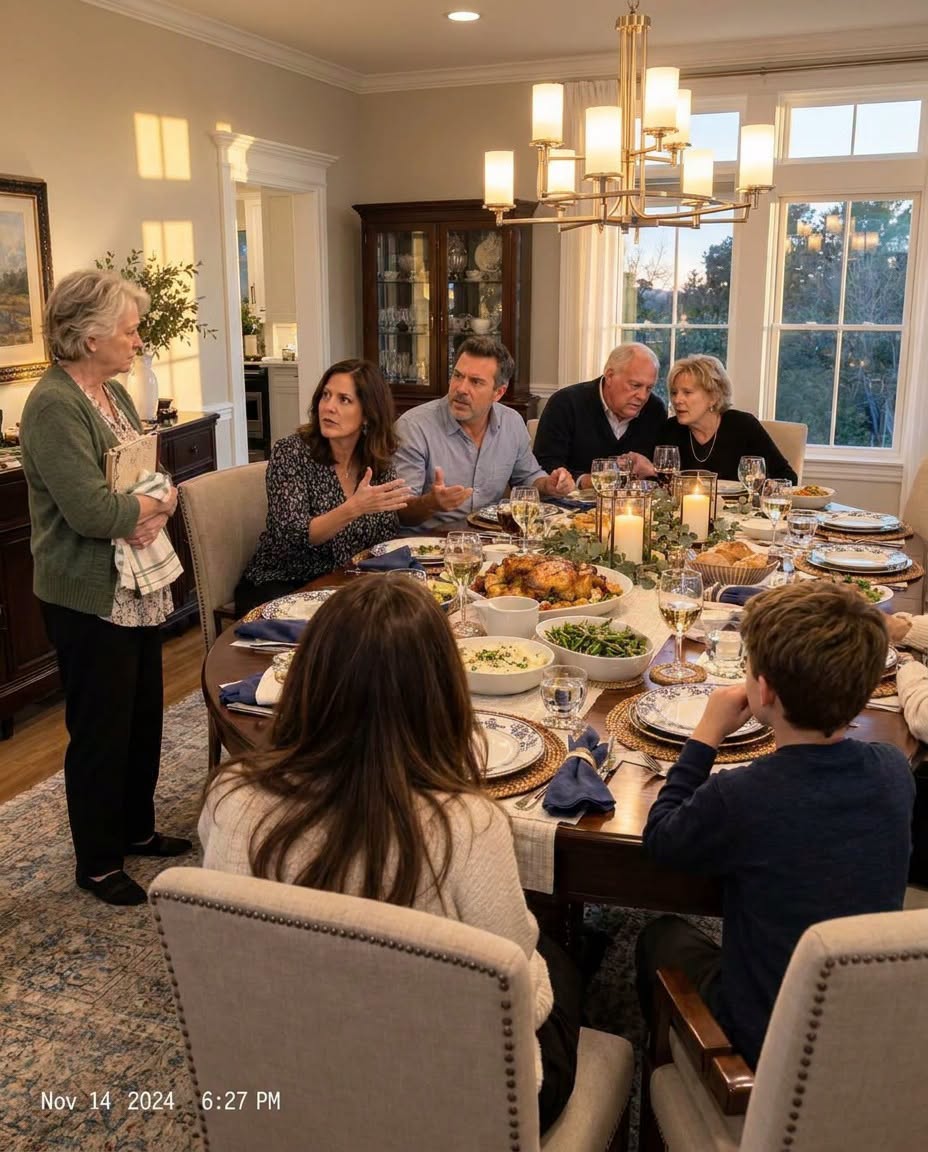
“We think you should start giving us most of your pension,” my daughter-in-law announced, reaching for another shrimp from the platter I’d prepared that afternoon. It was my sixtieth birthday, and the dining room smelled of roasted salmon, buttered lobster, and the dill sauce I’d spent half an hour getting just right. My son, Ryan, sat at the head of the table in his late father’s chair, avoiding my eyes while Megan explained that I could continue living with them if I contributed $2,000 a month and remained useful around the house. Across from me, Megan’s parents nodded sympathetically, apparently believing their daughter and son-in-law had been supporting an increasingly dependent widow. At the far end of the table, my seven-year-old grandson, Leo, looked up from his tablet and announced, “Grandma’s the maid,” making Megan laugh. Not one person had wished me a happy birthday, although I’d cooked the entire dinner and paid for every ingredient myself. Between the wine bottle and shrimp platter sat Arthur’s little silver Sony recorder, its red light glowing steadily as it captured the conversation. I waited until Megan finished describing how grateful I ought to be, then reached beneath my chair for a blue folder containing the deed to the house they thought belonged to them.
My name is Helen Marshall, and the house on Linden Avenue in Westerville, Ohio, had been mine long before Ryan and Megan moved into it. Arthur and I purchased the four-bedroom colonial in 1994 for $112,000, using nearly every dollar we’d saved for the down payment. He worked as an electrician with IBEW Local 683, while I spent thirty-one years managing the cafeteria at Hanby Elementary School. We raised Ryan there, replaced the roof after a windstorm, repaired the foundation when it began settling, and spent one memorable summer renovating the kitchen ourselves. Arthur did the electrical work while I laid the tile, and we argued about the grout color for three days before choosing the shade I’d wanted from the beginning. In March 2020, we made our final mortgage payment. We drove to the Huntington Bank branch on State Street, collected the payoff paperwork, and celebrated at Bob Evans with two forks and a shared piece of pie. Six months later, Arthur developed congestive heart failure. As his health deteriorated, he insisted that we meet our longtime attorney, Walter Collins, to update our estate documents. I hated those appointments because they forced me to imagine life without him, but Arthur approached them with the same steady practicality he’d brought to every household repair. He arranged for his interest in the house to pass to me through the appropriate survivorship provisions, confirmed the beneficiary designations on his life insurance and union benefits, and organized our records so I wouldn’t be left searching for important papers while grieving. One afternoon, as we left Mr. Collins’s office, he told me that grief made people vulnerable and good paperwork could keep them from being cornered. I thought he was talking about strangers trying to take advantage of widows. I didn’t understand that he was also worried about what might happen inside our own family. Arthur died in October 2021, holding my hand in the bedroom we’d shared for nearly three decades. I received the proceeds from his $150,000 union life insurance policy and survivor benefits under his retirement arrangements, while my own School Employees Retirement System pension paid approximately $2,860 a month. The house, fully paid off and properly titled in my name, remained mine. Two weeks after the funeral, Ryan and Megan visited. They were renting a two-bedroom apartment in Gahanna for $1,900 a month and had a toddler, Leo, who was then two. Megan held my hand and told me how worried they were about my being alone in such a large house. What if I fell on the stairs? What if something broke? Wouldn’t it be better for all of us if they moved in temporarily, helped with the upkeep, and kept me company? I was fifty-five, newly widowed, and so lonely that some evenings I couldn’t bring myself to turn off the television because I dreaded the silence. Arthur’s boots were still beside the back door. His coffee mug was still on the drying rack. I said yes. Ryan and Megan moved in that December, promising the arrangement would last only until they saved enough for a home of their own. During the first few weeks, they helped with meals and brought home groceries. Ryan mowed the lawn, and Megan occasionally folded laundry while we watched television together. Gradually, things changed. Megan began leaving dinner to me because she was exhausted after work. Then I took over the grocery shopping, using my debit card while Ryan promised to reimburse me. Eventually, I was preparing separate breakfasts for each of them, washing their clothes, cleaning their rooms, and collecting Leo from school every afternoon. Ryan liked two eggs over easy with wheat toast and black coffee. Megan wanted a smoothie made with almond milk, frozen berries, and precisely half a banana. Leo insisted on chocolate-chip pancakes shaped like Mickey Mouse, with the ears touching. I knew everyone’s preferences because I accommodated them every morning before sunrise. I also paid the household expenses. Property taxes ran about $6,400 annually, homeowner’s insurance another $1,800, and utilities came directly from my bank account. I covered most groceries and even advanced $14,000 for an upstairs bathroom renovation Ryan promised to repay after receiving his year-end bonus. When the bonus arrived, he purchased a large television instead. By the third year, I overheard Megan referring to me as “the help” during a telephone conversation with her sister. By the fourth, Leo had begun repeating the phrase “Grandma’s the maid,” because he’d heard it often enough to think it was funny. Ryan occasionally offered a halfhearted correction, but never made it clear the language was unacceptable. I told myself these were small indignities compared with having my family nearby. I worried that if I complained, Ryan and Megan would move out and take Leo with them. He was the bright spot in many of my days, and I couldn’t bear the thought of losing our ordinary afternoons together. So I kept cooking, cleaning, and paying the bills. On the morning of my sixtieth birthday, I woke at five, prepared all three breakfasts, and waited for someone to remember the date. Ryan came downstairs checking messages about his insurance sales appointments. He kissed the top of my head, asked me to collect Leo after school, and left. Megan appeared an hour later, complained about a sticky spot near the refrigerator, and reminded me that her parents would be arriving for a seafood dinner. Leo criticized one of his pancakes and asked for another. None of them said happy birthday. After dropping him at Highland Elementary, I drove to the farmers’ market near Main Street rather than going straight home. I was standing beside a display of peaches when Ruth Abernathy, a former colleague from the school cafeteria, recognized me. She asked how I was, and to my embarrassment I began crying before I could answer. Ruth bought us coffee and sat with me on a bench while I described five years of housework, unpaid expenses, casual insults, and my family’s forgotten birthday. She listened without interrupting, then asked whose name appeared on the deed to the house. When I told her it was mine alone, she asked a question that stayed with me: “Then why are you the one asking permission to live there?” Ruth handed me a flyer for the Willow Creek Senior Community Center, where she attended a book club and line-dancing classes. I started to explain that I couldn’t go because I had to collect Leo from school every afternoon. She simply looked at me until I heard what I’d said. I went home, opened the fireproof lockbox in my bedroom closet, and retrieved the blue folder Arthur had labeled HOUSE. HELEN. Inside were the recorded deed, mortgage payoff letter, estate documents, and a sealed envelope marked in Arthur’s handwriting: For Helen. Only if you ever feel pressured about the house. I also gathered the property-tax receipts, insurance statements, utility records, grocery envelopes, and documentation of the bathroom renovation. Years of managing a school cafeteria had taught me to account for every dollar, and I had kept the habit in retirement. Then I called Walter Collins. To my surprise, he greeted me with a cheerful birthday wish. Arthur, he explained, had asked him years earlier to remember the date because he worried Ryan might forget. I cried again, then told Walter what was happening. He confirmed that the deed identified me as sole owner and that Ryan and Megan had no ownership interest simply because I’d allowed them to live there. Their extended occupancy meant we needed to respect whatever notice and other legal requirements applied before ending the arrangement, but they could not unilaterally claim my property or demand my pension. My retirement income remained mine, subject only to lawful obligations, not a payment schedule invented at the dinner table. After speaking with Walter, I called a local real estate agent, Diane Kowalski, who estimated that the house might sell for somewhere between $465,000 and $480,000 in the current market. I wasn’t ready to sell, but learning I had genuine options felt like opening a window in a room I’d forgotten was stuffy. That afternoon, I prepared the seafood dinner Megan had requested, set out our wedding china, and placed Arthur’s digital recorder on the table. I wanted a reliable record of whatever was said, although I knew the legal use of a recording could depend on applicable consent laws and the circumstances in which it was made. I had no intention of making a public spectacle of my family’s private conversation. I simply wanted to stop doubting my own recollection every time someone told me I was being unreasonable. When Megan’s parents arrived, I served the meal and waited to see whether anyone remembered why that Friday mattered.Get Marriage Tips
The dinner began with conversation about grocery prices, gasoline, and the rising cost of raising children. Megan’s parents, Doug and Patricia Hale, had driven from Cincinnati for the weekend. Doug was a retired dentist, and Patricia volunteered with her church. Both seemed convinced that Ryan and Megan were making considerable sacrifices to care for me. Patricia remarked on how fortunate I was to have family willing to look after me at my age. I set down my fork, startled by the description. Before I could ask what she meant, Megan announced that she and Ryan had been discussing a more sustainable arrangement. She said I should transfer $2,000 of my monthly pension to them beginning the following month. In exchange, they would allow me to remain in the house, continue receiving meals and companionship, and keep a small amount for personal spending. Ryan added that I didn’t need much money anymore and ought to be grateful for the roof over my head. I looked at the lobster tails I’d purchased because Doug liked them, the roasted asparagus, the dill sauce, and the china Arthur and I had received as wedding gifts in 1987. I’d paid $184 for the groceries that afternoon, and the receipt was still in my apron pocket. Megan then suggested that, since I was still physically capable, I ought to do as much cooking, cleaning, and childcare as possible before age made those tasks difficult. That was when Leo called me the maid, and Megan laughed. I didn’t answer immediately. For nearly half an hour, I listened as they discussed my pension, their expenses, and how they planned to manage the money. My silence seemed to encourage them. Eventually, Megan proposed setting up the transfer on the first of the month. I reached under my chair, lifted the blue folder, and placed it on the table. From inside, I withdrew the certified deed and turned it toward her. The name printed beneath the property description was mine: Helen R. Marshall, sole owner. Megan stared at it. Ryan leaned forward and asked to see the document. I told him he could have a copy after speaking with Walter, but the original would stay with me. Megan insisted the title didn’t change the fact that she and Ryan were supporting the household. I opened the folder again and laid out the financial records. There were property-tax receipts, homeowner’s insurance statements, utility bills, and years of grocery expenses. I added the documents for the bathroom renovation and reminded Ryan that the $14,000 advance remained unpaid. Doug studied the papers, visibly confused. He asked Megan why she’d told her parents that she and Ryan were carrying me financially when the records appeared to show the opposite. Megan replied that they contributed in other ways, particularly by keeping me from being lonely. I told her companionship wasn’t a service for which anyone could demand most of another person’s retirement income. Ryan tried to soften the conversation by claiming that nobody considered me a burden. I looked toward the recorder. Rather than play it publicly, I told him that if he genuinely believed no one had said anything unkind, we could review the conversation later with Walter present. Megan demanded to know whether I’d recorded the dinner, and I acknowledged that I had. Doug asked his daughter to explain precisely what she’d meant by allowing me to stay in the house. She had no satisfactory answer. Then I opened Arthur’s sealed envelope. Inside was a formal letter from Walter explaining the ownership arrangements, together with a sheet of yellow legal paper covered in Arthur’s shaky handwriting. By the final months of his illness, holding a pen had become difficult, and the letters were uneven. I recognized them immediately. Arthur had written that the house was supposed to be a place where I felt safe, not somewhere I had to earn permission to exist. He reminded me that it belonged to me and that I should never surrender my peace because someone made me feel guilty for keeping it. I read the note aloud, my voice breaking on his final words. Ryan lowered his head. Megan dismissed the letter as something written by a sick man who might not have been thinking clearly. My son pushed his chair back so sharply that it scraped the hardwood floor and told her not to speak about his father that way. For a moment, I saw the boy who’d watched Arthur repair bicycles in our driveway and followed him around the house asking how electrical circuits worked. Then Megan said that even if the property belonged to me, I needed their family more than they needed me. The words struck a familiar fear. For years, I’d believed that if I stopped being useful, I might be left alone again. But I thought of Ruth at the market, the people dancing in the park, the bright yellow community-center flyer, and the possibility of a life that didn’t revolve entirely around my kitchen. I took out the preliminary market analysis Diane had prepared. I told Ryan and Megan that I was considering my options for the house, including selling it if I chose. Megan demanded to know where they would live. An hour earlier, she’d been asking where I expected to live without their generosity. Now the uncertainty belonged to her. I hadn’t placed those documents on the table to punish my family; I’d brought them because I finally understood that the house I’d spent thirty-two years paying for had quietly become the place where everyone else’s needs mattered more than mine.Order Takeout