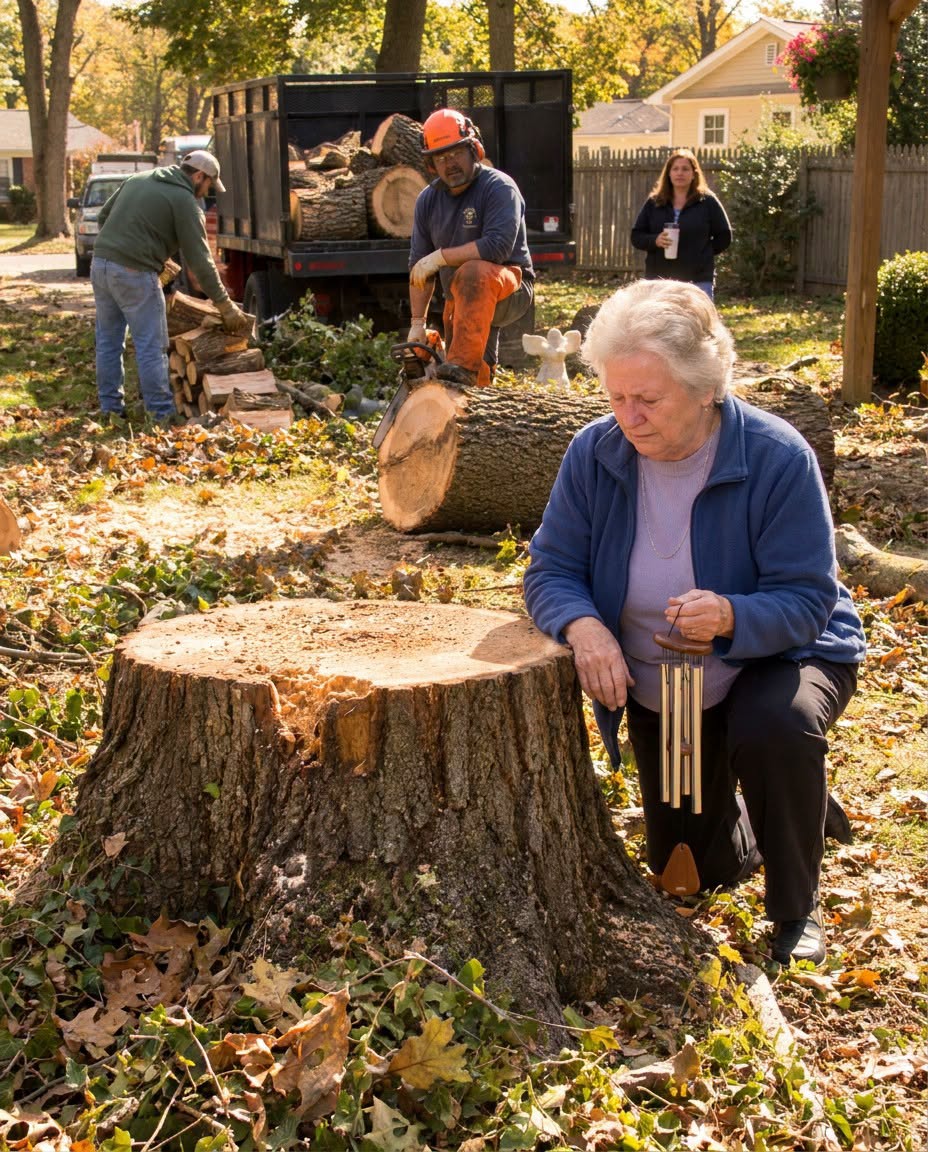
“Trees grow back, Linda. Husbands don’t.” Pam Whitaker said it from the other side of our white vinyl fence, holding a glass of iced tea while the remains of my husband’s beloved maple lay scattered across our front lawn. I had just returned from the cemetery, where I’d planted pink and purple petunias beside Tom’s grave, and the sound of a chainsaw was still ringing in my ears. Fresh yellow sawdust covered the sidewalk, enormous branches lay across my flowerbeds, and a pale stump stood where the tree had shaded our home for nearly half a century. At my feet was the brass wind chime Tom had made before he became ill, its little wooden cardinal cracked and its tubes bent beneath a fallen limb. Pam smiled and told me she’d finally solved the problem of leaves blowing into her swimming pool, as though cutting down a neighbor’s tree without permission were no different from trimming an overgrown hedge. I wanted to scream, but the grief was so enormous that I could scarcely manage a whisper. Instead, I picked up the broken wind chime, walked inside, and opened the kitchen drawer where Tom had kept our important papers—never imagining that a folder he’d prepared twenty years earlier would turn my neighbor’s small triumph into a $31,000 legal nightmare.
My name is Linda Harmon, and I’m seventy-two years old. I’ve lived at 214 Birchwood Lane in Cedar Hollow, Oregon, since 1978, when Tom and I bought our little blue Cape Cod for $41,000. He taught woodworking and shop classes at the local high school for thirty-four years, and I raised our son, Jeff, while working part-time at the library. We weren’t wealthy, but our house was full of things Tom had made with his own hands: the kitchen cabinets, a cedar chest at the foot of our bed, the porch swing, and the little brass wind chime decorated with a cardinal that looked rather more like a potato. The maple was his greatest creation, although he always insisted that all he’d done was plant it and let nature take over. On October 14, 1979, our son was born at four in the morning at Providence Hospital in Portland.
Tom held Jeff for the first time and cried so hard that a nurse gently took the baby from his arms. Five hours later, he kissed my forehead and announced that he had something important to do. He drove home, persuaded the owner of Fredrickson’s Nursery to open on a Sunday, and purchased a sugar maple sapling barely taller than I was. He planted it twenty feet from our front porch, tied its slender trunk to a wooden stake with an old necktie, watered the roots, and hurried back to the hospital with mud on his trousers. When I asked why he’d chosen that particular morning for yard work, he looked at our sleeping son and said, “So the boy has something to climb.” Jeff did exactly that. He climbed the maple at five, reached its lower branches at seven, and by twelve could disappear so high into its canopy that I could see only his sneakers between the leaves. At thirteen, he and Tom built a crooked treehouse from leftover school-shop lumber, complete with a sign reading NO GIRLS (EXEPT MOM). Jeff insisted the misspelling was deliberate. At fifteen, he kissed his first girlfriend there, although he never knew I’d seen her climbing down the ladder afterward. When he left for Oregon State University, he hugged me on the porch and then rested his palm against the maple’s trunk before getting into his car. Years later, his children, Noah and Ruby, claimed the treehouse as their own.
Tom rebuilt it in 2015, stronger and with a proper roof, and Ruby painted a new sign declaring NO GROWN-UPS (EXCEPT GRANDPA). Every October, the sugar maple turned a startling shade of red, so bright that motorists sometimes slowed along Birchwood Lane to admire it. A photograph of the tree even appeared in a newspaper feature about beautiful local gardens, and Tom framed the clipping for our hallway. The maple became part of the rhythm of our lives. Its spring buds announced the end of winter, its shade cooled the porch in July, and its falling leaves filled our gutters every autumn. Tom loved it through all those years, but it was during his final illness that I realized what the tree meant to him. Pancreatic cancer took him seven months after his diagnosis. He died in February, at seventy-four, in a hospice bed positioned near our bedroom window so he could see the bare branches.
His last clear words were about the buds that would appear in April. He told me to watch for them, calling them a little sign that life was continuing. When the reddish buds emerged that spring, I stood at the window crying until I had to sit down. In May, I hung his handmade wind chime from a low branch. Its soft metallic ringing carried through the kitchen when the breeze came from the west, and I began talking to Tom while washing dishes. I told him about Jeff’s work, Ruby’s swimming lessons, Noah’s school projects, and how badly I missed hearing him whistle in the garden. The tree gave those conversations somewhere to go. Pam Whitaker, who’d moved into the neighboring property three years earlier, saw the maple differently. She had demolished the modest old Kowalski house and replaced it with a large gray modern home, black-framed windows, a three-car garage, and a magnificent backyard pool. The pool sat near our shared fence, where part of the maple’s canopy extended over her side of the boundary. Each summer, leaves blew into the water, and Pam complained that they clogged her filters and increased her maintenance costs. The first year, she asked me to have the tree removed. Tom laughed when I showed him her note, saying the maple had been there decades before the swimming pool. He suggested she invest in a better pool cover. A year later, another complaint arrived, this time written in capital letters. Tom had already become seriously ill, and he studied that letter for a long time without making his usual jokes. One morning, I found him examining a thick folder in the drawer where we kept our deed, insurance policies, and important family documents. When I asked what he was reading, he said it concerned protection for the tree. I was too exhausted by medical appointments and sleepless nights to ask anything further. Four months after his death, another message arrived from Pam, written in red ink: I’VE ASKED NICELY. I threw it away.
I could barely manage my grief, much less an argument about leaves in somebody else’s pool. Then came that Saturday in July. I returned from visiting Tom’s grave to discover that Pam had hired Green Valley Tree Service to remove the maple while I was gone. Three men in orange safety vests were loading enormous sections of trunk onto a trailer. The treehouse lay splintered in the grass, and the wind chime was crushed beneath the branches. I asked Pam how she could order work on property that didn’t belong to her. She said half the branches hung over her yard and that she’d grown tired of waiting for me to do something. When I told her Tom had planted the maple the day our son was born, she responded that trees grew back but husbands didn’t. Even the workers stopped what they were doing. Their foreman, Dale Jessup, looked uncomfortable, but no one spoke. I carried the broken chime inside, stood at the kitchen sink staring at the unfamiliar patch of sky, and finally remembered the folder Tom had been holding during his illness.
It was a thick manila folder bearing the gold seal of the Cedar Hollow Department of Parks and Urban Forestry. Inside was a certificate identifying the sugar maple at 214 Birchwood Lane as Heritage Tree Number 47, officially designated on May 15, 2006. Tom had applied for the protection after hearing that the city might widen Birchwood Lane and remove older roadside trees. The designation recognized our maple’s size, beauty, age, and importance to the neighborhood. I found a copy of Tom’s handwritten application, explaining that he’d planted the sapling on the day Jeff was born, watched our son and grandchildren climb it, and hoped it would remain after he was gone. One sentence stopped me: My wife loves this tree more than I do, and that’s saying something. Beneath the application lay a certified property survey showing that the trunk stood entirely within our lot, even though part of the canopy extended across the fence. Another document was a copy of Cedar Hollow’s heritage-tree ordinance. Tom had highlighted the section prohibiting removal of a designated tree without authorization from the city forester. He’d also underlined the civil penalty: $1,000 per inch of trunk diameter, measured at breast height, together with required replacement planting costs. Contractors involved in unauthorized removal could also be held responsible under the local provisions. My hands shook as I reached the back of the folder and discovered a sealed envelope with my name written across it in Tom’s careful block lettering. His letter began by saying that if I was reading it, somebody had probably damaged our tree. He suspected Pam might try something because her complaints had become increasingly aggressive. Tom explained that he’d applied for heritage status many years earlier and had kept the certificate in case we needed it. He advised me not to waste energy arguing in the street, but to contact Marisol Vega, the city forester who’d inspected the maple. Her business card was stapled inside the folder. At the bottom, he wrote that he loved me, always would, and hoped I would remember to watch for the red buds. I sat in his chair and cried, holding the letter against my chest. Then I picked up the telephone. Marisol answered her mobile on the second ring. When I introduced myself and mentioned Tom, she immediately remembered Heritage Tree Number 47. She recalled its extraordinary autumn color and the birdhouse Tom had made for her after the original inspection. When I told her the tree had been cut down that afternoon, she fell silent. Then she asked whether the contractor was still at the house and whether anyone had obtained a removal permit. I couldn’t answer the second question, but Marisol said she could check the city’s records. She instructed me to photograph the damage, preserve the documents, and avoid disturbing the remaining wood until the city had examined the site. Less than an hour later, her green municipal pickup stopped outside my home. Marisol was a sturdy woman with gray braids tucked beneath a forestry cap. She walked straight to the stump, removed her hat, and stood quietly for a long time. She remembered the tree as it had looked in 2006, when its trunk measured eighteen inches across at the standard survey height. Now the measurements indicated approximately thirty-one inches at breast height. She photographed the stump, sawdust, branches, broken treehouse, and tire marks, checked the property-line markers, and documented the apparent unauthorized removal. The trunk was well inside my property. Pam watched from her poolside lounge chair until Marisol approached the fence and introduced herself. Asked whether she’d hired the contractor, Pam readily admitted she had. She said the tree was a nuisance and that she’d paid for the removal herself. When Marisol asked whether she had obtained permission from the tree’s owner and the necessary municipal authorization, Pam seemed genuinely surprised that either would be required. Marisol explained that the tree had been protected for years and that the city would review the matter under its heritage-tree regulations. After she left, I telephoned Jeff. He drove from Salem and stood in our front yard looking at the stump as though someone had removed part of the house. He knelt, pressed his hands against the freshly cut wood, and began crying. Then he told me something I’d never known. Before leaving for college in 1997, he’d climbed to the highest branch that would support him and carved his initials into the bark: J.H. 1997. He said he’d wanted to leave a piece of himself behind. I thought about those initials lying somewhere on a trailer, perhaps already destined for a wood chipper, and realized there was no financial penalty large enough to restore everything we’d lost. The next morning, city officials arrived to speak with Pam about the unpermitted removal. Their preliminary notice identified a potential $31,000 civil penalty, based on the tree’s recorded diameter, together with replacement planting obligations and further review of possible trespass and property damage. The assessment remained subject to the city’s procedures and Pam’s right to challenge it. Dale Jessup, the arborist she’d hired, provided a signed work order in which Pam had represented that she owned the tree and had obtained necessary permissions. He admitted he’d relied on her assurances without performing the checks a professional should have made. He also acknowledged that his crew had crossed onto my property to carry out the removal. Then he reached into his jacket and produced a small piece of gray bark attached to pale wood. Across its surface were the letters J.H. 1997. He’d found the carving high in the canopy, cut it from the branch before the wood was processed, and saved it because he couldn’t bear to destroy it. Jeff took the little piece in both hands. For the first time since seeing the stump, he smiled. Pam, meanwhile, stared at the notice as though it were written in another language. She accused me of ruining her life over a tree. I looked at the fine in her hand, the pool behind her, and the place where Tom’s maple had stood. My husband had protected that tree twenty years before his death, but the discovery that truly changed everything came later, when I began to understand why Pam had been so desperate to make it disappear.Marriage counseling