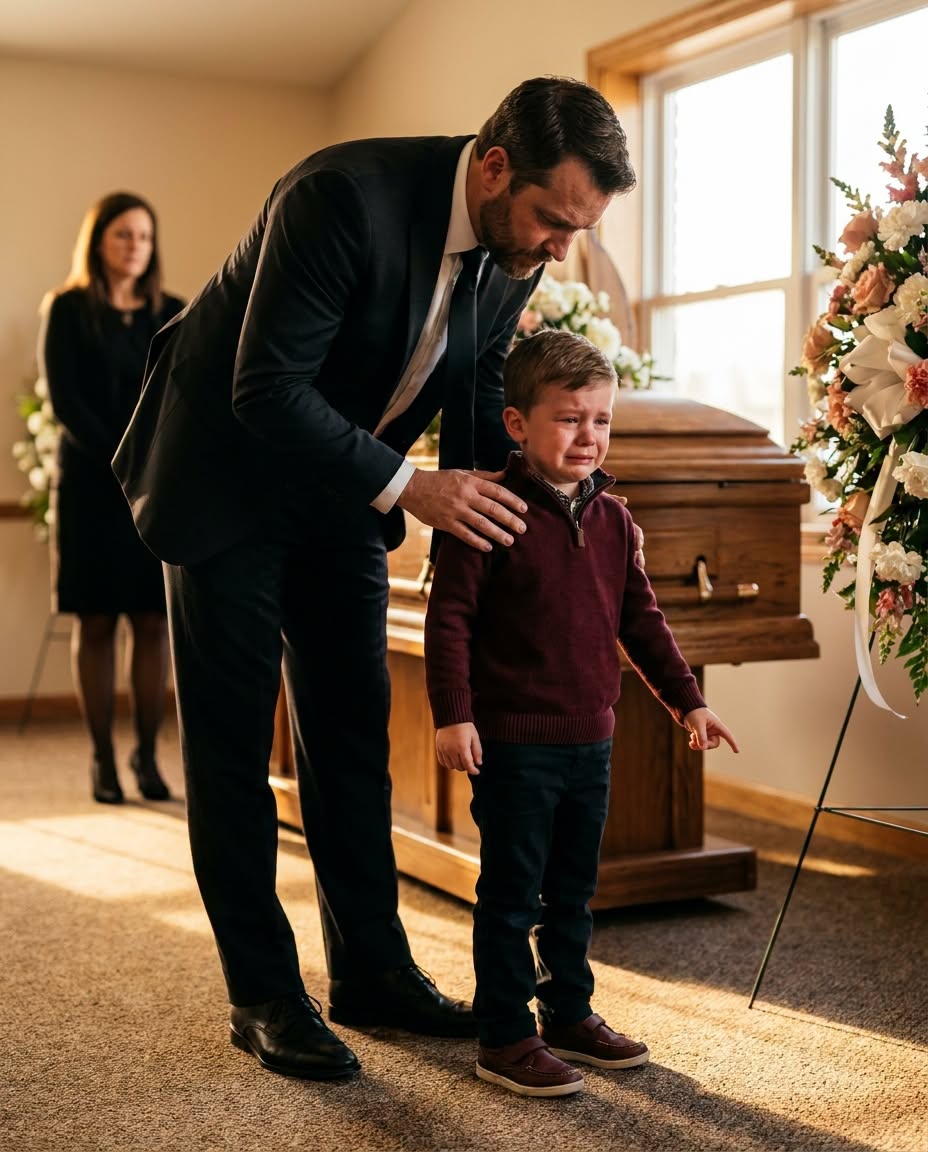
“I don’t think that was Mom,” my eight-year-old son said the morning after we buried her. Eli sat across from me pushing dry cereal around a bowl, his eyes fixed on the table as though he were reporting the weather rather than questioning the most painful certainty of our lives. My first thought was grief—the strange bargaining children sometimes do when death is too permanent to understand. Then he told me why. Mara had a small notch in her left earlobe from an accident when she was seventeen, something Eli had noticed years earlier and looked at whenever she hugged him. The woman in the coffin, he said, did not have it. I had spent my career as a structural engineer knowing that tiny discrepancies can expose failures in much larger systems, so instead of telling my son he was confused, I asked one question: “Which ear?”
Mara had always said Eli noticed what other people walked past. He noticed when a neighbor’s cat disappeared from its usual window, when I changed watches, when ordinary routines shifted by a few minutes. She understood that part of him and made room for it rather than dismissing it. So I called the funeral home and asked for the identification trail to be reviewed, then contacted Detective Ruiz, who had worked the traffic-accident case that killed Mara. Nobody accused anyone of wrongdoing; we simply asked to see the release records, transfer receipts, case numbers, and verification documents. At Willow Creek Memorial, Ruiz discovered that the case number on one archived intake tag did not match the transfer paperwork. The county facility then confirmed that two transfers had been processed close together and that their identification numbers had been transposed somewhere in the documentation chain.
For several hours, nobody could tell me with certainty whether the paperwork error had remained on paper or followed the physical transfers themselves. Another family had held a funeral the same day, and investigators quietly began checking identifying features from both cases. Their family confirmed a distinctive scar belonging to their relative, which initially suggested that the physical transfers had been correct despite the swapped paperwork. But a second problem appeared: one required verification signature was missing even though the system showed that step as completed. A process designed to require two people had effectively relied on one. Suddenly Eli’s observation was no longer simply about whether grief had changed the way he saw his mother; it had exposed a break in a chain that was supposed to protect every family from exactly this uncertainty.
Three days later, the formal review gave us the answer. Mara had been correctly identified and was buried where she was supposed to be; photographs, dental records, and the physical transfer review all supported that conclusion. The missing earlobe notch had a separate explanation: preparation near her left ear had caused localized swelling that made the old notch much less visible during the viewing. Eli had not imagined the difference—he had noticed a real physical change and drawn the most frightening conclusion available to an eight-year-old who desperately wanted his mother not to be gone. Yet his question still mattered. The investigation documented a genuine failure in the verification process, placed the responsible employee under review, and prompted additional confirmation procedures, training, and documentation audits. His observation had not brought Mara back, but it had forced adults to discover a weakness they otherwise might never have examined.Mother’s Day gifts
When I told Eli that his mother really had been the woman he sat beside at the viewing, his face fell. “Then I was wrong,” he said. I told him no: the conclusion had been wrong, but the observation had been right, and those were different things. Something about her ear truly had changed, he had trusted what he saw, and because he spoke up, an unrelated but serious procedural failure was found. We went for blueberry pancakes afterward and ordered extra syrup because Mara always did. A week later, Detective Ruiz called to say the county had strengthened its verification procedures because of what the review uncovered. That evening Eli asked whether his noticing had helped anyone even though his mother was still gone. I told him yes. He thought for a while, then said Mara would have liked that—and that he intended to keep noticing.