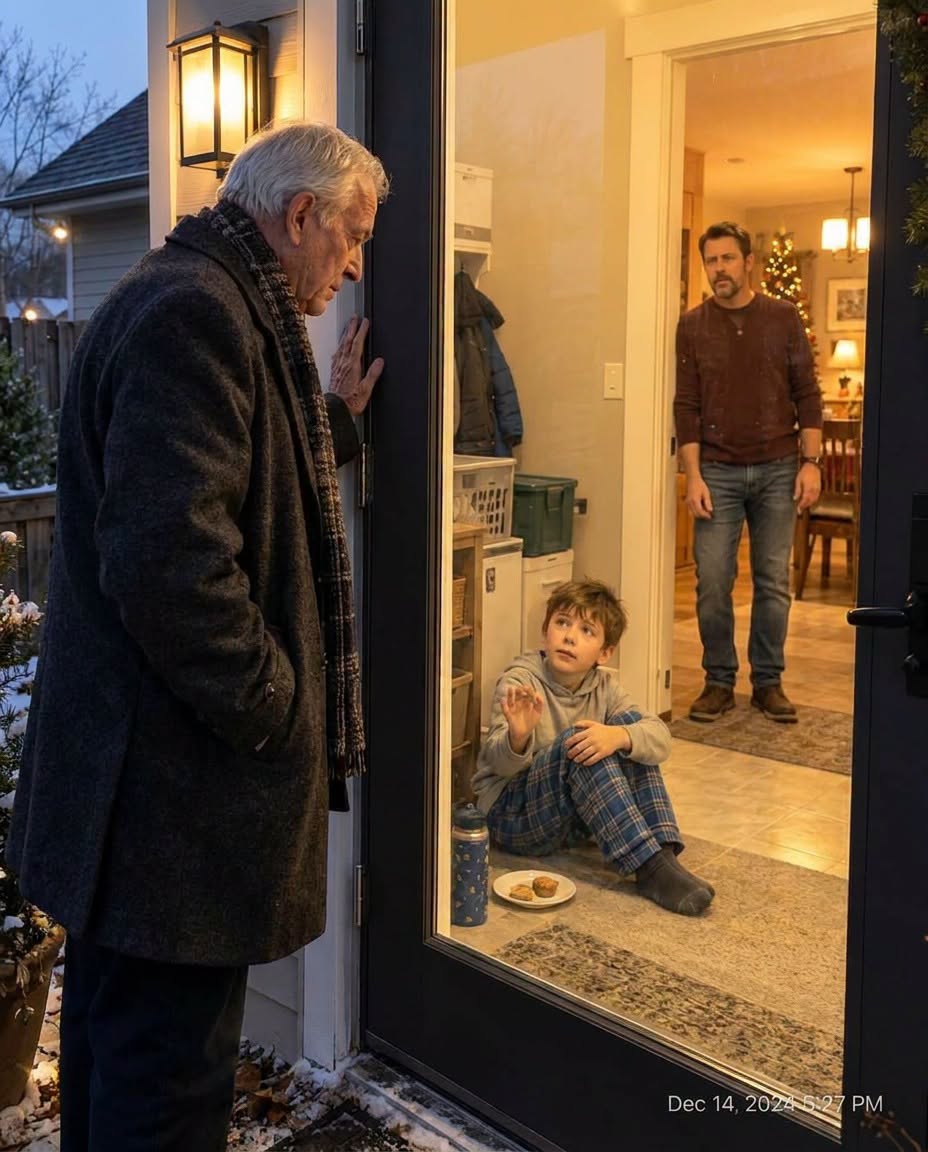
“Grandpa Joe, please don’t come for Christmas,” my twelve-year-old grandson whispered, his voice barely audible beneath the low hum of a washing machine. It was 5:47 on Christmas Eve, and I was standing in my Sacramento kitchen beside a thawing turkey when his call came through. I asked Tommy what was wrong, but he said his father had canceled our plans because nobody wanted his bad behavior ruining Christmas. Before I could ask another question, the line went dead, leaving me staring at the wrapped presents on the counter and listening to the silence. Less than an hour later, I was standing outside my son’s house in Folsom, looking up at Tommy’s dark bedroom window while my son insisted the boy was safely upstairs. Remembering the mechanical sound I’d heard during the call, I walked along the side of the house and knocked on the small window above the laundry room. A faint, slurred voice answered from inside, and when Tommy told me the door was locked from the outside, I knew something was terribly wrong. What I found behind that door would lead investigators from a frightened child on a cold tile floor to $94,000 missing from the trust my late wife had established for him.
My name is Joe Carter, and at seventy years old, I thought I understood the people closest to me. I’d spent thirty-four years driving trucks for Coastal Freight and had lived in the same Sacramento house since 1981, raising our family with my wife, Mary. She died of pancreatic cancer the previous March, leaving me with fifty years of memories and a home that suddenly seemed far too quiet. I missed the ordinary things most: her coffee cup beside the sink, the way she hummed while folding laundry, and her habit of buying Christmas presents months before anyone else had begun thinking about the holidays. Our son Robert was forty-three, worked in commercial insurance, and lived with his wife Jennifer and Tommy in a large house in Folsom. Tommy’s mother, Laura, died in a car accident when he was three, and Jennifer had been his stepmother for seven years. Mary had loved Tommy fiercely, especially after Laura’s death, and she made sure he knew there would always be room for him at our table. She also planned carefully for his future. Her estate documents provided for a college savings account, investments, and her interest in a rental duplex we’d purchased in Elk Grove decades earlier. Those assets were to be held for Tommy’s benefit under a trust, with me acting as trustee. I understood the responsibility and believed the accounts were secure. But after Mary’s funeral, I struggled with grief more than I wanted to admit. I spent two weeks at Robert’s house because I couldn’t bear returning to an empty home, and I allowed him to help with practical matters while I adjusted to life without Mary. During those weeks, I used his home office computer to review estate documents and financial information because my own laptop was being repaired. I believed I’d logged out properly afterward and didn’t give the matter another thought. As the months passed, Robert began finding reasons to limit my visits with Tommy. Sometimes he said the boy had soccer practice or schoolwork. Other times Jennifer needed quiet or the family wanted privacy while grieving. I accepted the explanations because I didn’t want to interfere with my son’s household. When I did see Tommy, he seemed subdued, though I attributed it to losing his grandmother. I should have asked more questions, especially after he tried to tell me something during a visit to Mary’s grave and stopped speaking when Robert approached. Instead, I convinced myself he was simply having a difficult year. On Christmas Eve, I had planned a family meal. A twenty-two-pound turkey was thawing in the kitchen sink, and a doll wrapped for my granddaughter Sophie waited beside the other gifts. I was looking forward to having everyone together, even if the holiday would feel incomplete without Mary. Then Tommy called. His words were strange enough that I immediately telephoned Robert, who insisted his son was grounded after an emotional outburst and warned me not to come. I drove to Folsom anyway. When I arrived, the house was brightly decorated, with white lights along the roofline and a wreath on the front door. Through the dining room window, I could see the table arranged for three people rather than four. Robert answered my knock but remained on the porch, refusing to let me see Tommy. Jennifer appeared behind him and suggested that grief had left me confused about what my grandson had said. They claimed Tommy was upstairs in his bedroom and told me to go home. After they locked the front door, I stepped back and looked toward the second-floor window above the garage. The room was dark. I remembered hearing the washing machine behind Tommy’s voice and walked toward the ground-floor laundry room at the rear of the house. A small window glowed faintly above the side yard. When I called Tommy’s name, he answered slowly, his speech thick and difficult to understand. He told me he couldn’t open the door because it was locked from the outside. I found the rear mudroom entrance unlocked and went inside, where a sliding bolt had been fitted to the outside of the laundry-room door. I pulled it back and discovered Tommy sitting against the dryer on the tile floor, his eyes half closed and his school sweatshirt twisted around him. A red plastic cup stood near the sink, containing a little pink liquid. When I asked what he’d been drinking, he whispered that Jennifer had given him medicine to make him sleep. I immediately called 911. Robert appeared moments later, furious that I’d entered the house, and demanded that I leave. When he realized I was speaking to an emergency dispatcher, his anger changed to alarm. Jennifer arrived behind him and stared at the open door. Police officers reached the house first, followed by paramedics who checked Tommy’s breathing, responsiveness, and vital signs. Officer Reyes noticed the outside bolt and prevented Robert from touching the cup while the scene was documented. Jennifer said she’d given Tommy an antihistamine to help him sleep, but she couldn’t immediately identify the product or explain the dose. Tommy weakly insisted that she’d poured more than the normal amount and that he hadn’t wanted to drink it. The paramedics transported him to the hospital for evaluation and monitoring. When they asked whom he wanted beside him, Tommy reached for me. I rode with him in the ambulance, keeping my hand where he could see it whenever he opened his eyes. He repeatedly asked whether he was in trouble for calling me. I told him he had done the right thing. Then he said his father considered telling outsiders about family problems a betrayal, and I felt a cold weight settle in my chest. At the hospital, doctors described his symptoms as consistent with significant sedation and ordered tests to determine what he’d taken. Robert and Jennifer arrived with an attorney, insisting the incident had been misunderstood. But Tommy turned away when he saw them, and the nurse quietly closed the door between us.
Later that evening, a hospital social worker named Dana Ruiz asked to speak with Tommy about what had happened. She allowed me to stay initially because he was frightened, but she reminded me not to answer questions for him. Tommy lay against the pillows, still exhausted, and stared at the blanket while she gently asked why he’d been placed in the laundry room. At first he said he’d been bad. Dana asked what he’d done, and after a long silence, he admitted he’d told me something he wasn’t supposed to say. Then he explained that he’d overheard Robert and Jennifer arguing about money Mary had left him. He’d heard them say a college account was nearly empty and that his grandfather might discover what had happened. Robert had told him I signed documents authorizing the withdrawals, but I knew I’d signed nothing of the kind. As trustee, I was responsible for protecting Tommy’s money and ensuring distributions followed the terms of Mary’s trust. Robert was neither the owner of the assets nor the trustee authorized to manage them. Tommy said he’d overheard the argument while walking past his father’s office and had tried to ask questions. When Robert discovered what he knew, he’d restricted his telephone access and warned him not to discuss family business with me. On Christmas Eve, Tommy was told he’d ruined the holiday by trying to reveal the secret. Jennifer offered him a cherry-flavored medicine to make him sleep, and when he resisted, Robert held his shoulder while she insisted he drink it. He was then locked in the laundry room, where he’d been kept away from the family’s Christmas dinner. Dana recorded his statements carefully and arranged for additional interviews with child protection professionals. I stepped into the hallway while she continued, struggling to control my anger as I watched Robert and Jennifer sit beside their attorney. The boy I’d raised had apparently been willing to frighten his own child to prevent questions about money. Laboratory findings later supported the medical team’s concern about excessive antihistamine exposure, though investigators still needed to establish exactly how the medication had been administered and what each adult knew. Officers collected the cup and medicine packaging, documented the door’s exterior lock, and gathered statements from those present. A detective specializing in financial crimes also became involved after learning about Tommy’s trust. I told her that I’d never authorized Robert or Jennifer to withdraw money from it, though I admitted they might have obtained access to old account information while I was staying at their house. Early on Christmas morning, I called our longtime estate attorney, Frank Delgado, who’d helped Mary and me arrange our wills and trust documents. He advised me not to confront Robert about the financial details until the records could be reviewed and the accounts secured. When the bank reopened after Christmas, Frank and I examined the trust statements. Three withdrawals totaling $94,000 had been recorded as educational or housing expenses for Tommy, but the payments had gone to a business named Northline Family Services. The company belonged to Jennifer and described itself as providing family-transition and educational consulting services. Its invoices included items such as behavioral transition support, educational environment consulting, and residential stability planning, with charges ranging from $18,000 to $30,000. None of those services corresponded to legitimate expenses we’d authorized for Tommy. The approvals bore my digital signature, but I had never reviewed or signed the invoices. Our attorney discovered that an email forwarding rule had redirected financial notifications from an old account I rarely used, and the recovery phone number associated with the banking access had been changed to Robert’s. A forensic review later linked suspicious access to the computer I’d used at Robert’s house after Mary’s funeral. Saved browser credentials appeared to have allowed someone to enter accounts I believed I’d securely closed. Further investigation showed that Robert had also tried to pledge Tommy’s future interest in the Elk Grove rental property as collateral for a business loan, although that transaction had not been completed. His insurance business was in serious financial trouble following debts, an unsuccessful expansion, and mounting obligations. Robert and Jennifer had apparently begun treating Tommy’s inheritance as a source of money they could use to survive. Investigators then uncovered an attempted withdrawal of $140,000, far larger than the earlier transactions. Mary’s trust included an additional security safeguard for major distributions: withdrawals exceeding $50,000 required confirmation by the trustee using a physical authentication device. I kept that small security token in a drawer at home. Even though the account’s telephone information had been altered, the transaction could not be completed without the required authentication. That protection prevented the larger amount from leaving the trust. But the investigation revealed something still more disturbing. On Robert’s computer, investigators found a draft document suggesting that I was suffering cognitive decline and might no longer be capable of managing trust responsibilities. I remembered Jennifer standing on the porch Christmas Eve, telling me I was confused, and realized that the description was not a spontaneous remark. It appeared to be part of a developing explanation that could be used to discredit me if I questioned the accounts. Tommy, meanwhile, had been paying more attention than any of us realized. During a later forensic interview, he disclosed that he’d photographed financial papers on his father’s desk and saved the images in a separate email account he’d created. The photographs included trust statements and handwritten notes discussing whether I’d noticed the withdrawals, how to obtain further authorization, and what to do if Tommy spoke to me again. Those records provided investigators with important leads about the alleged misuse of the trust and the pressure placed on my grandson. As the evidence accumulated, I began to understand that the Christmas Eve incident was not an isolated punishment that had gone too far. The laundry-room lock, the sedating medication, the restricted phone calls, and the attempt to portray me as confused all appeared connected to one purpose: keeping a twelve-year-old boy from revealing what the adults responsible for him had done.Bank account protection