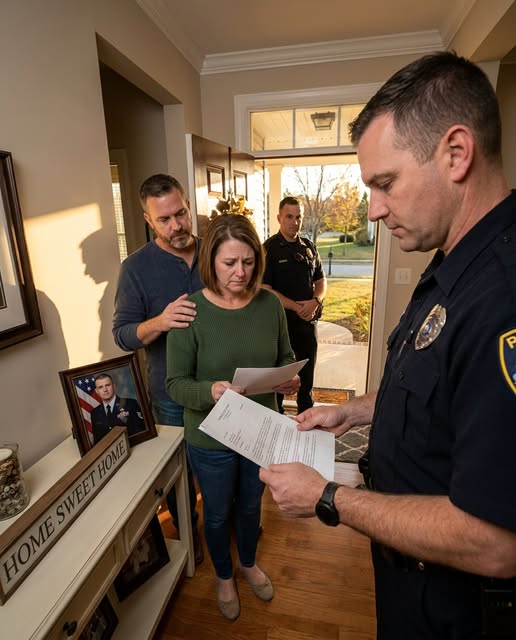
“You think you’re too good for this family now?” my father shouted through my phone speaker while two police officers stood in my entryway. The lemon cleaner I had been using still gleamed on the console table, my coffee had gone cold in the kitchen, and my husband stood quietly beside me while Dad insisted he had belongings in my house and a financial stake in the property. One officer asked whether I felt safe. Dad kept talking, growing louder as though volume could somehow substitute for proof. Then he said the phrase I had heard in one form or another my entire life: “I helped her with that house.” I looked toward the cabinet where I had stored months of bank records and property documents and realized he had finally brought his arguments somewhere they could be measured against facts.
I had spent most of my life being the daughter who paid. When my younger sister Emily needed dance lessons, I gave things up; when she needed a laptop, Dad pressured seventeen-year-old me into surrendering the savings I had built for a used car. Even after joining the Army at nineteen, I sent money home from a private’s salary for repairs, bills, and Emily’s expenses. My husband was the first person who ever asked me when my family had last done something for me rather than requested something from me, and I could not answer. Still, I kept giving until basic training graduation. I had mailed my parents the date, directions, and even offered to help with travel costs, yet I stood in formation scanning packed bleachers for faces that never appeared. A stranger’s mother eventually hugged me and whispered that she was proud of me; three weeks later, without mentioning the graduation at all, Dad texted: I need $8,000 for your sister’s wedding.
Something in me finally stopped negotiating. I opened my banking app and sent him eight dollars with the memo Best wishes. Then I asked my husband to change the locks. Dad called the next morning demanding the other $7,992, moved through guilt, insults, and accusations, and finally claimed that because he had once contributed money toward our house, I had no right to lock him out. What he did not know was that I had already assembled a folder containing the recorded deed, repayment records showing that his contribution had been paid back, years of transfers I had made to the family, and screenshots of the wedding demand. When he threatened that I would regret refusing him, I suspected he would try to turn the argument into a public scene. A few days later, the police arrived at my door.Explore Premium Cookware
I put Dad on speaker and handed the officers the documents. The deed showed only my husband and me as owners, while the bank records documented repayment of Dad’s earlier contribution rather than an ongoing ownership interest. The officers explained that if he genuinely believed money was still owed, he could pursue a civil claim and support it with evidence; police could not grant him access to a residence simply because he was my father. Dad tried calling me selfish and ungrateful, the same words that had worked on me since childhood, but this time they sounded different. I told him about the empty graduation bleachers, about the stranger who had been more present for me than my own family, and about receiving an $8,000 demand three weeks later without so much as an apology. “You didn’t want a daughter,” I told him quietly. “You wanted an ATM.” Then I told him not to come to the house and that any genuine financial dispute could go through lawyers and the courts.
Emily called two days later asking about the wedding deposit and dismissed my graduation as “just some ceremony.” That ended the last argument I was still having with myself. I wished her a beautiful wedding but told her I would neither finance it nor attend, and nearly a year later my father still had not apologized. Emily married without me, and seeing photographs of Dad proudly beside her hurt more than I expected. But the quiet in my own home gradually became something different from loneliness. My husband and I later had a daughter, and the old graduation photograph still hangs near our entryway—not because I enjoy remembering the empty seats, but because it reminds me of the promise I made afterward. Whatever our little girl grows up to become, when she looks toward the people who are supposed to show up for her, she will never have to search the bleachers twice.