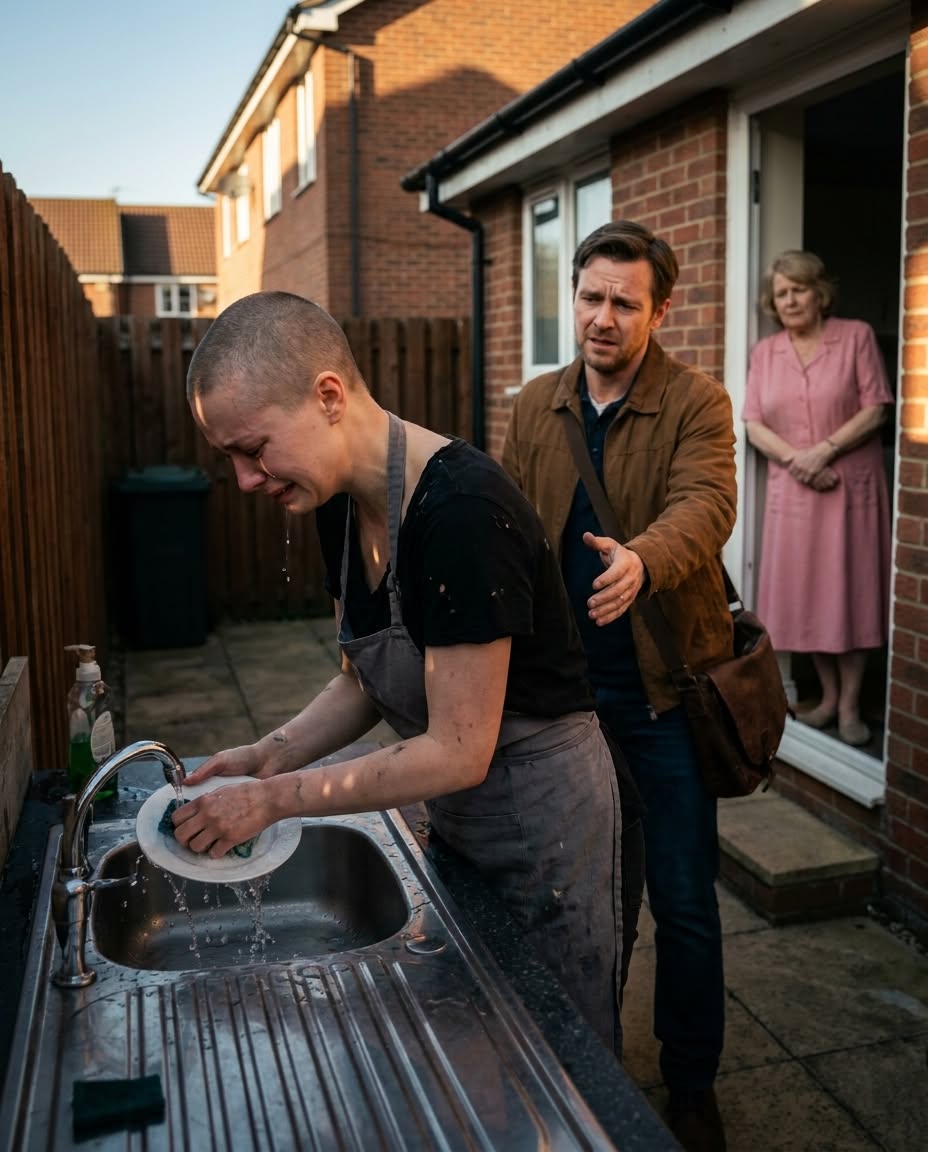
The first thing that frightened me was not Chloe’s shaved head—it was the way she backed away when she saw me. I had just driven through the gates of the beautiful two-story Ohio house my deployment money had helped finance, expecting my wife to run into my arms after four years apart, but instead I found her kneeling in the muddy backyard beside a rusted washing basin, gathering pieces of a broken plate with trembling fingers. Her clothes hung from a body so thin I barely recognized her, and beneath the knitted cap she wore despite the summer heat, her scalp was bare and marked with small red cuts. From an open window, my younger sister Brenda shouted that the “bald woman” should stay out of sight while guests were visiting. Then my mother Patricia appeared in silk clothes and gold jewelry and calmly told me Chloe had ruined her own hair, starved herself and wasted the money I had sent home. I might have believed some part of it until Chloe’s sleeve slipped upward and exposed a hospital bandage beside the purple mark of a recent IV. I had learned overseas that when a story does not match the evidence in front of you, sometimes the smartest thing you can do is let the person telling it believe you are still listening.
For four years, while serving overseas with the U.S. Army, I had transferred almost $100,000 home believing it was supporting Chloe and securing the life we would share when I returned. Instead, the money appeared to have financed a pristine house, a new Ford truck, expensive furniture, jewelry and Brenda’s designer purchases, while my wife had somehow been pushed to the back of the property like an unwanted servant. I decided not to confront anyone immediately. Instead, I smiled and invented a piece of news designed to test exactly what mattered to them: I told Patricia and Brenda that additional deployment compensation and back pay were coming and that the amount might approach $400,000. Their transformation was immediate. Mother began discussing renovations; Brenda talked about another truck, tropical vacations and shopping. Neither asked about Chloe’s weight, her hospital bandage or why she could barely stand. That night I searched the enormous house for my wife and eventually found her on a thin mattress in a damp storage room among cardboard boxes and lawn equipment. There, with the door closed, Chloe showed me the biopsy scar across her chest and whispered that doctors had diagnosed her with stage-three cancer five months earlier. She said she had begged Patricia for $300 to see a specialist, but my mother accused her of faking illness for money, while Brenda interfered with her attempts to contact me. Desperate for answers, Chloe had cut off her own hair, sold it to a wig maker for $150 and used the money toward transportation and the biopsy that confirmed she was seriously ill.
I did not sleep that night. By sunrise, I was examining bank statements, transfer records, receipts and medical paperwork, trying to separate what Chloe remembered from what could actually be documented. The paper trail transformed my anger into something colder: money I believed had been available for our household appeared instead alongside purchases and accounts connected to Patricia and Brenda, while Chloe’s medical bills told an entirely different story about how little support she had received. Then Patricia unknowingly gave me the clearest indication yet of what she expected from me. She walked into the kitchen carrying documents she described as a power of attorney and financial-management agreement, explaining sweetly that she could oversee the imaginary $400,000 payout because she had already managed everything so successfully while I was away. Brenda stood beside her browsing luxury vehicles on her phone. I placed my folder of statements, receipts and medical records beside Patricia’s paperwork and asked one question: “Where did the hundred thousand dollars go?” For the first time since I had arrived, my mother had no prepared answer.
What followed was not something I could responsibly treat as a private shouting match. I preserved the financial records and sought legal guidance about the transfers, account access and Chloe’s treatment; allegations involving unauthorized transactions, coercive control or financial exploitation require evidence and the applicable law, not simply an angry family accusation. Patricia insisted Chloe was an outsider who had turned me against my “real family,” but that argument collapsed against the reality of the woman sleeping beside lawn equipment while people upstairs enjoyed the money I believed I had sent for our future. I refused to sign the power-of-attorney documents, separated my finances from anyone who did not have legitimate authority over them and arranged for the questionable transactions to be reviewed through the appropriate legal and financial channels. My first priority, however, was not recovering a truck or calculating jewelry receipts. It was Chloe. I took her out of that storage room and arranged immediate specialist oncology care so her diagnosis, staging and treatment options could be evaluated by medical professionals. Whatever happened later with disputed transfers, ownership of property or potential civil or criminal proceedings would have to be determined from the evidence. Chloe had already lost months she could never recover, and I refused to let another day of her medical care become collateral damage in a fight over money.
When we finally left the house, Chloe sat beside me with a blanket around her shoulders and asked where we were going. I told her we were going somewhere she could be treated as a patient instead of an inconvenience, and afterward we would find somewhere safe to live while the rest was sorted out. For years I had measured sacrifice in miles from home, missed holidays and money wired into an account; I had never considered that sending money and protecting the people you love are not necessarily the same thing. The nearly $100,000 mattered because it represented years of work, but what haunted me was the smaller number—$300, the amount Chloe said she had once needed simply to reach a specialist, and the $150 she raised by cutting away her own hair when no one would help her. I could investigate accounts, challenge unauthorized transactions and rebuild finances, but I could not purchase those lost months back for her. As we drove away, Chloe reached across the console and took my hand. I had returned home expecting to surprise my family; instead, I discovered that the person who needed me most had been surviving almost entirely alone. From that morning forward, the question was no longer how much of my money could be recovered—it was how much of our life still could.