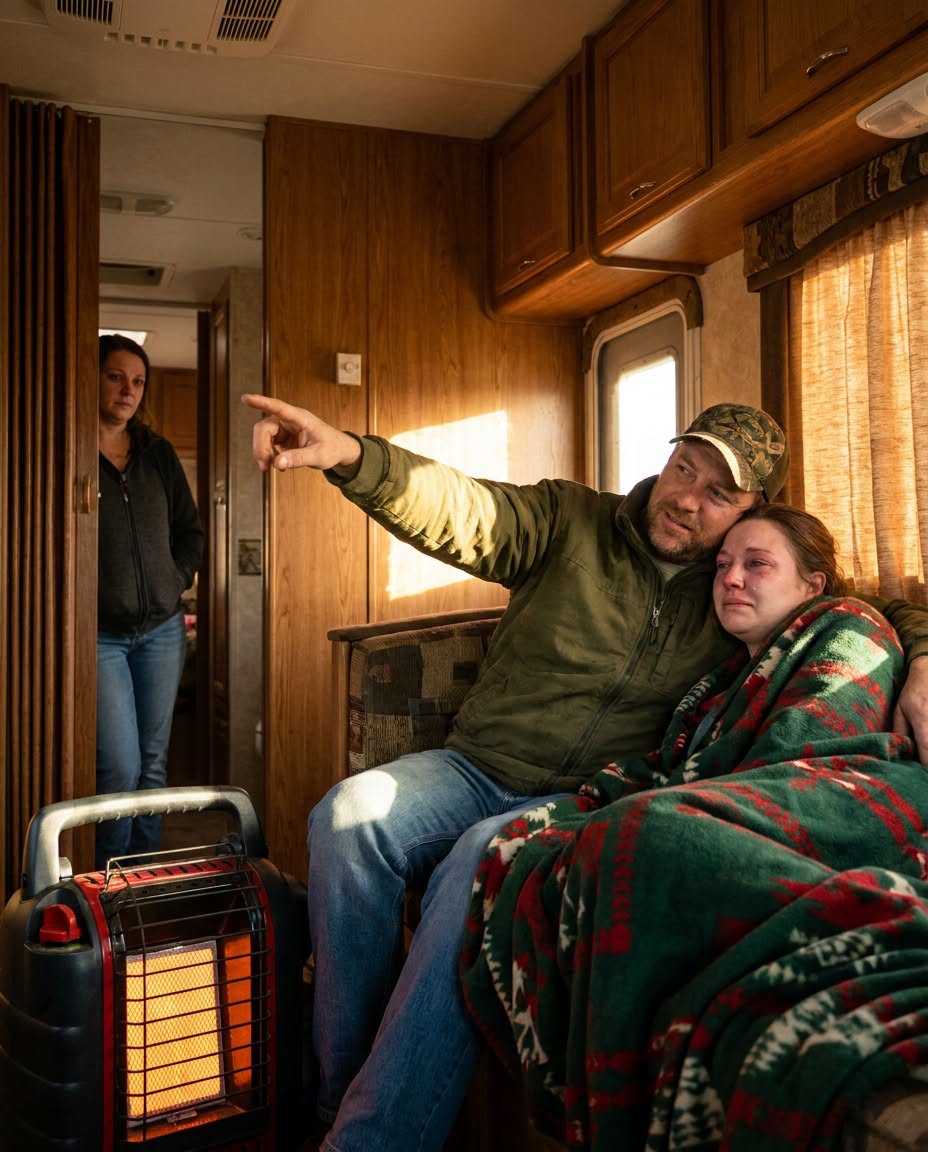
I drove fourteen hours through the cold Texas night to surprise my daughter on her sixteenth birthday, but when I arrived home, I discovered she’d been sleeping in a freezing camper behind our house for five weeks—and the old baby monitor she’d hidden inside would expose why my wife had put her there. It was 11:40 on a Wednesday night, and the dashboard thermometer read nineteen degrees. Beside me sat a strawberry birthday cake with pink sugar roses and the words HAPPY 16TH KAYLEE written across the frosting. I’d even buckled it into the passenger seat to keep it safe. My daughter wasn’t expecting me until Saturday, and I imagined how excited she’d be when she saw me. Instead, I walked into our house and found my brother-in-law Rick asleep in my recliner, his muddy boots resting on Kaylee’s school papers. My wife Tara appeared from the kitchen, looking startled. When I asked where Kaylee was, she said she was asleep and tried to stop me from checking on her. I walked down the hallway anyway. My daughter’s bedroom was gone. Her bed, dresser, photographs, softball trophies, and the little desk her late mother had painted were missing. A treadmill, weight bench, and enormous mirror had replaced everything. Tara casually explained she’d needed an exercise room. When I demanded to know where Kaylee was sleeping, she claimed my daughter had stolen $40 and was being punished in our old camper. I ran into the backyard and found the camper door secured from the outside with a bungee cord. Inside, Kaylee lay curled beneath several blankets, wearing two coats and a winter hat. I could see my breath in the air. Her little electric heater was cold because its extension cord had been unplugged at the house. When I touched her shoulder, she flinched as though expecting someone to hurt her. Then she recognized me and whispered, “Dad?” I pulled her into my arms. Her hands were freezing, her lips were cracked, and she’d lost weight. She admitted she’d been sleeping there since Thanksgiving. Five weeks. When I asked why she hadn’t told me, she began crying and begged me not to make things worse. “I can handle two more years,” she whispered. “Until I’m eighteen.” Then she pointed to a white baby monitor taped beside the camper window. It was the same monitor her mother Amy and I had bought when Kaylee was born. “Dad,” she said, gripping my sleeve, “please wait until my birthday party tomorrow. When Grandma, Grandpa, and Aunt Joanne are here. I need everyone to hear what they say, or Tara will call me a liar again.”Shop Baby Gear
My name is Wade Collins. I’m forty-four years old, and I’ve spent most of my adult life driving long-haul trucks between Amarillo, Atlanta, Memphis, and other cities. I’m usually away three weeks out of every four. The money is good, but it means missing birthdays, school events, and ordinary evenings at home. My first wife, Amy, died from ovarian cancer when Kaylee was eleven. Before she passed away, she made me promise I’d protect our daughter and make sure she never struggled financially. Amy had established a trust using family money, a college fund, and her life insurance. As trustee, I protected every dollar, and by the time Kaylee turned sixteen, it had grown to more than $310,000. I paid for everything else from my trucking income, including our house, which was fully paid off. Two years after Amy’s death, I married Tara, a woman I’d met at a diner near Amarillo. She seemed warm, kind, and genuinely interested in Kaylee. She promised to treat my daughter like her own. Six months after our wedding, Tara’s brother Rick moved in temporarily after losing his job. Temporary became eighteen months, but I was rarely home to question the arrangement. Tara repeatedly assured me everything was fine. During my trips, she’d send messages complaining that Kaylee was stealing money, disrespecting her, and becoming difficult to manage. I believed her. Whenever I called my daughter, Tara was nearby, and Kaylee always answered that everything was fine. I assumed she was being a typical teenager. Now I realized she’d been frightened to tell me the truth. After finding her in the camper, I carried her inside, ignoring Tara’s protests that I was undermining her discipline. I settled Kaylee into my bedroom, warmed her hands, and gave her something to eat. She devoured a granola bar and admitted she hadn’t eaten since lunch at school because Tara refused to let her join family dinners until she apologized. That night, I slept in a chair beside her bed. The next morning, Tara placed twelve pages of paperwork in front of me. It was an application for Red Mesa Youth Academy, a residential program for troubled teenagers in Utah. She’d described Kaylee as dishonest, aggressive, and impossible to manage. But hidden among the enrollment forms was a limited power of attorney authorizing Tara to request money from accounts established for Kaylee’s benefit to cover educational and therapeutic expenses. A yellow arrow marked where I was supposed to sign. I said I’d review everything after the birthday party. Then I called my older sister Joanne, a paralegal in Amarillo, and told her what I’d discovered. She instructed me not to sign anything and to preserve evidence. I photographed the freezing camper, the unplugged heater, the cord securing its door, Kaylee’s converted bedroom, and every page of Tara’s paperwork. What frightened me most wasn’t simply the cruelty. It was the possibility that someone had deliberately made my daughter suffer to gain access to the money her mother had left her.Marriage counseling services
The next evening, our family gathered for Kaylee’s sixteenth birthday. Joanne arrived early, along with Amy’s parents, Harold and Dot Brennan, who’d driven from Lubbock. Tara greeted everyone with hugs and smiles, calling Kaylee her sweetheart and telling stories about what a wonderful stepmother she’d been. If I hadn’t found the camper the previous night, I might have believed every word. Kaylee sat beside me, pale and exhausted, wearing a blue sweater Joanne had brought her. She barely touched her lasagna and flinched whenever Tara raised her voice. After dinner, I brought out the strawberry cake and lit sixteen candles, plus one for good luck, just as Amy used to do. Kaylee smiled for the first time since I’d returned. Then Tara suddenly announced that we needed more ice and asked Rick to help her get some from the chest freezer in the garage. The moment they left, Kaylee pulled the old baby monitor from her pocket and placed it beside the cake. She explained that she’d discovered it in a box of her mother’s belongings while searching for blankets. She’d hidden the transmitter behind paint cans in the garage, where Tara and Rick frequently went to discuss things they didn’t want her to hear. The receiver was inside the camper. Using an old phone, Kaylee had recorded thirty-one nights of their conversations. My hands shook as I held the little white monitor, still marked with the faded yellow duck sticker Amy had attached years earlier. Joanne immediately started recording on her own phone. Kaylee looked at me and nodded. I turned up the volume. At first, there was only static and the sound of a freezer opening. Then Tara’s voice came through clearly. “One more week in that camper, and she’ll agree to anything.” Rick laughed and asked about the trust. Tara replied that it contained $310,000 and that once I signed the paperwork, they could find a way to access it. She explained her plan to convince me the Utah program cost $10,000 a month when the real price was closer to $4,000, then request the inflated payments herself. Rick asked about the missing forty dollars Kaylee had supposedly stolen. Tara casually admitted he’d taken it to buy scratch tickets. My daughter had been punished for something Rick had done. Then Tara explained that she knew I’d believe her because I was away for weeks at a time and trusted her to manage everything at home. Amy’s father stood up, his hands pressed against the table. I couldn’t move. I’d spent years protecting my daughter’s trust from financial misuse while failing to protect my daughter from the people living inside our home. Then Tara said something that made my blood run cold: “Just make sure the heater stays unplugged tonight. Cold makes kids stop arguing.” Kaylee began crying. She explained that Rick regularly disconnected the heater and that the bungee cord prevented her from leaving the camper at night, even to use the bathroom. She’d been forced to keep a bucket inside. I held her close and apologized for believing Tara’s accusations instead of asking what was really happening. Before I could say anything else, the garage door opened. Tara walked into the dining room carrying a bag of ice, with Rick following behind. She stopped when she saw our faces. Then she noticed the baby monitor beside Kaylee’s birthday cake. The bag slipped from her hands and crashed onto the floor. She stared at my daughter and demanded, “What have you done?” I stepped between them. “I heard everything,” I told her. Tara went pale, then quickly began insisting that Kaylee had manipulated the recordings. I asked whether Rick had stolen the forty dollars and whether they’d deliberately left my daughter without heat in nineteen-degree weather. Neither answered. Then Joanne raised her phone and said she’d contacted the sheriff’s office. Headlights suddenly appeared outside our window, and someone knocked at the front door. I opened it to find a deputy standing on the porch. He introduced himself, looked past me toward the birthday decorations, and asked—Shop Baby Gear
“Mr. Collins, can you show me where your daughter has been sleeping?” I took Deputy Ruiz into the backyard. The temperature had fallen below twenty degrees again. He examined the camper’s cracked window, the frost on the inside, the pile of blankets, the unplugged heater, and the bucket in the corner. He photographed everything and asked how long Kaylee had been living there. When I answered five weeks, his expression changed. Another deputy spoke privately with Kaylee while Joanne stayed nearby for support. We provided the original recordings, photographs, Tara’s messages, and the paperwork she’d tried to make me sign. Tara continued insisting she’d merely been disciplining a difficult teenager, but her explanations couldn’t change the conditions inside that camper or the words captured on Kaylee’s phone. The deputies explained that investigators and child protective services would review what had happened. That night, Tara and Rick packed their immediate belongings and agreed to stay elsewhere during the investigation. I changed the locks the next morning and contacted the residential program, confirming that no enrollment had been authorized. Then I called the attorney who’d prepared Amy’s trust. He explained that Tara’s proposed power of attorney wouldn’t automatically give her legitimate authority over the trust, but the arrangement could have enabled her to request payments before anyone noticed irregularities. We added stronger safeguards to prevent unauthorized withdrawals. I began divorce proceedings. Meanwhile, Kaylee struggled to feel safe again. For days she slept on an air mattress beside my bed, waking whenever she heard a car outside or someone moving through the hallway. She ate quickly, as though meals might disappear, and sometimes looked toward the backyard with the terrible feeling that she’d eventually have to return to the camper. One evening, she asked whether she still needed to record conversations to prove what people were doing to her. I sat beside her and promised she’d never again have to gather evidence just to make me believe her. In January, my dispatcher offered me a high-paying three-week route to Atlanta. It was the kind of assignment I’d always wanted. But when I looked across the room and saw Kaylee checking whether I was still home, I declined. Instead, I accepted regional deliveries around Amarillo, which paid considerably less but allowed me to return most evenings. Kaylee worried that we’d lose the house or have to spend her mother’s trust. I explained that the house was paid off and that we could manage by spending less. “Your mom didn’t want you to have a big bank account while you were suffering,” I told her. “She wanted you to have a good life.” The investigation continued, and the divorce was finalized by June. Tara received neither the house nor Amy’s trust. Kaylee began seeing a counselor to help her recover from the fear she’d lived with. In April, we had the old camper removed from the property. Kaylee watched it disappear on the back of a flatbed truck, then told me she didn’t want anyone ever sleeping in it again. The following month, we planted sunflowers where it had stood. Then we restored her bedroom. We sold the treadmill, removed the weight bench, and took down the enormous mirror. Behind it, we discovered a pencil mark Amy had made when Kaylee was ten years old. Kaylee stood beside it, and I measured her height at sixteen, writing a second mark on the wall. We painted the room pale yellow, the same color Amy had once chosen for her nursery. When we carried her bed back inside, Kaylee stood in the doorway and whispered, “It feels like my room again.” I put my arm around her and told her it was, and always would be.
The following months weren’t easy, but little by little, our home began feeling peaceful again. I left early every morning for regional deliveries and usually returned before six. We had to stop eating out as often, and I sold my bass boat to make our budget work. But I could attend Kaylee’s softball games, help with homework, and hear about her day without someone standing nearby controlling what she said. She gradually began laughing again. Her counselor helped her understand that recovering from weeks of fear would take time, and I learned to listen without becoming defensive when she admitted she’d once been angry that I believed Tara. She had every reason to feel that way. I couldn’t change the nights she’d spent freezing or the phone calls when I failed to recognize her fear. But I could be present now. One evening, Kaylee brought the old baby monitor into the living room and placed it on the coffee table. “I don’t think I need this anymore,” she told me. She explained she’d kept it because she was afraid nobody would believe her again. Then she smiled and said I could keep it in case I ever wanted to hear her. I pulled her close and told her I’d rather she simply come and talk to me. “I will,” she promised. Later that night, I passed her bedroom and heard her humming softly while folding laundry. It was the lullaby Amy used to sing when she was little, the one she’d made me write down before she died. I stood in the hallway listening, remembering the promises I’d made beside Amy’s hospital bed. For years, I’d thought being a good father meant earning enough money, keeping the house paid off, and protecting Kaylee’s college fund. I’d driven thousands of miles believing those things were proof I was taking care of her. But when she needed me most, she hadn’t needed another paycheck. She’d needed someone close enough to notice she was afraid. The next morning, I made breakfast before leaving for work. Kaylee sat across from me eating scrambled eggs with too much ketchup, wearing her softball sweatshirt. “You’re coming to my game Friday, right?” she asked. “It’s the semifinal against Canyon.” I looked at her and smiled. “Wouldn’t miss it.” And this time, I knew I meant it. I came home early expecting to surprise my daughter with a birthday cake. Instead, I found her freezing behind our house and learned that the most important promise I’d ever made wasn’t to protect her inheritance. It was to make sure she never had to face the world alone.Hospital ethics training