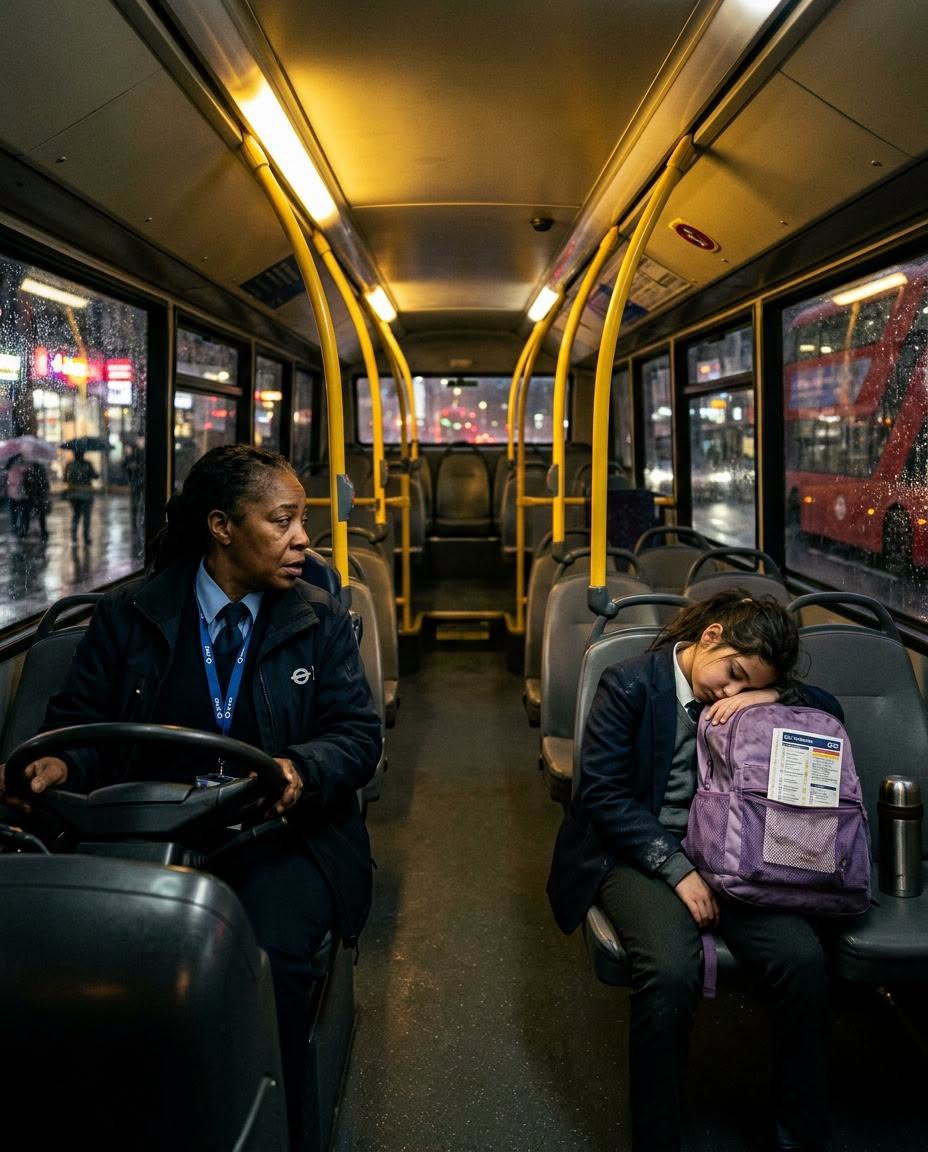
A ten-year-old girl rode my bus to the end of the line and straight back again every Thursday night for fourteen months, and in all that time she never once got off at a stop.
I drive the 42 out of the Calderbank depot. Evenings. Half past four until twenty past eleven.
My name is Winifred Achterberg-Cruz. I am fifty-eight and I have driven that route for nine years.
The 42 is a loop. Calderbank interchange, out through the Tannery estate, round the retail park, the long bit past the reservoir where nobody gets on, and back in. Two hours and forty minutes door to door.
She got on for the first time on a Thursday in the September, at eighteen minutes past six, at the stop by the chemist on Kelso Row.
She paid. A child single. She had the right money and she had it ready in her hand before the doors opened, which almost nobody does.
And then she sat in the third row behind me on the left and she did not get off.
We went all the way round. Back into the interchange at nine o’clock.
I said, love, this is the end, you’ll have to get off here.
She got off. And then she walked round the front of the bus and got back on and paid again.
Her name is Bronwen Castellanos-Pike and she was ten.
Every Thursday. Fourteen months. I counted fifty-two Thursdays in the first year and then I stopped counting because it had stopped being interesting and started being something else.
Here is what I did, and I want it on the record because I have had a lot of time to think about it.
I let her.
I asked, obviously. The first month I asked her every week.
Where are you going, love.
“Nowhere. I just like the bus.”
Does your mum know where you are.
“Yes.”
And that second answer came so fast and so flat, every single time, in exactly the same three letters, that after about the sixth week I stopped believing it and kept asking anyway because I did not know what else to do.
Understand what I had. A child, on a public bus, in a lit vehicle, with an adult, paying her fare, polite, warm, doing nothing wrong at all.
There is no form for that.
I could not put her off. Where would she go. It is dark at six in November on the Tannery estate.
So I did small things instead, which I now think were the right small things done for eleven months too long.
I stopped taking her second fare. I told her the machine was playing up, which it was not.
I kept the heater on the third row even in the mild weather.
I started bringing a flask with two cups in it, and a second sandwich in my bag that I pretended I had bought by accident.
She always ate it. She never once said she was hungry and she always ate it, right down to the crusts, and that was the first thing that properly frightened me.
She did her homework on the shelf by the window. She is good at maths. She showed me a sheet with twenty-eight out of thirty on it and she was not boasting, she was just holding it up.
And every Thursday, somewhere out past the reservoir with nobody on the bus but the two of us, she fell asleep with her head on her bag.Track Sleep
Only Thursdays. Never a Monday, never a Friday.
I asked her once what was special about Thursday.
And she said, “It’s the longest one.”
I did not understand that for eleven months.
What finally broke it open was not me being brave. It was a broken-down lorry on Kelso Row on the eighth of November last year.
We were held thirty-five minutes. The whole timetable went. I came back into the interchange at twenty-five to ten instead of nine, and the second loop was cancelled, and there was no bus after mine.
So I had a ten-year-old girl standing on a concrete platform at twenty-five to ten at night, in the rain, with nowhere to be for another hour and twenty minutes.Buy Lumber
And she started to cry, which she had never done, not once in fourteen months.
I put my coat round her and I took her into the depot canteen and I sat her down and I said: I am going to drive you home now, in my own car, and you are going to tell me where that is.
She said, “You can’t. Not yet. Not till ten past eleven.”
And I asked her why not.
She said: “Because the lights don’t come back on till Mum gets in.”
They are on a prepayment meter. The key kind, that you top up at the shop.
Her mother is called Seren and she is thirty-one and she works two jobs, and the second one is a Thursday night shift at a packing warehouse out by the motorway that pays thirteen dollars twenty an hour.
The money lands in the account on a Friday morning.
So Thursday is the day the meter runs out. Every week. Not sometimes. Every single week, because the gap between the top-up and the pay is one day long and it has been one day long for years.
Thursday evening, in that flat, there is no light, no heating, and no television, from about half past five until her mother gets in at ten past eleven and puts the key in on the way home.
Five hours and forty minutes of a dark flat on the fourth floor of the Tannery.
And a ten-year-old sat down with a bus timetable, which I have seen, because she kept it, folded into eight, in the front pocket of her bag.
She worked out that the 42 does two full loops between six eighteen and ten past eleven. Two hours forty each. Five hours twenty, plus the walk.
She did not pick my bus because she liked it. She picked it because the arithmetic came out right, and because it was the only warm lit room in the borough that a child is allowed to sit in for five hours without anybody asking her to leave.
“It’s the longest one.” She meant the night.
Her mother did not know. I want to be very clear about that, because the easy version of this story has a bad mother in it and that is not the story.
Seren thought her daughter was at a friend’s house on Thursdays. Bronwen told her that. She invented a friend, with a name, and a mum, and a street, and she maintained it for fourteen months so that her mother would not have to know that the dark was a problem.
Ten years old, managing her mother’s shame, on a bus, with a folded timetable.
I drove her home that night at ten past eleven and I sat in the car park until I saw the fourth-floor windows come on, and then I went and sat in my own kitchen until about two in the morning.Shop Kitchenware
Here is what happened after, and some of it is better than I expected and some of it is not.
I went to Seren on the Saturday. Not to the council, not to anybody official, to her, in her kitchen, and I told her everything, including the fourteen months and including that I had known something was wrong for eleven of them and had bought sandwiches instead of saying so.
She did not shout at me. She sat down on the floor, actually on the floor, with her back against the cupboard.
The debt on that meter was four hundred and ten dollars of standing charge arrears, which is the part people do not know about prepayment meters: they take the arrears out of every top-up before you get any electricity at all.
The depot heard about it because I told nine people in one week, including my own union rep, who turned out to be the most useful person in this entire story.
Between the drivers’ social fund and a collection in the canteen we put together six hundred and twenty dollars in eleven days.
The arrears are gone. The meter went to a credit account in the February.
Bronwen is eleven now. She does not ride the 42 on Thursdays.
She rides it on Sundays, once a month, with her mother, who gets on at Kelso Row and pays two adult singles because she will not let me not charge her.
They sit in the third row behind me on the left.
And I still bring the flask with two cups in it, and nobody on that bus pretends any more that it was ever an accident.