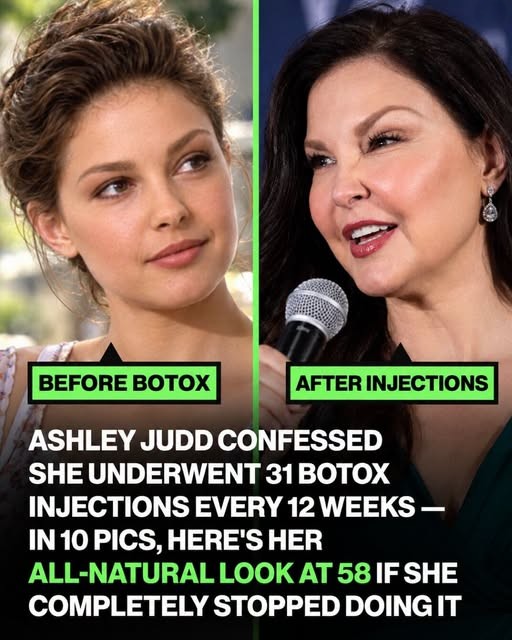
A series of photographs showing a familiar Hollywood actress with silver strands in her hair and visible facial lines has sparked renewed conversation online. For decades, audiences recognized her for her striking looks, memorable movie roles, and confident appearances on red carpets. But recent pictures offer a different glimpse of the woman behind the glamorous Hollywood image. Some show her smiling outdoors, while others capture natural details that professional lighting and carefully styled photographs often conceal. Fans have responded with messages of admiration, praising her willingness to share ordinary moments without hiding the visible signs of aging. Yet the attention surrounding these images is connected to a much older controversy that followed the actress for years.
The discussion began long before her latest photographs appeared. During a television appearance in 2012, viewers noticed changes in her facial appearance and began questioning whether cosmetic procedures were responsible. Her representative rejected those claims and offered an explanation involving illness and medication. Similar speculation resurfaced in 2020, prompting the actress to publicly address the criticism surrounding her appearance. Now, a collection of artificial intelligence-generated portraits has added another dimension to the conversation, showing imagined versions of her with gray hair and wrinkles. But the actress’s identity, her explanation for the changes, and the surprising contrast between her real photographs and AI-created images reveal a much bigger story.
The actress is Ashley Judd, born April 19, 1968, and widely recognized for films including Kiss the Girls, Double Jeopardy, and High Crimes. Her career also includes humanitarian advocacy and public speaking. In March 2012, her appearance while promoting the television series Missing attracted speculation about cosmetic surgery. Her representative explained that she had been experiencing the flu and a serious sinus infection, with medication contributing to facial swelling. Years later, Judd discussed another medical concern: severe migraines. In a public statement, she explained that Botox injections were part of her prescribed migraine treatment and that her union health insurance covered 31 injections every 12 weeks. She also described how treatment and reduced exercise affected her appearance. While cosmetic procedures can represent a significant personal investment, photographs alone cannot establish whether someone has undergone elective treatments. The public discussion did not involve any reported attorney, estate, mortgage, or court dispute over her appearance. Instead, Judd challenged the tendency to judge women’s bodies rather than recognize their accomplishments and contributions.
More recent photographs from 2025 and 2026 show Judd with naturally visible silver strands, fine lines around her eyes, and relaxed expressions in outdoor settings. One picture captures her beside a stream, while another shows her surrounded by colorful wildflowers. Fans praised her appearance, with several describing her as beautiful and relatable. Meanwhile, 11 AI-generated portraits reimagined the actress in different environments, including public appearances, casual selfies, and peaceful outdoor scenes. These illustrations are creative interpretations, not authentic photographs or evidence of cosmetic changes. The comparison has brought fresh attention to Judd’s earlier comments about confidence, aging, and personal worth. At 58, she continues to demonstrate that a woman’s identity extends far beyond her appearance. And perhaps the most meaningful detail in these photographs is not the gray hair or wrinkles, but the confidence of a woman who has spent years reminding people that her value cannot be determined by strangers’ opinions.