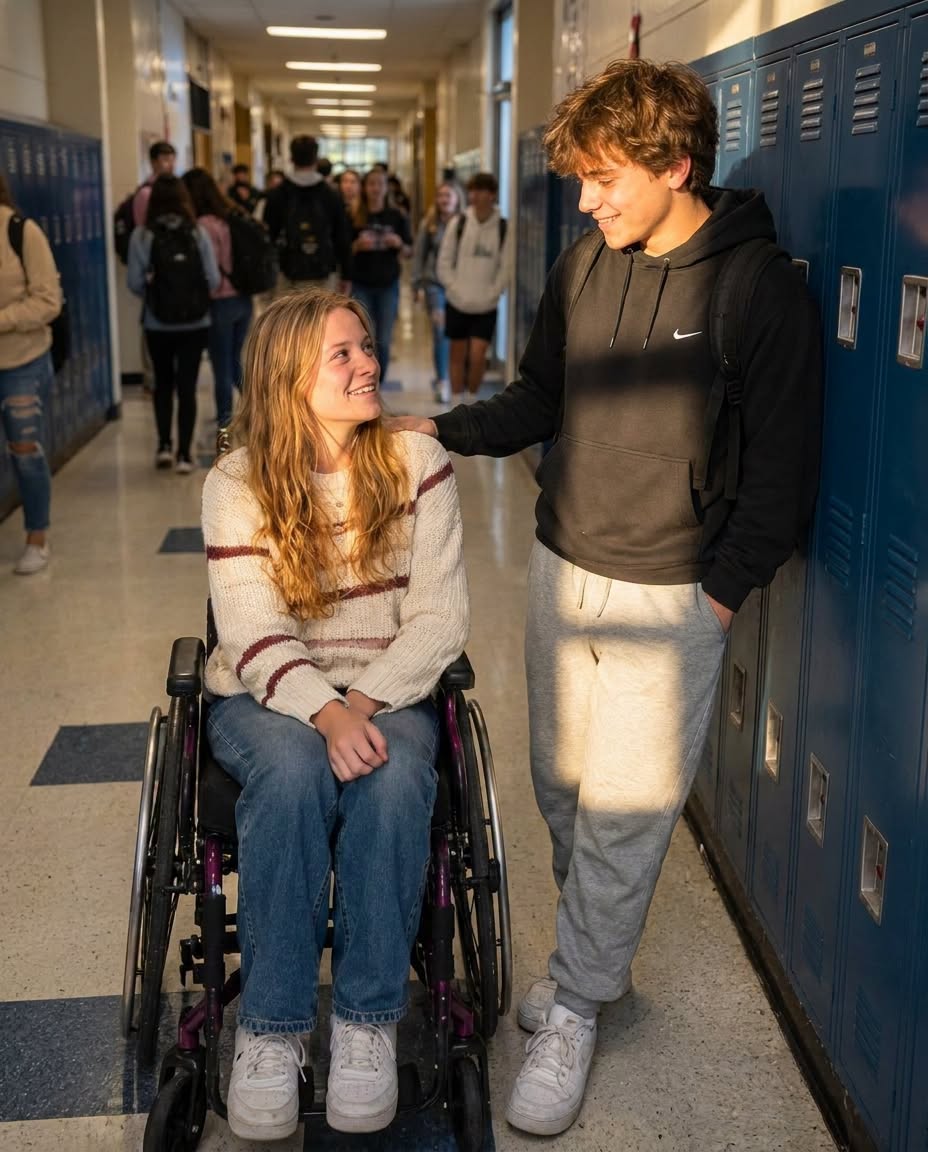
“Mrs. Vance, we need to speak with your son.” The older police officer stood on my porch at seven o’clock in the morning, his breath visible in the cold October air. Behind him, a patrol car idled at the curb while his younger partner held her hat in both hands, looking unusually solemn. I was still wearing my bathrobe, with the smell of burnt toast drifting from the kitchen, and my first thought was that something terrible had happened to my husband at work. Then thirteen-year-old Julian appeared on the stairs in his old Nirvana T-shirt, his hair damp from the shower, and went pale when he saw the uniforms. He reached for my hand and squeezed so tightly that my fingers hurt. The taller officer introduced himself as Daniels, glanced toward my son, and said there was something about the previous day that I didn’t know. I looked at Julian, remembering the empty guitar stand in his bedroom, and wondered whether the extraordinary sacrifice he’d confessed to making had somehow led him into trouble.
My name is Sarah Vance, and until that week, I thought I understood the things that mattered most to my son. My husband, Ben, works as a lineman for Tri-County Electric, and I’m a dental hygienist at a practice in Westbrook, Oklahoma. We have a mortgage, two car payments, and an aging dog whose veterinary bills occasionally make us wince. We manage well enough, but expensive purchases require planning, and Julian’s guitar had been the most extravagant birthday present we’d ever given him. He’d fallen in love with the electric guitar at nine after hearing Jimi Hendrix on his grandfather’s record player. For years, he’d stood outside Westbrook Music Exchange admiring a custom Fender Stratocaster with a sunburst finish and rosewood neck. It cost $2,100. Ben and I saved for eleven months, putting aside money from each paycheck and taking additional work whenever we could. On Julian’s twelfth birthday, we handed him the hard-shell case. He opened it, recognized the instrument, and began crying before he’d played a note. From then on, our house was full of music. Julian practiced after school, taught himself to change strings, polished the guitar every evening, and repeated difficult passages until he got them right. Sometimes I heard the same four measures drifting through the kitchen for an hour. Ben claimed they drove him crazy, but I liked knowing our boy was upstairs making something of his own. So when I carried clean laundry into Julian’s room one Monday afternoon and noticed the empty guitar stand, I immediately assumed someone had stolen it. His case was empty too. When he came home, I asked where the guitar was. He stood in the hallway with one shoe off and his eyes fixed on the floor. Finally, he admitted he’d sold it. I was so stunned that I could hardly speak. Julian explained that a girl in his eighth-grade class, Maya Medina, needed a new wheelchair. I knew Maya from school concerts and pickup lines: dark hair, purple glasses, a beautiful singing voice, and a warm smile. I hadn’t realized how difficult moving through school had become for her. Julian described the bent front caster that caught on door thresholds, the worn cushion that left her aching, and the steep ramp beside the science wing that exhausted her arms. Some students mocked the chair’s squeak, imitating it whenever she passed. The previous week, Maya had been trapped at the cafeteria entrance when a wheel caught against a metal strip, and several children had simply walked around her. Her parents knew she needed a replacement, but medical bills and insurance difficulties had delayed the process. Julian had researched wheelchairs for two weeks, found a lightweight model advertised with improved casters and a supportive cushion, and decided he couldn’t bear watching Maya struggle while everyone discussed possible fundraisers. He sold his guitar to Lenny Marsh at the music shop for $800. Then he sold his PlayStation and games for $240 and emptied the red metal savings tin he’d filled with birthdays, Christmas money, and lawn-mowing earnings. Altogether, he collected $1,422, enough for the chair and shipping, with a few dollars left for a chocolate-chip cookie he bought Maya at lunch. The more he explained, the harder it became to sort through my feelings. I was proud of his kindness, but I was upset that he’d sold valuable belongings without speaking to us. A wheelchair isn’t simply another piece of equipment, either. Proper fit, pressure relief, posture, and safe maneuvering matter, especially for a growing child with a spinal cord injury. I worried whether the chair he’d selected would meet Maya’s needs and whether her parents had been consulted. Julian assured me that Maya had discussed the model with him and that her family was arranging to have its fit checked. I told him his generosity was remarkable, but that the next time he wanted to make such an important purchase, we would work together and involve the people responsible for using and fitting the equipment. He nodded, embarrassed, then admitted he’d already had the chair delivered to the Medinas’ house. At supper, Ben listened quietly as Julian explained where the money had gone. My husband was visibly shaken by the loss of the guitar we’d sacrificed to buy, yet he stood, walked around the table, and rested a hand on our son’s shoulder. He told Julian he was proud of him, although he wished we’d been included in the decision. That night, I lay awake thinking about our boy’s empty shelves. I believed his generosity was the most surprising thing I would learn that week. Then the police knocked.
Officer Cooper quickly assured Julian that he wasn’t in trouble. She explained that Sergeant Rafael Medina, Maya’s father, wanted to meet him and had asked whether we could come to the police station before the morning shift briefing. I hadn’t known Rafael was a police officer, and neither had Julian. The officers told us he’d worked for the department for nineteen years and had moved to administrative duties after a serious accident. I called the school to explain that Julian would arrive late, and he changed into the blue button-down shirt he’d worn to a cousin’s wedding. As we drove to the station, Officer Daniels told us what had happened to the Medina family six years earlier. Rafael had been driving seven-year-old Maya home from a birthday party when an impaired driver ran a red light and struck their vehicle. Rafael suffered broken ribs, a fractured arm, and a severe back injury while getting his daughter to safety. Maya sustained a spinal cord injury that left her unable to walk. Years of surgeries, rehabilitation, home modifications, transportation expenses, and mobility equipment had placed enormous strain on the family. Her mother, Elena, worked as a nurse and also handled medical billing from home to help cover their expenses. Colleagues had repeatedly offered assistance, but Rafael refused. He blamed himself for not anticipating the crash, even though another driver had caused it. He had come to believe that accepting help meant admitting he couldn’t care for his daughter. When the new wheelchair arrived, he initially thought his colleagues had ignored his wishes and purchased it behind his back. Then Maya showed him the handwritten card Julian had enclosed. Officer Daniels handed me a printed copy. I unfolded it in the back seat and began reading. Julian had written about fourth grade, when he’d broken both legs in a trampoline accident and spent several months using a wheelchair. I remembered the casts, the frustration, and the way he’d resisted returning to school. What I hadn’t known was that Maya, newly enrolled at Westbrook and still adjusting to her own wheelchair, had approached him when other children avoided his lunch table. She’d taught him how to navigate ramps, lift the front wheels over small obstacles, and stop feeling embarrassed every time he needed help. She’d made him laugh. She’d treated him as a friend rather than a problem to be solved. In his note, Julian apologized for never properly thanking her and explained that he’d remembered her kindness every time he saw her struggling with the broken caster. He described the new chair’s quiet wheels, calling them silent as a ninja, and told her the gift wasn’t charity or an obligation. It was simply his way of saying thank you four years later. At the bottom he’d added a postscript asking her not to tell me he’d sold his guitar. I looked at my son, who was staring through the patrol-car window with his cheeks bright red. For years, I’d assumed he’d adjusted to the wheelchair after his accident because children were resilient. I’d never realized another child had helped him feel confident again. Officer Daniels explained that Rafael had read the note and called him late the previous evening, overcome with emotion. For six years, Rafael had turned away support from adults who wanted to help his family. Now a thirteen-year-old boy had surrendered nearly everything he owned simply because his daughter had once made him feel welcome. When we entered the police station’s briefing room, I understood why Rafael had insisted on meeting Julian in person. Nearly sixty officers and staff members were waiting, along with several familiar faces from the community. At the front stood Rafael in uniform, his dark hair graying at the temples. Beside him sat Maya in her new wheelchair, a sleek black frame beneath her green sweater, her purple glasses catching the overhead light. She smiled when she saw Julian. Rafael came forward, slowly lowered himself to one knee despite his injured back, and thanked my son for treating Maya with such thoughtfulness. He admitted that he had spent years rejecting assistance because of guilt and pride, and that Julian’s gift had made him reconsider what it meant to receive help. Then he told us something else. Maya had returned home happier during the months she’d spent teaching the boy she called the trampoline kid. Helping Julian had given her confidence at a time when she was frightened and angry about her own injury. Neither child had understood how much the friendship meant to the other. Rafael stood, turned toward his colleagues, and said he was finally ready to accept their support. Then he nodded toward the side of the room, where Lenny Marsh from Westbrook Music Exchange rose holding a familiar black guitar case. My son’s sacrifice had already changed the way one father thought about asking for help, but the people gathered in that room had quietly arranged a surprise that would make Julian understand how far one act of kindness could reach.