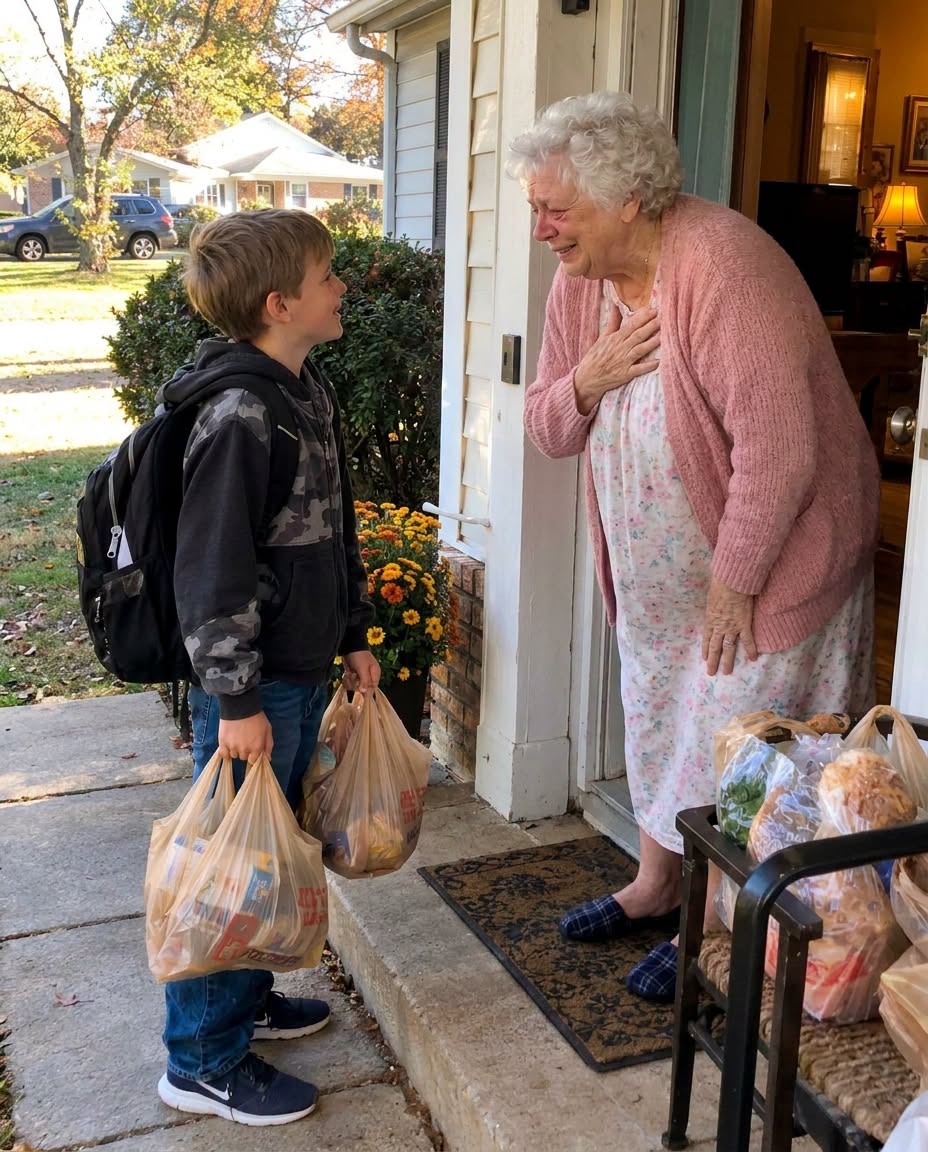
“Erin, your boy is all right, but you need to come outside,” my neighbor Ivy whispered through the phone, her voice breaking. I stood frozen in my kitchen, twenty minutes after my eleven-year-old son should have returned from his first walk home alone, listening to the rustle of October leaves beyond our window. When I ran onto the porch in the pink bunny slippers Joel had given me for Mother’s Day, I saw seventy-two-year-old Ivy Novak standing three houses down, wiping tears from her cheeks. She pointed toward the corner, where Joel stood with his backpack on both shoulders beside an elderly man wearing pajama pants, crushed-down slippers, and a faded orange crossing-guard vest. The man held a handmade cardboard stop sign high above his head, gripping Joel’s hand with his other hand and smiling as though he’d just completed the most important task of his life. I recognized him immediately as Ivy’s husband, Lou, who had spent twenty-two years guiding schoolchildren across a busy intersection before Alzheimer’s disease forced him to retire. He straightened his shoulders, lowered his little sign, and told me in the familiar voice I hadn’t heard for years, “Delivered him safe, ma’am.” Ivy began crying harder, because only moments earlier, her husband had called her by name for the first time in four months.
My name is Erin Matthews, and at forty-one I was the sort of mother who could imagine a dozen dangers in the six-tenths of a mile between our home in Clintonville, Ohio, and Whitman Elementary. I worked as a family-law paralegal in downtown Columbus, spending my days reading custody disputes and stories about children whose parents hadn’t protected them. My husband, Chris, was a firefighter at Station 14, working twenty-four-hour shifts that often left me managing the household alone. Joel, our only child, was bright, observant, and impatient to do things independently. He’d been asking since September to walk home with the other sixth graders rather than wait for me in the pickup line. The route was straightforward: sidewalks all the way, a traffic light at Elm and Fifth, and a crossing guard stationed there through the afternoon dismissal period. I’d walked it with him many times, yet for six years I’d driven him home regardless of the weather or how busy work became. Every afternoon, he repeated that the walk took only ten minutes and that his friends already managed it without trouble. I finally agreed to a Friday trial run, laying down rules about using the designated crossing, avoiding shortcuts, contacting me if anything seemed wrong, and texting as soon as school ended. At dinner the night before, Joel asked an odd question: if he encountered someone who was lost or confused, would he be allowed to help? I told him to call me or another trusted adult rather than put himself in danger. When he asked what if the person wasn’t a stranger, I brushed the question aside. That Friday afternoon, his message arrived at 3:11: On my way, followed by a thumbs-up. I was already home, having rearranged my schedule so I could be there when he arrived. I deliberately sat with my back to the window, determined to give him the independence I’d promised. Ten minutes passed, then fifteen, then twenty. I was reaching for my phone when Ivy called. Now, standing on the sidewalk beside Joel and Lou, I began to understand why my son had wanted that walk so badly. Lou Novak had once been one of the most familiar faces in our neighborhood. Before becoming a crossing guard, he’d carried mail through Clintonville for thirty-one years. After retiring from the postal service, he discovered he couldn’t bear being indoors all day and took a position at the intersection of Elm and Fifth. For twenty-two years, in rain, snow, and summer heat, he helped children cross safely, remembering their names and asking about their spelling tests. He kept butterscotch candies in his vest pocket and ended every crossing with the same cheerful assurance to the waiting parent: “Delivered safe.” Lou had guided Joel across that intersection when he was little, and I’d heard those words countless times while waiting with his stroller or standing on the opposite curb. Three years earlier, Lou began forgetting appointments, misplacing objects, and occasionally confusing familiar names. After an alarming incident in which he led children toward the road against the traffic signal, a medical evaluation resulted in a diagnosis of Alzheimer’s disease. He was no longer permitted to work as a crossing guard. Ivy kept his old vest, but watching someone else take his position devastated him. As the disease progressed, he grew disoriented and sometimes failed to recognize his own wife. Caring for him became increasingly demanding, and Ivy gradually withdrew from neighborhood gatherings and church. Our neighbors, including me, offered vague promises to help but seldom followed through. We told ourselves they needed privacy, when often the truth was that watching Lou decline made us uncomfortable. Yet while I was driving Joel home and answering work emails, my son had been watching the corner where Lou once stood. I learned that afternoon that Joel had noticed him there repeatedly during September, sometimes confused, sometimes without proper shoes, and sometimes being mocked by older children. Joel had tried to point him out during one drive, but I’d been distracted and told him to wait. He stopped trying to tell me and began keeping notes instead. By October, he’d decided he wanted to do something more than watch.
Ivy explained that Lou had slipped out of their house while she was showering, taking his old orange vest from the closet and wandering toward the intersection where he’d worked for decades. When she discovered the open front door, she searched the property, called out for him, and contacted police, terrified he might step into traffic. Joel had encountered him at Elm and Fifth shortly after leaving school. Lou stood at the curb in pajama pants and slippers, looking toward the crossing guard who’d replaced him. Some older students were laughing at his appearance, and one was filming him. According to Joel, Lou stepped toward the roadway as though he intended to stop traffic, even though the signal wasn’t in his favor. Joel called to him and caught his arm, pulling him back toward the sidewalk before an approaching truck passed. Shaken, Lou began asking repeatedly where his stop sign had gone. That’s when Joel reached into his backpack and produced a cardboard octagon painted red with the word STOP written across it in uneven white letters. He’d made it in art class two weeks earlier, attaching it to a yardstick and carrying it folded in his bag every school day. He’d seen how distressed Lou became standing empty-handed at the intersection and remembered Ivy once saying her husband had always been happiest when he had something useful to do. Joel gave him the sign and asked whether he could help him get home to Linden Avenue. Lou’s confusion seemed to ease when he recognized the familiar object. He raised it, stood straighter, and offered to accompany Joel, who guided their route along the sidewalks while Lou carefully watched the streets. They stopped beneath the large oak tree on Oakland Avenue, where Lou unexpectedly remembered Joel collecting acorns when he was younger. By the time they reached Ivy’s house, Lou appeared proud of having completed a task he understood. He greeted his wife by name and told her to put the coffee on because he was off duty, a phrase she hadn’t heard in years. When a police officer arrived in response to Ivy’s earlier call, Lou raised his homemade sign again and seemed to believe he was still helping children cross. The officer, Danny Holloway, approached gently and explained that Lou had once guided him to school too. Remarkably, Lou recalled a red-haired child who always lost his mittens, a memory Danny confirmed belonged to him. The officer helped Lou return home with Ivy, and Joel finally stood beside me, apologizing for being late and stopping instead of walking straight home. He showed me the folded notebook paper where he’d recorded sightings of Lou on five previous Mondays, including one occasion when the former crossing guard had stepped into the road and another when he appeared barefoot. Joel said he’d asked repeatedly to walk home because he hoped he’d have the chance to help Mr. Lou, who had once helped him every day. I knelt on the sidewalk and hugged him, overwhelmed by his thoughtfulness but also aware of the danger he’d faced near traffic. I told him I was proud he’d cared enough to intervene, while making clear that he should seek help from a crossing guard or other nearby adult rather than enter a dangerous roadway himself. That evening, Ivy sat on my porch for the first time in almost three years. She told me how lonely she’d become caring for a husband who sometimes didn’t know her name and how much it hurt to watch a once-active man apologize for needing assistance. For decades Lou had been the one who took care of others, first delivering their mail and then keeping their children safe. Losing that role had taken something essential from his daily life. Joel hadn’t reversed the Alzheimer’s disease or restored the independence Lou had lost, but for one afternoon he’d helped him feel useful again. As Ivy spoke, I remembered all the times I’d said I should visit and then let another week pass. I also realized that Lou’s repeated appearances at the intersection were a serious safety concern, not something we should treat as a harmless eccentricity. If Joel could recognize what the rest of us had overlooked, perhaps the adults on Linden Avenue could finally find a way to help Lou and Ivy without putting either of them in danger.