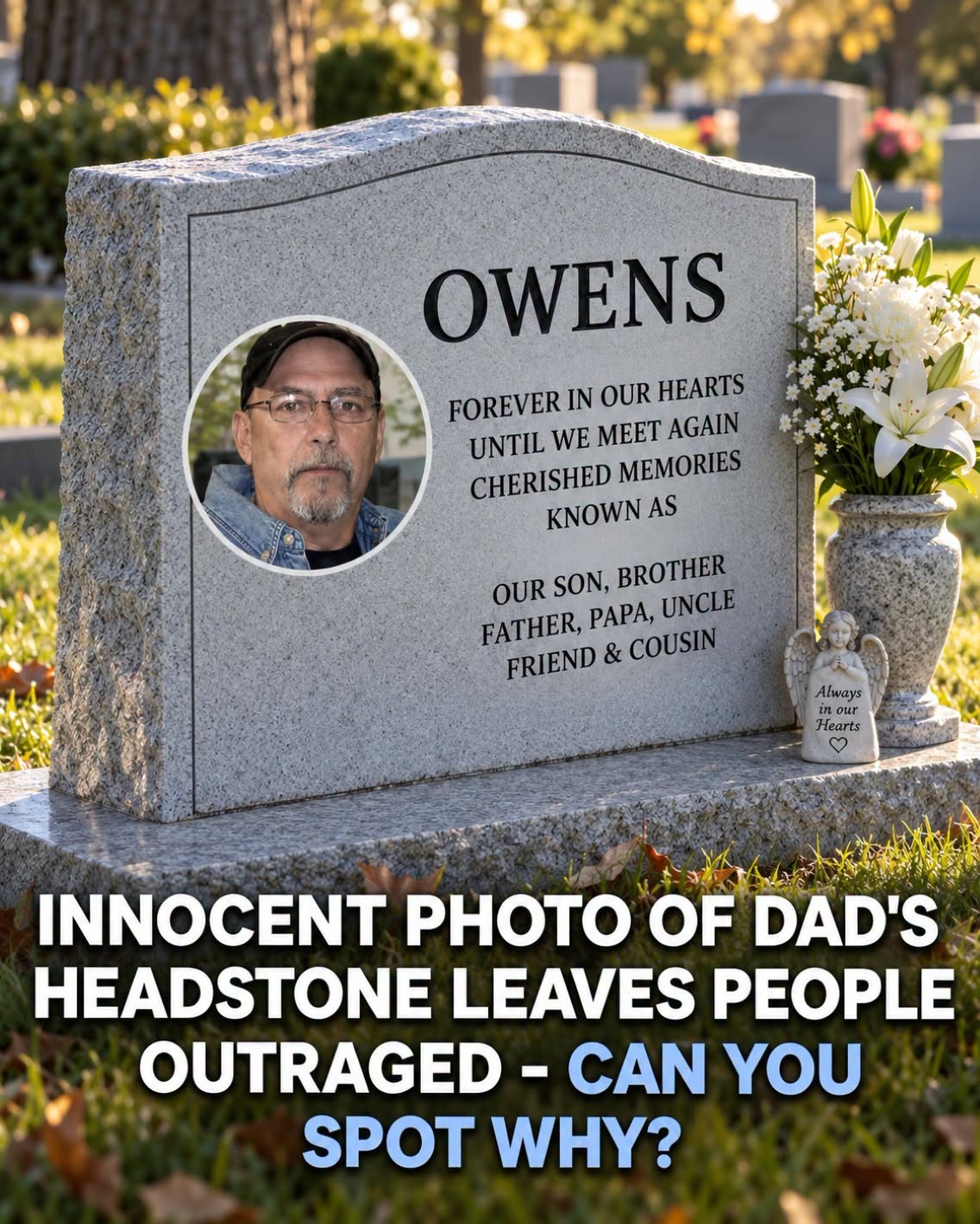
When my father died, my siblings and I wanted his memorial to reflect the man he truly was.
Not the serious businessman everyone remembered from photographs. Not the respectable gentleman who always wore a tie to family gatherings.
We wanted to remember the mischievous father who played practical jokes, laughed at inappropriate moments, and believed life was too short to take everything seriously.
That was why we agreed on an unusual inscription for his gravestone.
At first glance, it looked completely ordinary. His name, dates, and a few heartfelt lines honoring his life were carefully engraved into the granite.
But there was something else.
The first letter of each line, when read from top to bottom, formed a private joke containing profanity.
It was exactly the kind of thing Dad would have loved.
My brother Daniel laughed when he noticed the finished design.
“Dad would be laughing so hard right now,” he said.
For a few weeks, everything seemed peaceful.
Then the cemetery manager called.
He informed us that the memorial had become the subject of a formal complaint. Someone had discovered the hidden message and considered it inappropriate for a shared burial ground.
The cemetery trustees wanted the inscription changed.
My sister Emily immediately objected.
“You cannot erase part of his personality just because someone doesn’t appreciate his humor.”
I agreed.
We had not placed the message there to insult anyone. It was a private tribute to a man whose humor had carried our family through difficult years.
But the cemetery saw things differently.
The manager explained that the grounds were visited by families, children, and people grieving loved ones. Their responsibility was to maintain standards that applied equally to every memorial.
He also raised an important question.
Had the final design been formally approved before installation?
That question changed the entire conversation.
We had submitted the original wording, but nobody could immediately locate a document confirming that the hidden arrangement of letters had been reviewed.
The cemetery argued that approval of the visible inscription did not necessarily mean approval of a concealed message.
Daniel was furious.
“They accepted the stone. They took our money. Now they want us to pay again?”
Emily suggested contacting an attorney before agreeing to anything.
We gathered the purchase agreement, emails, design drafts, and payment records. Our lawyer explained that the answer would depend on the cemetery’s written regulations, the approval process, and the rights established in the agreement.
There was no guarantee that either side would prevail.
Meanwhile, the family became divided.
Some relatives believed we should fight to preserve the inscription exactly as Dad intended. Others worried that a prolonged dispute would turn his resting place into a public argument.
One afternoon, I returned to the cemetery alone.
I stood before the stone and read the ordinary inscription aloud.
It described a loving father, a devoted husband, and a man whose generosity had touched many lives.
Then I followed the first letters downward.
I smiled.
For a moment, I could almost hear his familiar laugh.
I realized that the hidden message was never really about shocking strangers. It was about preserving a small piece of the man we knew privately, beyond the polished image everyone else had seen.
Eventually, I proposed a compromise.
We could preserve the joke in a small engraved keepsake placed with the family, while keeping the main memorial within the cemetery’s written standards.
It would not be the exact outcome we originally wanted, but it would protect the memory without turning the cemetery into a battleground.
The trustees had not yet issued a final decision, and our attorney continued reviewing the documents.
Still, something important had changed.
We stopped arguing about who had the final word and began asking what Dad would have wanted us to do.
He had always told us that family mattered more than winning an argument.
As I left the cemetery, I looked back at his stone.
The inscription might eventually change, but the memories behind it would not.
And perhaps that was the real lesson hidden in the message all along: a person’s legacy is not defined by a few carved words, but by the laughter, love, and stories that remain after they are gone.