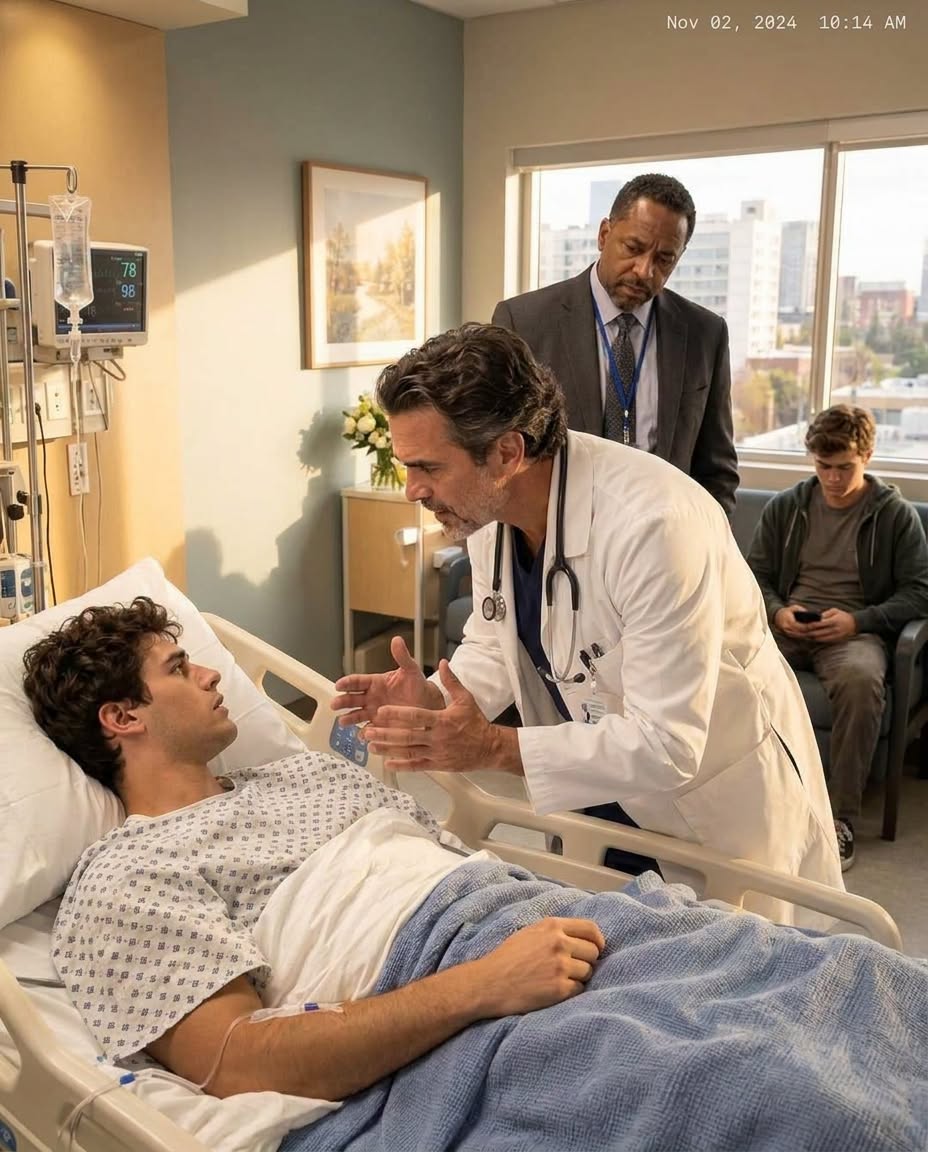
“Dad, they think I’m faking it.” My son’s voice came through the phone at 3:47 in the morning, thin with pain and humiliation. Ethan was twenty-two, three hours away at Mercy General, with worsening right-sided abdominal pain, vomiting, fever, and a doctor preparing to discharge him after giving little more than Tylenol. I was Chief of Surgery at another hospital, but in that moment I was simply a father listening to symptoms that sounded dangerously like acute appendicitis. Ethan told me the physician had focused on his tattoos, piercings, and whether he had ever used opioids rather than on the progression of his pain. I told him not to leave. Then I drove through freezing rain knowing that if the diagnosis was what I feared, every hour mattered.
By the time I reached Mercy, Ethan was febrile, tachycardic, pale, and guarding his abdomen. The charge nurse quietly told me she had asked the attending, Dr. Leonard Vance, to reassess him more than once and had been dismissed. A careful examination showed pronounced tenderness and rebound, findings that should have triggered further evaluation regardless of who the patient was or how he looked. When I confronted Vance, he defended his earlier assessment by saying Ethan had seemed focused on pain medication and had presented with what he considered vague complaints. I did not threaten him or announce a diagnosis from the hallway. I asked for immediate surgical evaluation, labs, imaging, and review by his department leadership. Another surgeon examined Ethan properly and ordered a CT. The scan showed the outcome everyone had been trying not to imagine: a ruptured appendix with contamination and early peritonitis.
Ethan went to surgery immediately. The operation controlled the perforation, washed out the contamination, and began the harder work of preventing sepsis, but the surgeon later documented that the timing of the rupture was consistent with a delay during the hours Ethan had been waiting untreated. That documentation mattered. So did the nurses’ notes recording abnormal vital signs, escalating pain, and repeated requests for reassessment. Ethan recovered, but what stayed with him was not only the incision or the hospital stay. He kept repeating that after being told for hours he was exaggerating, he had started wondering whether he really was. That was the moment the case became larger than one missed diagnosis. A patient had learned to distrust his own body because a physician had decided what kind of person he was before deciding what kind of illness he might have.
We pursued the matter through the channels designed for exactly that purpose: complete medical-record requests, hospital peer review, a formal complaint to the medical board, and independent legal evaluation of whether the delay breached the standard of care and caused additional harm. Internal review uncovered other complaints involving patients whose symptoms had allegedly been minimized, although each case required its own evidence and could not simply be treated as proof of misconduct. Mercy placed Vance on leave during the review, and the board later examined the charting, nursing testimony, operative findings, and his clinical reasoning. The civil case proceeded separately, with questions of negligence, causation, damages, and institutional responsibility handled through counsel rather than public outrage alone. Whatever discipline followed would belong to the licensing authorities after due process. What I cared about most was that Ethan’s case could no longer be dismissed as an unfortunate misunderstanding.
Months later, Ethan and I began helping patients understand how to request records, ask for second opinions, document worsening symptoms, and use hospital advocacy and complaint systems when they felt unheard. He finished his degree and eventually worked with young people who had learned, as he had, how intimidating medical systems can become when nobody believes you. Years after that night, he told me about a teenager whose family had used one of our resources to push for further evaluation after chest pain was initially attributed to anxiety. The details were different, but the lesson was familiar: listening carefully can change what happens next. I still think about that 3:47 a.m. call and the terrible advantage Ethan had because his father knew the language of the system. What stayed with me was not that my title helped save my son. It was the question of what happens to the patient whose father has no title at all.