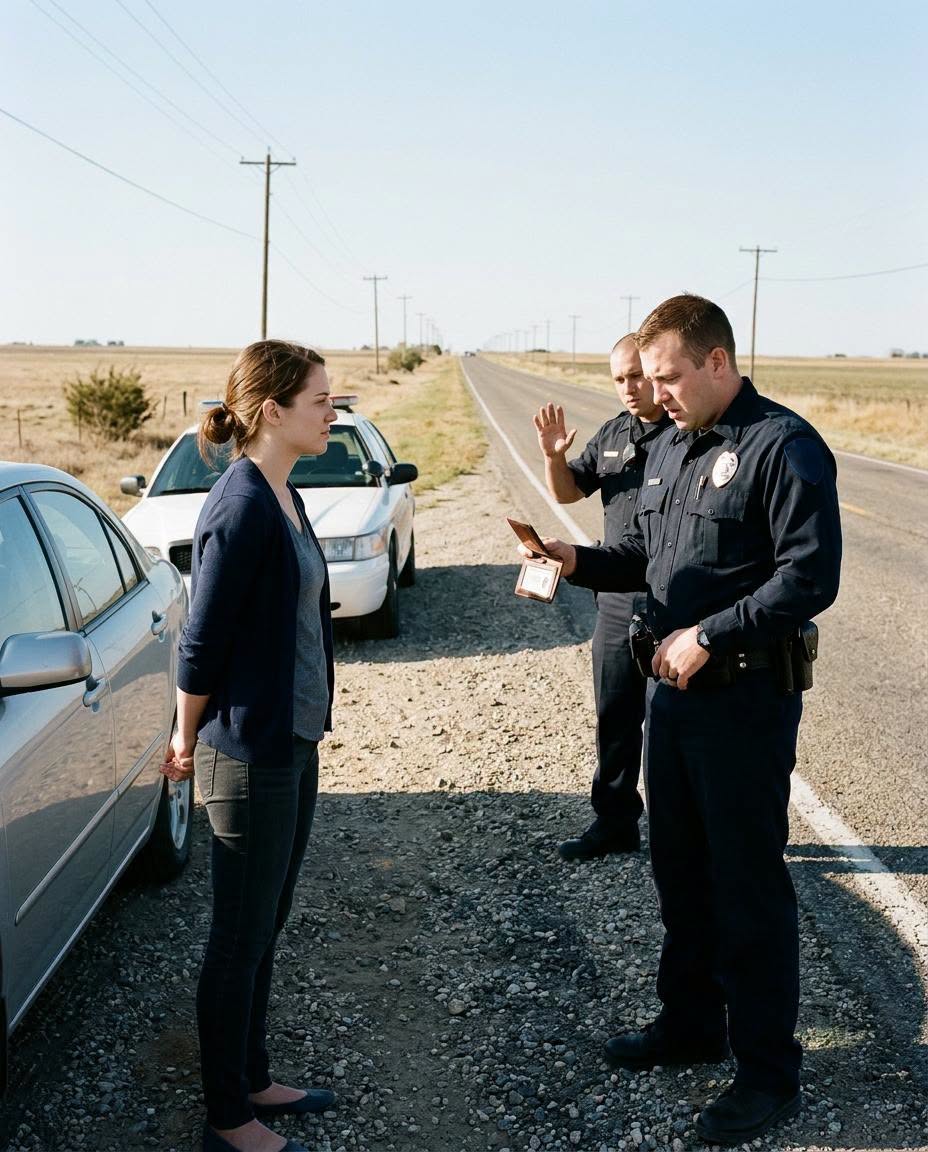
Victoria was driving home on a quiet rural highway one afternoon.
Under the limit. Indicating. Watching her mirrors.
The sun was out, there was almost nothing else on the road, and it was as ordinary a drive as a person can have.
A few miles in she noticed a patrol car behind her. A minute later the lights went on and they waved her onto the shoulder.
She pulled over at once, switched off the engine, and lowered her window.
A broad-shouldered officer with a hard face walked up to the car. His partner stayed a few feet back, watching her.
“Licence and registration. Now.”
She handed them over.
He looked at them for a long time. He walked all the way around the car. He came back to the window.
He had found nothing. He kept her documents anyway.
“Officer, could you tell me why I’ve been stopped?”
“Routine traffic check.”
“Checking for what? I haven’t done anything wrong, and neither of you has told me your name.”
His jaw tightened. He had clearly expected her to sit there and say nothing.
“Oh, we’ve got a smart one,” said the partner, coming up. “Close your mouth and do what you’re told when an officer’s talking to you.”
Victoria looked from one to the other.
“I am doing what I’m told. But you’re being rude to me and you won’t tell me why I’m here. I’d like your identification and a lawful reason for this stop.”
The first officer slapped her documents down on the roof of the car.
“Out of the vehicle.”
“Why?”
“Because I said so.”
She understood exactly what was happening. She reached for her phone to record it.
The partner yanked the driver’s door open and took her by the arm.
“Put the phone down. Right now.”
“Let go of my arm. You have no right to do this.”
That made it worse.
The first officer pulled her out of the seat, turned her round, and pushed her against the side of the car. His partner took her wrists, twisted them behind her and cuffed them.
“Maybe a trip to the station’ll teach you some manners,” he said while he did it.
Victoria did not scream. She did not struggle.
She turned her head slightly and looked at both of them, steadily.
“Have you thought carefully about what you’re doing?”
The first one laughed.
“What’s that, a threat? You threatening police officers now?”
“No. I’m pointing out that you stopped me without a reason, you used force on me, and you’ve detained me without filling in a single piece of paper.”
“Paperwork can wait,” he said. “Station first.”
She was quiet for a few seconds.
Then she said, in an unusually calm voice:
“Fine. But before we go, would you take something out of the right pocket of my shorts? My hands are behind my back. I can’t reach it.”
They looked at each other. One of them smirked. He thought she was trying something.
“And what’s in your pocket?”
“Take it out and you’ll understand.”
The first officer reached into her pocket.
It was a small black leather wallet, folded shut.
He opened it.
On one side was a gold shield. On the other was a photo identification card for Lieutenant Victoria Achebe-Strand, Office of Professional Standards, State Police.
Internal affairs.
The officer holding it did not say anything for about five seconds.
His partner said, quietly: “Uncuff her.”
And she said: “No. Leave them on. Call it in exactly as it is.”
Here is what neither of them knew.
She was not driving home.
That stretch of road — nine miles of two-lane highway between two small towns — had produced fourteen complaints in eleven months.
Every single one from a woman. Every single one driving alone. Every single one under thirty. Every single one describing a stop with no reason given, a refusal to give names, and an escalation the moment she asked a question.
And every single one closed, because it was one young woman’s word against two officers, and there was never any footage.Support Causes
Victoria had driven that road eleven times in five weeks, in her own car, in civilian clothes, at the times of day the complaints described.
This was the first time they had stopped her.
And here is the detail that decided everything that came after.
One of those two officers had his body camera switched off.
The other one did not know his was on.
It had been running since the moment he got out of the patrol car. It caught every word — the refusal to give a reason, the refusal to give names, the documents slammed on the roof, the phone, the arm, the cuffs, and the line about teaching her manners.
Both officers were suspended that evening. Both were dismissed in the March.
The one whose camera was off was also charged, because switching it off during a stop is a separate offence in that state, and because it turned out he had done it on nine of the previous fourteen dates.
All fourteen complaints were reopened.
Victoria rang every one of those women herself.
One of them cried for most of the call. One of them said she had moved house to get off that road. One of them had stopped driving altogether and had not told anybody why, including her husband.
Several of them are now part of a civil action against the county, and it is still going.
And now the part that people argue about, and it is a real argument.
Victoria could have ended that stop in the first ten seconds.
The credential was in her pocket the whole time. She could have shown it at the window. Nobody would ever have touched her.
She chose not to. She let two men take her out of a car and push her against it and put her in handcuffs, because she needed them to do on camera exactly what fourteen women said they had done off it.
She asked fair questions. She never raised her voice. She did nothing those fourteen women had not done.
But she knew what was coming, and she let it come.
Half the people who hear this say that is the only way it was ever going to be proved, and that eleven months of closed complaints is what happens when you wait for footage that is never switched on.
The other half say she walked into it on purpose, and that a stop you set up is not the same thing as a stop that happens to you — and that the next officer accused this way will point at her and say so.
She has heard both. She was asked at the hearing whether she had provoked them.
She said: “I asked for a reason and a name. If that is provocation, then all fourteen of them provoked it too.”
She still drives that road. Not for work. It is the quickest way home.