My name is Rick Dalton, and for most of my life, I’ve believed that hard work deserves respect.
My father, Jack, taught me that lesson.
He spent fifty years working at a GM factory. He wasn’t a wealthy man, and he never cared much about expensive clothes or impressive titles. He was simply the kind of person who showed up whenever someone needed help.
If a neighbor’s furnace broke, Dad came.
If someone’s lawn mower stopped working, Dad fixed it.
If something in my house needed repairing, he was usually the first person I called.
To me, the faint smell of motor oil that followed him around was never unpleasant.
It smelled like my childhood.
But my wife, Karen, came from a very different family.
Her parents were wealthy and deeply concerned with appearances. They dressed carefully, spoke carefully, and seemed to believe that certain people simply belonged in certain rooms.
For years, I tried to keep the peace.
Then came Thanksgiving.
That morning, I called Dad to tell him I was coming to pick him up.
Instead, he quietly told me he wasn’t coming.
“Karen called last night,” he said. “She said it would be a small dinner and she didn’t want me feeling crowded.”
I immediately knew something was wrong.
Dad wasn’t uncomfortable around people. He had spent fifty years working with hundreds of them.
So I asked Karen what had happened.
She didn’t even look guilty.
“Rick, your father smells like an old garage,” she said. “My mother notices things like that. I don’t want to spend Thanksgiving worrying about it.”
I stared at her.
My father had helped us countless times.
He had driven nearly an hour in the middle of winter once just to repair our broken furnace.
Nobody complained about the smell then.
I finally understood.
This wasn’t really about the garage.
It was about status.
My father wasn’t considered good enough to sit at the same Thanksgiving table as her parents.
So I made a decision.
“If Dad isn’t welcome,” I told her, “then I’m not having Thanksgiving here.”
Karen thought I was bluffing.
I wasn’t.
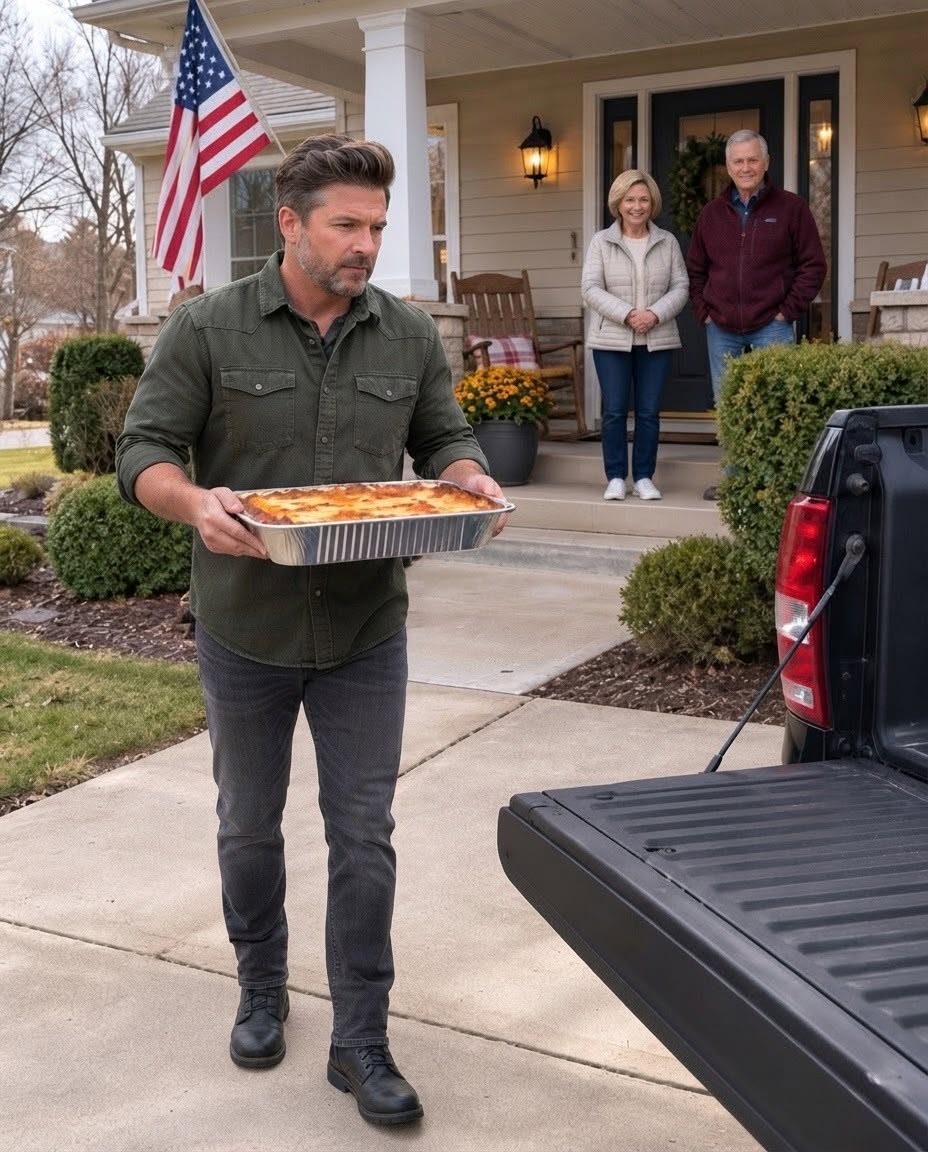
I packed the turkey, sweet potatoes, green beans, rolls, and pumpkin pie into containers and carried everything to my truck.
Then I drove to Dad’s house.
When he opened the door and saw all the food, he looked confused.
“Happy Thanksgiving, Dad,” I said.
He smiled.
We ate together at the small kitchen table he had built decades earlier.
We watched football, drank coffee, and talked about ordinary things.
For the first time that day, Thanksgiving felt peaceful.
Later, Dad looked at me and said, “You didn’t have to do this.”
“Yes, I did,” I answered.
“You’re my wife,” I said, “but you’re my father. I should have defended you years ago.”
When I returned home that evening, Karen was sitting alone.
Her parents had already left.
The beautiful dining table was still set, with untouched plates and crystal glasses.
We talked for a long time.
I told her that my father wasn’t something to be hidden whenever her parents visited.
He had spent his entire life working with his hands, helping people, and showing up when others needed him.
That deserved respect.
A few days later, Karen asked if she could come with me to Dad’s house.
I agreed.
She spent the afternoon in his garage while he worked on an old truck. She asked questions, listened, and slowly began seeing the person behind the work clothes and motor-oil smell.
Things didn’t magically change overnight.
But something had changed.
Months later, Dad came to another family dinner.
This time, nobody questioned whether he belonged.
He sat beside Karen’s father, and somehow the two of them ended up talking about old trucks and baseball.
They had apparently had things in common all along.
That night, I realized something.
My father had spent fifty years building a reputation as the man who always showed up.
The least I could do was make sure he always had a place at my table.
Because sometimes, the people who smell like hard work are the very people who taught us what it means to work, love, and show up for others.