“Mom, I need the keys,” my son said, holding out his hand across my birthday cake as though I were a child refusing to surrender something dangerous. We were sitting in a Wisconsin supper club, surrounded by the smell of roast beef, fresh coffee, and the relish trays that appeared on every table. My daughter-in-law, Kim, stared into her coffee cup while Brian explained that my 2005 Buick LeSabre had already been sold to a man from Janesville for $4,200. Outside, the last of the May daylight glowed through the windows, and I could hear the Schmidts laughing with their grandchildren two tables away. It was my seventy-sixth birthday, and I had driven safely for fifty-eight years, yet my son had decided that clipping a neighbor’s mailbox in a rainstorm meant I could no longer be trusted behind the wheel. He placed a cashier’s check beside my cake and told me he’d done it for my own good, his voice steady even though the hand he’d extended toward me was trembling. I could have raised my voice, demanded an explanation, or embarrassed him in front of everyone, but I had spent thirty-one years working a telephone switchboard and knew when a person had already decided not to listen. Instead, I surrendered the keys, asked Kim to cut the cake, and went home to make a plan that would leave my son staring through his office window the very next morning.
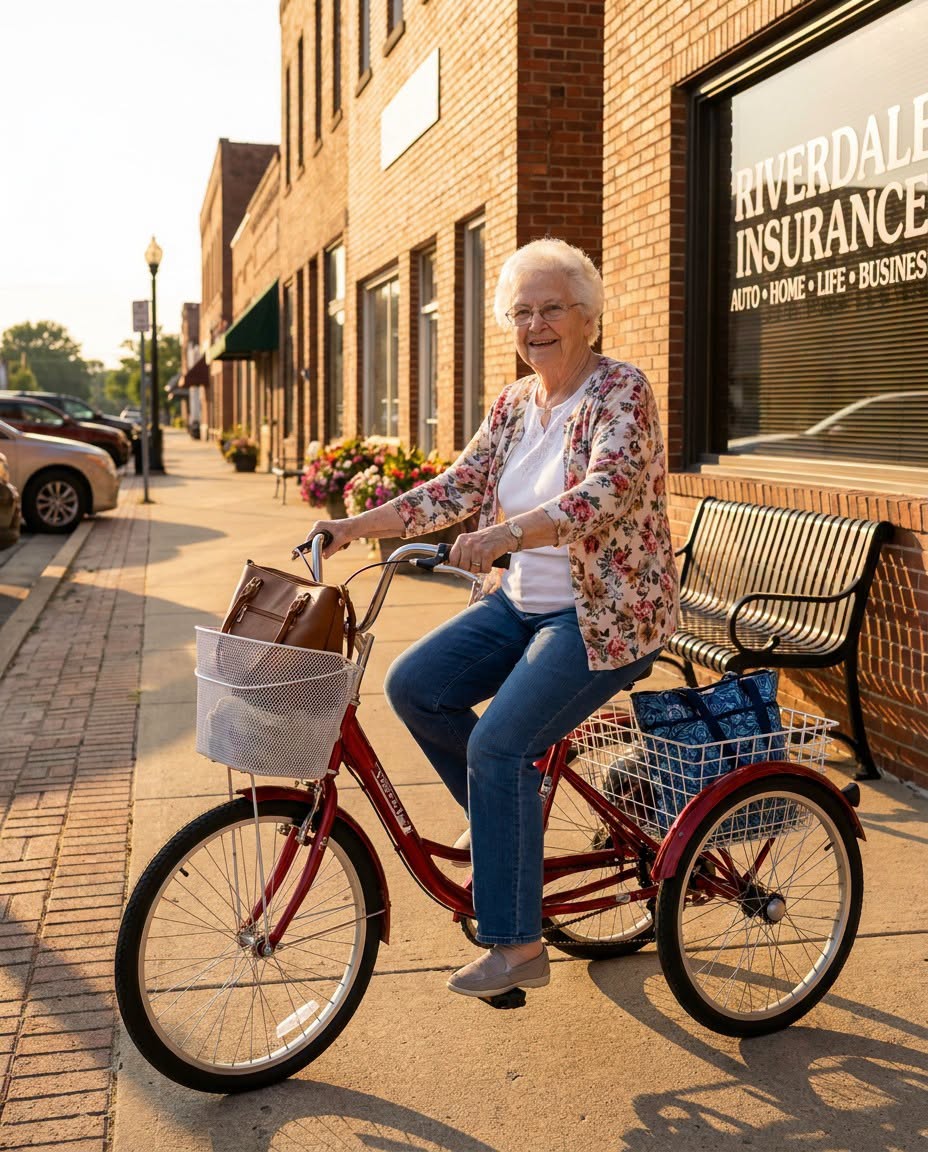
My name is Dorothy Hale, and before that birthday dinner I’d never seriously considered that my independence could disappear because someone who loved me became frightened. My husband, Walter, had died eleven years earlier, leaving me alone in the little Wisconsin town where we’d raised our son and built a life together. The Buick was a tan 2005 LeSabre with only 71,000 miles, a broad comfortable seat, and the familiar smell of an old car that had been carefully maintained. Walter had chosen it himself at the dealership, driven it for ten years, and left it to me when he died. I kept a roll of his wintergreen mints in the center console, hard as buttons by then, because I couldn’t bear to throw away something he’d handled so often. After the funeral, Brian had helped organize our affairs. He put his name alongside mine on the bank accounts, house documents, and vehicle title, explaining that it would make everything simpler when my own time came. I trusted him and appreciated his attention to details I wasn’t eager to face while grieving. What I didn’t fully understand was the importance of the word “or” on the Buick’s certificate of title. The ownership record listed Dorothy Hale or Brian Hale, rather than requiring both our signatures for a transfer. Under the rules governing that particular title, either named owner could sign the vehicle over, and Brian had used that authority to sell my car without consulting me. Two weeks earlier, I’d clipped the Hendersons’ mailbox while maneuvering around a delivery truck in heavy rain. The fender struck the post, leaving the mailbox leaning sideways. I apologized, bought a replacement for thirty-eight dollars, and stood outside while Jeff Henderson installed it. He told me not to worry, and the matter was settled. I called Brian myself afterward because I had never hidden anything from him. He heard about the incident and apparently began imagining every possible disaster that could follow. Instead of asking whether I was hurt, whether the weather had contributed, or whether my driving needed to be evaluated, he arranged to sell the Buick. The buyer came to my house while I was at my birthday dinner, and Kim let him into the carport with the spare key. When Brian told me what he’d done, I watched him carefully. He was fifty years old, an insurance agent who ran Hale Insurance from a storefront on Main Street, and a conscientious man who took his responsibilities seriously. I could see he was afraid, although I didn’t yet know exactly what frightened him. At the supper club, I refused to give him the argument he seemed to expect. I handed over the keys and accepted the envelope. Brian drove me home in his truck, promising he’d take me anywhere I needed to go: church, the grocery store, the doctor, or any appointment I couldn’t reach myself. He said I could telephone his office and Mandy, his receptionist, would find him immediately. I believed he meant it. But when we pulled into my driveway and I saw the empty carport, with only the familiar oil stain on the concrete where Walter’s Buick had stood, I felt something settle heavily inside me. Brian hadn’t merely removed a means of transportation. He had made a decision about my abilities without asking anyone qualified to evaluate them, and he’d done it while I was celebrating another year of being alive. I thanked him for driving me home and closed the door quietly behind him. Then I sat at my kitchen table with the cashier’s check and considered my options. I had enough savings to purchase another car, but I knew that would turn the matter into an ongoing contest between my son and me. Every small driving mistake would be treated as proof he’d been right, and every objection I made would be dismissed as stubbornness. I needed to show him that my judgment still mattered, not simply replace the car he’d taken. At 8:15 that evening, I telephoned my friend Wilma, a seventy-eight-year-old widow who’d sat beside me at First Lutheran Church since 1974. I told her what had happened and asked whether she could collect me at nine the next morning. She immediately assumed I wanted to visit an attorney. I told her I needed a ride to the bicycle shop at the old railroad depot, and after a long silence she promised to arrive ten minutes early. The shop was run by a young man named Eli, who greeted us warmly and listened when I asked about a red three-wheeled bicycle I’d seen displayed in his window the previous Christmas. He brought it from the back room: bright red, with a broad seat, three gears, sturdy fenders, a chain guard, and a wire basket between the rear wheels large enough for several bags of groceries. I hadn’t ridden a bicycle since President Kennedy was in office, but Eli didn’t laugh or suggest the machine was too ambitious for a woman my age. He adjusted the seat and explained that a tricycle handled differently from the two-wheeled bicycles I remembered. On a regular bicycle, riders lean into turns; on a tricycle, leaning can lift a wheel and cause a tip, so he told me to sit upright and steer as though pushing a shopping cart. We went to the gravel lot behind the depot, where he walked beside me while I made several circuits. I leaned during my first turn, felt one wheel lift, and immediately corrected myself. By the fourth lap, I could steer comfortably without thinking about it. The tricycle cost $389, or $410.40 including tax, and I paid with a check drawn from the money Brian had given me. Before I left, Eli attached a shiny chrome bell to the handlebar. Wilma had mentioned my birthday while I was practicing, and he insisted the bell was a gift. Its clear little ring almost brought me to tears. Then I buttoned my cardigan, placed my purse in the rear basket, and began the two-mile trip toward Main Street with Wilma following slowly in her Ford, hazard lights flashing. The fresh air touched my face in a way it never had through a car window. I smelled new grass, damp fields, and someone’s breakfast cooking as I pedaled along the rail trail. My legs protested during the first half mile, then settled into a rhythm. By the time I turned onto Depot Street, I was smiling. When I reached Hale Insurance, I rolled the red tricycle to a stop directly outside Brian’s front window. Mandy rose from her desk in astonishment, and Brian appeared from the back office to see what had caught her attention. The color drained from his face when he recognized me. He rushed outside, alarmed that I’d ridden through town, and warned that trucks and traffic could have killed me. I told him I had used the trail for most of the journey and that Wilma had followed to make sure I was safe. Then I asked him one question: before deciding I was no longer fit to drive, had he consulted my doctor, my eye specialist, or a professional driving instructor? Had he even ridden with me to see how I handled a vehicle? After a long silence, he admitted he hadn’t. I asked what evidence he’d relied upon, but before he could answer, Mandy signaled that a client was waiting on the telephone. Brian returned to his office, and I rode to the Piggly Wiggly, bought milk, bread, butter, and a small ham, and carried everything home in my basket.Bank account protection
By Wednesday, nearly everyone in our town of four thousand had heard about the old woman who rode a bright red tricycle to her son’s insurance office the morning after he sold her Buick. I went to the library, the bank, and church, where women from my prayer circle came outside to inspect the basket and ring the bell. Several asked whether they could try sitting on it. On Thursday, I rode toward the cemetery where Walter was buried, pushing the tricycle up the steepest part of the hill and resting beside his headstone. I told him about the Buick and admitted I couldn’t understand why Brian had acted so suddenly. Our son was behaving less like a bossy middle-aged man than someone desperately trying to prevent something he couldn’t name. The following week, Wilma bought a tricycle of her own. She first found a blue one at a rummage sale, but the frame was too tall and made her knees rise uncomfortably high, so she purchased a properly fitted green model from Eli and kept the blue one in her garage for visitors. Then Shirley, an eighty-one-year-old widow who had voluntarily given up driving two winters earlier, bought one. She’d grown weary of waiting for her daughter’s free Saturdays to run errands or visit the cemetery. Donna joined us too, and Eli began selling more adult tricycles than he had in years. Wilma named our little group the Wednesday Riders and established a weekly route from my carport to the library, the grocery store, and the Dairy Queen. We traveled slowly, used quiet streets and the trail where possible, and walked our bicycles whenever a hill was too steep. On our second Wednesday together, Shirley asked whether we could include the cemetery. We pushed our tricycles up the hill and waited at the gate while she carried a pot of red geraniums to her husband’s grave. She’d never visited him on her own since surrendering her car keys. When she returned twenty minutes later, her cheeks were damp, but she was smiling. She asked who was buying ice cream, and we went on with our morning. I began to understand that the tricycle represented more than a way to carry groceries. For women who had spent years depending on relatives for transportation, even a slow, carefully chosen route through town could restore the simple pleasure of deciding when to go somewhere. Brian continued calling every evening at six and came each Saturday to mow my lawn, just as he’d done since Walter’s death. He offered rides I didn’t need and avoided looking directly at the red tricycle parked where the Buick used to stand. But I noticed how exhausted he appeared, and one evening Kim telephoned to tell me he’d been waking around four every morning, unable to sleep. She admitted she’d advised him to discuss his concerns with me before selling the car, but he’d been determined to act. The more I thought about it, the less I believed his behavior was merely an attempt to control me. I decided that if Brian refused to explain his fear, I would obtain an independent assessment of my driving and let the evidence speak for itself. I made a long appointment with Dr. Keller, who’d cared for me for twenty-two years, and asked him to examine me thoroughly for conditions that might affect my ability to operate a vehicle safely. He evaluated my balance, mobility, reflexes, memory, and thinking skills. I completed a brief cognitive screening, drew a clock face, recalled words, and performed calculations while he observed. He found no medical condition that would presently prevent me from driving and put his findings in writing, although we both understood that an office examination couldn’t measure every skill required behind the wheel. The following week, my eye doctor tested my distance vision, peripheral awareness, and response to glare. With my glasses, I measured 20/25 in both eyes, and she documented the results. Finally, I paid eighty-five dollars for a practical driving assessment with Gus, a retired shop teacher who taught at the county driving school. We used a dual-control vehicle equipped with an instructor’s brake, and he guided me through town, around the courthouse square, onto the highway, and into a parallel-parking space. He never needed to use his brake, and his written evaluation noted that I checked my mirrors consistently and handled the route competently. My driver’s license was still valid; no licensing authority had suspended or revoked it. Brian had sold my car, not removed my legal ability to drive. I assembled the medical letters, vision results, and practical assessment into a folder and rode to his office on the last Tuesday in June. Mandy was unlocking the front door when I arrived. She told me Brian had been coming in before six every morning since the mailbox incident, sometimes sitting alone in his dark office before anyone else arrived. I found him at his desk with an untouched cup of coffee and a photograph of him and Walter holding a stringer of bluegills when Brian was twelve. I placed the folder in front of him and waited. He read every page carefully, then read them again. When he reached the driving instructor’s report, he covered his face with his hands, and his shoulders began to shake. I hadn’t seen my son cry like that since he was a child. I closed the office door, stood beside him, and gently rested my hand on the thinning hair at the back of his head. When he could finally speak, he told me what had happened eleven years earlier, the Sunday before Walter died. Brian had ridden with his father to look at a boat near the Millers’ property. During the four-mile drive, Walter drifted across the center line twice. The second time, an approaching milk truck was close enough that Brian grabbed the steering wheel. Walter laughed it off, saying the road must have moved. Brian had intended to tell me about the incident and suggest his father have his eyesight checked, but he decided to wait until after Thanksgiving rather than upset the family. Walter died on November nineteenth, driving to the cheese plant where he’d supervised maintenance for thirty-four years. His car slid off a curve on County N, near the Miller farm. Because I was helping at a church bazaar and couldn’t be reached immediately, the deputy sheriff telephoned Brian first. Our son drove to the scene and saw his father’s damaged car before the recovery crew had finished their work. He’d never told me that. For eleven years, he carried the belief that his silence about Walter’s driving had contributed to his death. When I mentioned the mailbox incident, the memory returned so violently that Brian couldn’t bear the possibility of receiving another telephone call about a family member killed on the road. Instead of asking for an assessment, he decided that removing the Buick would eliminate the risk before I could persuade him otherwise. I listened while he cried, then told him something I had known for years. The deputy’s accident report described black ice on that curve near the creek, and another driver had gone off the same stretch of road shortly before Walter’s crash. Investigators had identified the dangerous road conditions as a major factor. Walter’s eyesight might still have needed examination, but there was no sound basis for concluding that Brian’s failure to speak caused the accident. I told him he didn’t have to carry that guilt alone, and he couldn’t protect me by taking away my ability to make ordinary decisions about my own life. Fear had convinced him that if he controlled enough circumstances, nothing terrible could happen again. But he’d spent weeks sleeping badly even after the Buick was sold. I reminded him that caring for someone doesn’t automatically give us the right to make decisions without consulting them. He apologized, then offered to telephone the buyer and buy back the car. The man from Janesville answered and explained that he’d purchased the Buick for his granddaughter, who would soon begin college in Platteville. She’d already named the car Walter and had found the old wintergreen mints in the console, still wrapped with a note I’d once written asking that they not be discarded. The young woman had left them exactly where they were. Hearing that, I realized I could let the Buick go. It would carry another generation into a new stage of life, still bearing Walter’s name and a small remnant of his habits. I told the buyer to remind his granddaughter to warm the engine properly on cold winter mornings and to leave the mints where they belonged. Then I stopped Brian from offering more money. The Buick was gone, but our relationship didn’t need to remain damaged.Bank account protection