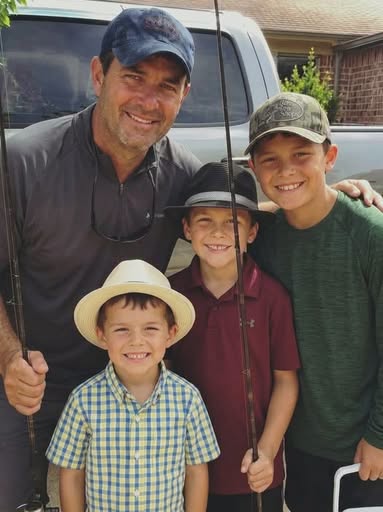
Six years ago, my husband left our house with our three sons for what was supposed to be an ordinary fishing trip.
None of them came home.
For years, I was told it had been a terrible accident. Their boat had gone down, the evidence was inconclusive, and eventually the investigation was closed. I had no choice but to live with the unanswered questions.
But six years later, my daughter opened an old drawer and found something I never expected to see again.
It was her father’s phone.
The screen was cracked, the battery was completely dead, and it had been hidden beneath a stack of old clothes. She found an old cable and managed to charge it.
Then she discovered a video.
She brought the phone into the kitchen and placed it in front of me.
“I wasn’t going to watch this alone,” she whispered.
I knew immediately that something was wrong.
We pressed play.
The video had been recorded at 11:47 p.m., the night before the fishing trip.
My husband, Daniel, was sitting inside his truck. The light above him was on, and he looked exhausted. He wasn’t smiling. He wasn’t relaxed.
He looked like a man who had discovered something frightening.
“Alison,” he said, looking directly into the camera. “If you’re watching this, something went wrong.”
My hands began shaking.
Daniel explained that several weeks earlier, he had contacted an insurance agent about refinancing the boat insurance. That’s when he discovered that the policy had been changed without his permission.
The coverage had been increased dramatically.
An accidental death rider had also been added.
And according to the insurance agent, the request had come from Daniel’s own brother, Dean.
Daniel said he hadn’t confronted him.
Instead, he started investigating quietly.
Then he found something even worse.
Dean had taken out a separate life insurance policy on Daniel for $750,000.
Daniel’s signature had been forged.
And Dean was listed as the sole beneficiary.
I covered my mouth as I watched.
But Daniel wasn’t finished.
He explained that he had also discovered something wrong with the boat.
While inspecting it before the fishing trip, he had noticed that part of the drain plug housing appeared to have been tampered with. Someone had loosened it in a way that could make it look like an ordinary mechanical failure.
Daniel believed his brother was planning to kill him.
And he believed the fishing trip was going to be part of the plan.
Then he said something that broke my heart.
He told us he had repaired the damaged part and reinforced the boat.
He was still going fishing with our boys.
He believed he had discovered the danger in time.
“If something happens to me — and to our boys — it wasn’t an accident,” he said.
Then he looked directly at the camera.
“It was Dean.”
The video ended.
For several minutes, neither my daughter nor I spoke.
I thought about the last six years.
Dean had been there through all of it.
He had comforted me after Daniel disappeared. He had helped around the house. He had brought groceries. He had told my daughters that their father would want them to move forward.
He had repeatedly told me that I needed to stop asking questions.
Now I realized something terrifying.
He hadn’t been helping me move on.
He had been controlling the story.
I immediately called Detective Rosa Chen, the detective who had worked on the original disappearance.
When she arrived, she watched the video twice.
Then she made two phone calls.
Within days, the investigation was reopened.
The phone was sent to a forensic laboratory, where investigators confirmed that the video was authentic. The timestamp was verified, and there was no evidence that it had been edited.
The investigators also examined the insurance policy Daniel had mentioned.
It was real.
Dean had taken out the $750,000 policy and had eventually collected the money after Daniel was legally presumed dead.
But that wasn’t the only discovery.
Investigators began reviewing Dean’s finances.
They found that he had spent hundreds of thousands of dollars during the six years following the disappearance.
He had purchased property.
He had bought a vehicle.
He had made large cash withdrawals.
And all the while, he had continued visiting my home.
Detective Chen also reopened the investigation into the boat.
The original evidence had suggested a high-speed impact and hull failure.
But now investigators had a different theory.
A marine forensic engineer discovered tool marks indicating that the drain plug housing had been deliberately loosened at two separate points.
Daniel had repaired one.
The second had been hidden beneath a rubber gasket.
He hadn’t seen it.
That meant Daniel had done everything he could to protect himself and his sons.
But someone had made sure it wasn’t enough.
Months later, Dean was arrested.
He didn’t run.
According to Detective Chen, when officers approached him at a gas station, he simply put the fuel nozzle back and said, “I figured this was coming.”
He was charged with multiple counts of murder, along with insurance fraud, forgery, and obstruction of justice.
The trial lasted months.
Dean’s attorney argued that the evidence was circumstantial. They questioned Daniel’s video and suggested that his suspicions could not prove what actually happened.
But the prosecution had the insurance documents.
They had the financial records.
They had the forensic examination of the boat.
And they had Daniel’s own recording.
Eventually, Dean was convicted.
I was sitting in the courtroom when the verdict was announced.
I expected to feel relief.
Instead, I felt exhausted.
For six years, I had carried