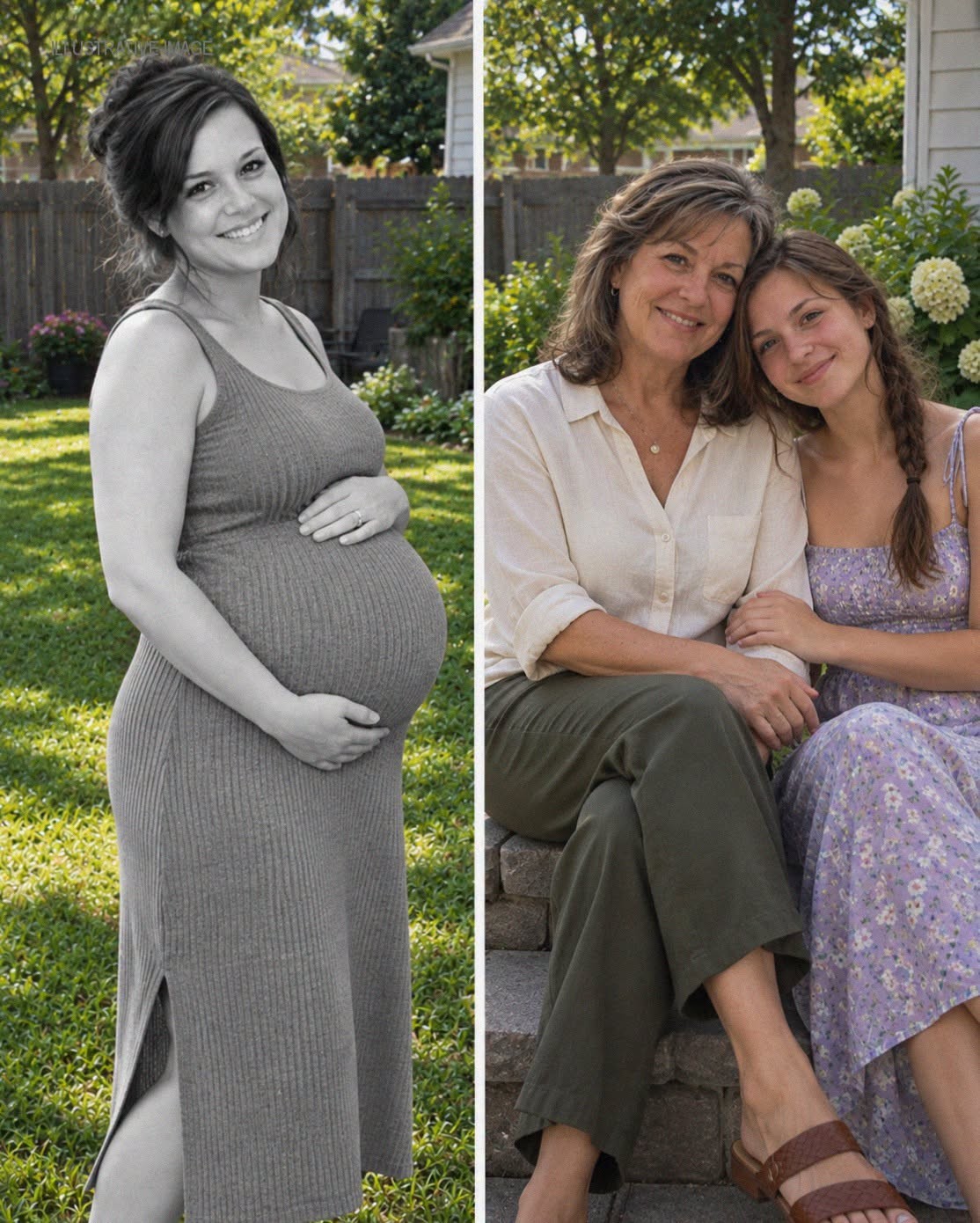
The white candle had been part of my granddaughter’s birthday for fifteen years.
Every year, before Audrey blew out her candles, I lit one small white candle for her mother.
Hannah.
My daughter had died giving birth to Audrey, leaving me with a newborn baby and a grief I never thought I would survive.
But on Audrey’s fifteenth birthday, I discovered something that made me question everything I thought I knew about those years.
I found a small cardboard box hidden behind a shelf in Hannah’s old bedroom.
Written across the lid, in Hannah’s unmistakable handwriting, were two words:
“For Audrey.”
I sat down on the floor.
For several minutes, I couldn’t bring myself to open it.
Hannah had been only twenty-four when she died.
I still remembered driving her to the hospital.
She had spent most of the ride joking about the terrible roads and complaining that every pothole seemed determined to make her pregnancy harder.
But about ten minutes from the hospital, she suddenly became quiet.
“Mom?”
“Yeah?”
“What if I’m terrible at this?”
I looked at her and smiled.
“You’re going to be a wonderful mother.”
She squeezed the strap of her purse.
“You have to say that.”
“No, I don’t,” I told her.
I reached over at the red light and held her hand.
“And I’ll be right there whenever you need me.”
I kept that promise.
Just not in the way I had imagined.
Hannah never came home from the hospital.
Instead, I left carrying her newborn daughter.
Audrey’s father stayed for less than a week.
“I can’t do this,” he told me. “Every time I look at her, I see Hannah.”
Then he left.
So I raised Audrey myself.
For fifteen years, I tried to make sure she knew her mother.
I showed her photographs.
I told her funny stories.
I told her how Hannah hated tomatoes but loved ketchup.
I told her about the time Hannah laughed so loudly during choir rehearsal that she was asked to leave.
And every birthday, we lit the white candle.
I thought it was helping Audrey feel connected to her mother.
I never realized it might also be keeping her trapped in the day she lost her.
That morning, I had gone upstairs looking for a silver cake server before Audrey’s birthday party.
Instead, I found the box.
Inside was a blue folder, an envelope and several papers from the childbirth classes Hannah had attended.
My name appeared repeatedly.
Emergency contact.
Person authorized to make decisions.
Person Hannah trusted to care for Audrey if something happened.
Then I found a folded piece of paper.
Across the top, Hannah had written:
“If I don’t get to say this myself.”
My hands started shaking.
I unfolded it.
The first sentence stopped me completely.
“If Audrey ever asks whether I died because of her, the answer is no.”
I read it again.
Then again.
Hannah had written that she never wanted Audrey to believe she owed her life to her mother’s death.
She wanted her daughter to understand that she was wanted.
Loved.
Chosen.
Hannah had also written something that made me cry.
She asked me not to turn Audrey’s birthdays into memorials.
She wanted Audrey to laugh.
To have friends.
To eat cake.
To make wishes.
She wanted her daughter to have a birthday that belonged to her.
I looked downstairs at the white candle sitting beside Audrey’s birthday cake.
For fifteen years, I had thought I was honoring Hannah.
But perhaps I had unknowingly made Audrey carry my grief too.
Then I heard the front door.
“Gee Gee?”
It was Audrey.
She came upstairs wearing a ridiculous silver birthday crown.
She stopped when she saw the box.
“Is that Mom’s?”
I nodded.
She slowly put down her backpack.
“What’s inside?”
I handed her the letter.
“Something she wrote for you.”
Audrey sat beside me and began reading.
I watched her eyes move across the page.
When she reached the part about not carrying a debt because her mother had died, she stopped.
She swallowed.
Then continued.
When she finished, she folded the letter carefully.
“Gee Gee?”
“Yeah, Audie?”
“Did you already buy the white candle?”
“Yes.”
She nodded.
Then she looked at the floor.
“Why didn’t you ever tell me?”
I didn’t understand.
“Tell you what?”
She looked toward the hallway.
“You cry every birthday.”
My heart sank.
“And you always look at the clock around lunchtime.”
I knew exactly what she meant.
The hour Hannah had died.
Audrey had noticed every year.
I had thought I was hiding my grief from her.
I hadn’t.
She continued.
“Then everybody gets quiet for Mom.”
I reached for her hand.
“I never wanted you to feel like—”
“I know,” she interrupted softly.
“I know it wasn’t my fault.”
Then she said something that broke me.
“How am I supposed to make a birthday wish on the day you lost your daughter?”
I had no answer.
Because suddenly I understood.
All those years, Audrey had been trying to protect me too.
She had eaten the strawberry cake because it was Hannah’s favorite.
She had accepted the white candle because she thought it mattered to me.
She had never complained.
Then I asked the question I should have asked years earlier.
“What did you wish for?”
Audrey looked at me.
“Mostly?”
She paused.
“I wished Mom hadn’t died.”
I pulled her into my arms.
For fifteen years, I had been afraid that forgetting Hannah for even one moment would mean losing her all over again.
But that day, I finally understood something.
Remembering someone doesn’t mean stopping everyone else from living.
That evening, fifteen colorful candles stood on top of Audrey’s birthday cake.
Not strawberry.
Chocolate.
“I hate strawberry cake,” she announced.
I stared at her.
“You’ve eaten it for years!”
“I thought it was important!”
I laughed so hard that I started crying.
Then I reached for the white candle.
Audrey stopped me.
“Not tonight.”
She picked it up and placed it beside Hannah’s box.
“We’ll light it on Mom’s birthday.”
I nodded.
Her friends gathered around the table.
They started singing.
Audrey closed her eyes.
Fifteen flames danced in front of her.
Then she took a breath and blew them all out.
The white candle remained untouched.
For the first time in fifteen years, I didn’t wonder what Audrey had wished for.
I already knew something important.
Her birthday didn’t have to belong to grief anymore.
It could belong to Audrey.
And Hannah, wherever she was, had gotten exactly what she had asked for.
Her daughter was finally free to live her own life.