The number on the tax form made my hands go cold: $26,000 in annual farm rent. I was sitting in my car outside a tax preparer’s office in Kentucky, staring at a document my older sister, Sherry, had asked me to deliver for our father. For three years, I had been withdrawing $2,100 every month from my retirement savings to help pay Daddy’s nursing home bill because Sherry insisted his money was gone. Yet the tax form showed that Bobby Whitt, the farmer renting Daddy’s 200 acres, had paid $26,000 that year. I checked the bank statements underneath it, but none of those rental payments appeared in Daddy’s account. Thirty-six months of helping him had cost my husband and me $75,600, not including the additional taxes on my retirement withdrawals. I sat motionless behind the steering wheel, realizing that the sister I had trusted with our father’s finances might have been telling us two very different stories.
My name is Teresa Akers, and I spent thirty-one years working as a postmaster before retiring with my husband, Doug. My father, Clayton, was eighty-four and had farmed the same rolling Kentucky fields since childhood, raising tobacco and cattle until a broken hip left him unable to live independently. His nursing home charged $7,400 monthly, with Social Security and long-term care insurance covering $5,300. Sherry held his durable power of attorney and managed his paperwork because she lived closer. She told me the farm no longer produced rental income, so Doug and I agreed to cover the remaining $2,100. We postponed replacing our leaking roof and abandoned a long-planned trip to the Smoky Mountains. I never questioned her figures. But instead of confronting Sherry immediately, I visited Daddy and showed him the tax form. He revealed that Sherry had told him the farm rent was already paying his nursing home expenses. When I explained what I had actually been contributing, he sat silently for several minutes before asking me to fetch his hat. He wanted to visit his farm and speak to Bobby himself.
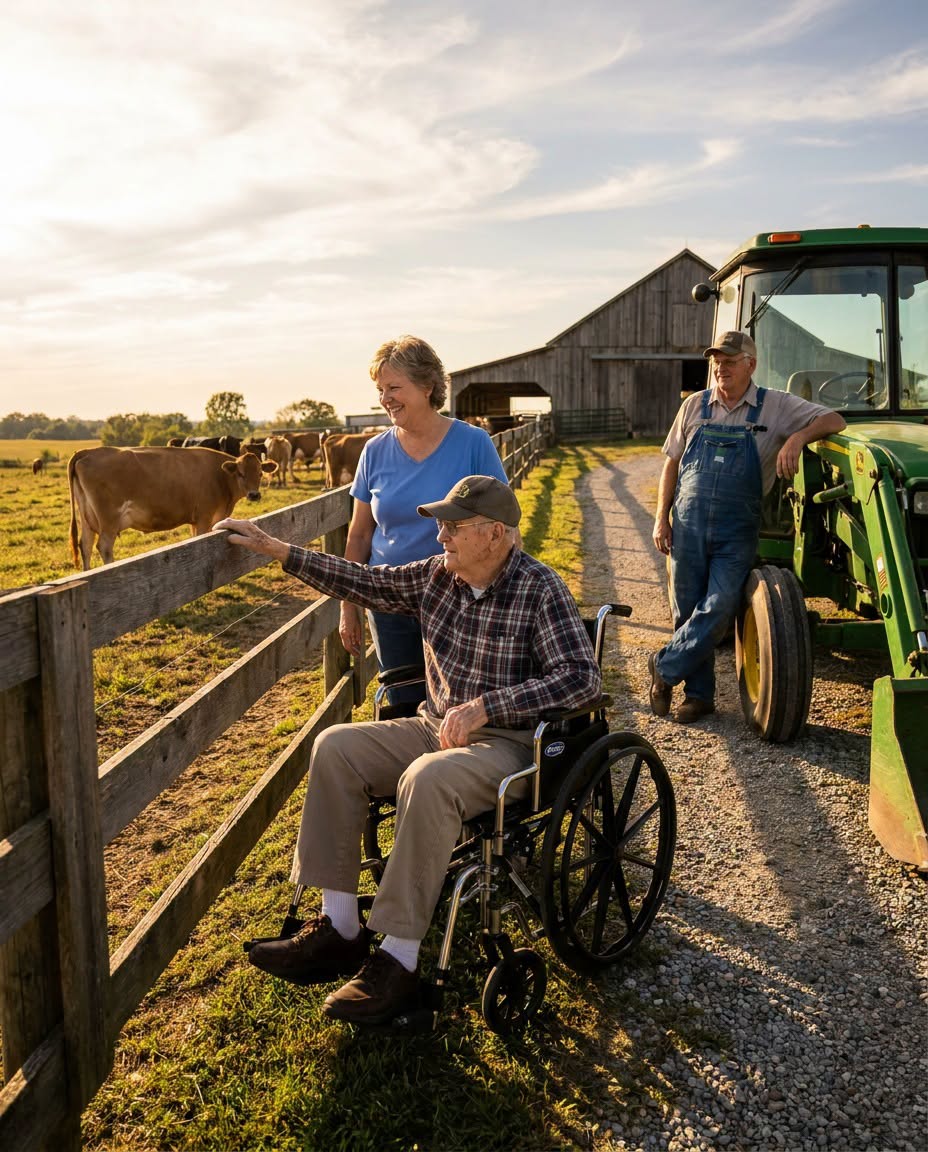
We drove past the church where Mama was buried and followed the gravel lane through fields Daddy could still identify by name. At the north pasture fence, I helped him into his wheelchair, and he rested his weathered hand on a cedar corner post he had installed with his own father in 1961. When Bobby approached from the cattle pasture, Daddy calmly asked where he had been sending the rent. Bobby explained that Sherry had instructed him to mail the payments directly to her after receiving power of attorney. He paid $13,000 in March and another $13,000 in November, just as the lease required. Daddy told him that I had been covering the nursing home shortfall from my own retirement funds, and Bobby looked devastated. He insisted he had believed the money was reaching its rightful owner. Daddy reassured him and instructed him to send all future checks directly to his room at the nursing home. Then he asked me to arrange a meeting with Sherry the following morning. When I told her we had visited Bobby, the silence on the telephone said more than any confession could have.
Sherry arrived at the nursing home pale and trembling. When Daddy asked where the rent had gone, she began crying and admitted she had used it to pay medical debts from her husband Roger’s heart attack, triple bypass surgery, and complications. Their remaining bills had exceeded $61,000, and collection notices had frightened her. She had intended to repay the money but continued taking the rent while telling Daddy it covered his care and telling me he had nothing left. Daddy listened before asking why she had never simply requested help. He told her he would willingly have supported Roger, but she had taken away his right to decide. Then he established new rules: rental payments would go directly to him, both daughters would have access to his statements, and I would stop paying the nursing home. He forgave Sherry for using his rental income but required her to reimburse my $75,600 contribution at $500 a month. She agreed, later beginning payments with a handwritten apology. Daddy kept Sherry’s power of attorney for emergencies but insisted on reviewing transactions himself. When the next $13,000 rent check arrived, he carefully directed its payment toward his care and asked the nursing home’s business office to remove me as the responsible payer.
The first December payment from Sherry arrived in a plain envelope marked as the beginning of 152 installments. Repairing our relationship took longer than arranging the repayments, but her consistency mattered. Roger eventually learned what had happened and began working part-time, determined to contribute toward reimbursing us. Doug and I replaced our leaking roof, and the following autumn, we finally rented a cabin overlooking the Smoky Mountains. At Christmas, Sherry came to our house carrying food, uncertain whether she was welcome. I hugged her for the first time in over a year, remembering the sister who used to braid my hair before school. We were not pretending the deception had never happened, but we were finding a way forward. I still visit Daddy on the first of every month, and together we review his bank statements line by line. Twice a year, the farm rent appears alongside his Social Security and insurance payments. He always rests one finger on that entry for a moment, just as he touched the old corner post on our visit to the farm. “That’s mine,” he says quietly. And every time, I answer, “Yes, Daddy. It always was.”