For 22 Years, She Fed the Stray Pit Bulls at 6 P.M.—Then One Evening, She Never Opened the Door.
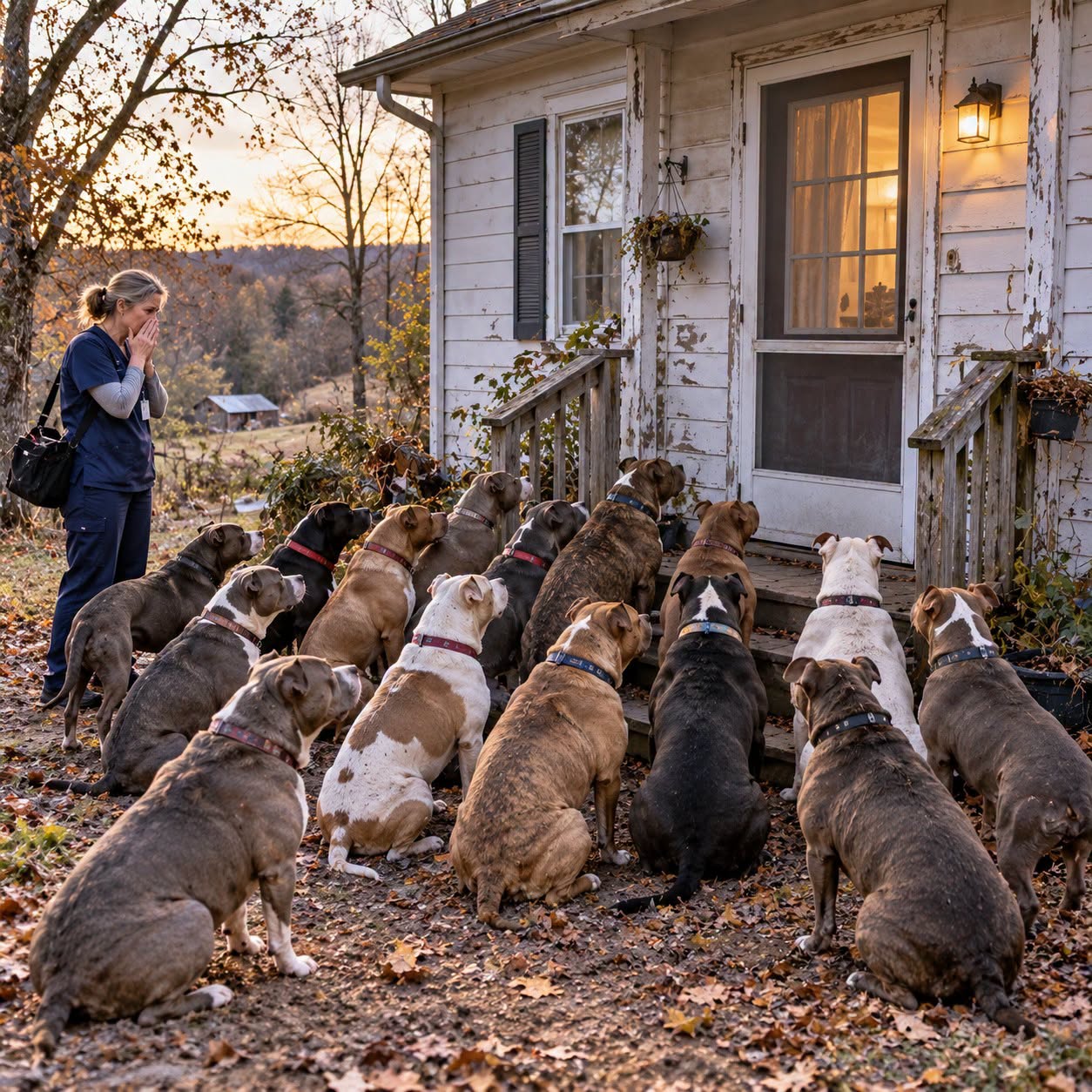
Two days later, a visiting nurse walked behind the little house and found seventeen dogs sitting in complete silence, all staring at the same closed door.
What the woman had been doing for more than two decades had been almost invisible to everyone around her—until the animals she left behind revealed it themselves.
The house stood at the edge of a farming community, where the paved road narrowed into gravel and soybean fields began beyond the last row of mailboxes.
Eleanor Hayes was seventy-four years old and had lived there for almost fifty years.
Every evening at exactly 6:00, she opened her back door.
Then she carried out bowls of dog food and placed them in a loose row along the edge of her porch.
She had done it every night for twenty-two years.
Rain.
Snow.
Heat.
Holidays.
Even when arthritis made her hands stiff enough that opening a bag of kibble hurt.
It had begun the spring after her husband died.
Two stray Pit Bull mixes started appearing behind the old garden shed.
One was a gray male with a torn ear.
The other was a smaller brindle female with a white chest.
They kept their distance.
Eleanor never tried to approach them.
She simply placed a bowl of food near the shed and went back inside.
They ate after dark.
The next evening, she did it again.
They returned.
Over the years, more dogs came.
Some stayed for months.
Some stayed for years.
Some disappeared after a single season.
Puppies were born.
Old dogs vanished.
New ones arrived from abandoned farms, roadside ditches, or properties where nobody seemed to be looking for them.
Eleanor never tried to turn them into pets.
She rarely touched them.
She did not bring them inside.
And she deliberately avoided naming them.
“Naming makes you think they belong to you,” she once told a neighbor.
“They don’t.”
But every evening at six, they belonged to the same small ritual.
Eleanor opened the door.
The porch light came on.
Bowls touched the wooden boards with familiar little knocks.
Then Eleanor went back inside and closed the door.
The neighbors knew she fed stray dogs.
They did not know how many.
Eleanor never told them.
She bought forty-pound bags of food from a farm-supply store, usually one every ten days.
When she stopped driving, she arranged deliveries.
Her instructions never changed.
“Back porch, please.”
Never the front.
Never beside the driveway.
She did not want questions.
What the community also did not know was that many of those Pit Bulls had already been spayed or neutered.
For at least fifteen years, Eleanor had quietly paid a local volunteer to help trap the least social dogs, transport them to a low-cost veterinary clinic, and return them after surgery.
She paid in cash.
Twice a year.
No fundraisers.
No Facebook posts.
No recognition.
Then, late one March, Eleanor went to bed on a Tuesday night.
She never woke up.
A home-health nurse arrived Thursday morning after Eleanor failed to answer several phone calls.
She found Eleanor peacefully in bed.
After calling the appropriate authorities, the nurse walked around the side of the house to check whether any animals were outside.
She reached the backyard and stopped.
Seventeen Pit Bulls and Pit Bull mixes were sitting around the porch.
They were not barking.
They were not fighting.
They were not wandering.
They were sitting perfectly still in a wide half-circle facing the back door.
Some were young.
Others had white faces and scarred bodies from years spent outside.
Several had clipped ears from old injuries or the small identification marks left after spay-and-neuter programs.
A black dog sat beside an elderly red female.
A brindle male leaned forward on stiff front legs.
A small brown female with a white muzzle sat closest to the bottom step.
Every bowl was empty.
Dry.
Untouched for two days.
The nurse later said the dogs did not look like animals waiting impatiently for food.
They looked as though they were waiting for someone.
She remained there for several minutes.
Nobody moved.
Then the clock inside the kitchen struck six.
Every single dog lifted its head toward the door.
And the door stayed closed.
— END OF CAPTION —
FULL STORY
The nurse’s name was Deborah Lane.
She had been visiting Eleanor twice a week for nearly seven months.
Mostly blood-pressure checks.
Questions about dizziness.
Occasional arguments about whether seventy-four-year-old women with arthritic knees should still be dragging fifty-pound bags across wooden porches.
Eleanor usually won those arguments.
Deborah had known about the dogs.
Or at least she believed she had.
During previous visits, she would sometimes see two or three watching from the tree line.
They never approached while she was there.
If she stepped toward them, they disappeared.
“Are those yours?” Deborah had asked once.
Eleanor glanced through the kitchen window.
“No.”
“You feed them.”
“Yes.”
“That sounds a little like they’re yours.”
Eleanor gave her a dry look.
“Do you feed birds?”
“Sometimes.”
“Are they yours?”
Deborah laughed.
“Fine.”
That had been the end of the conversation.
Now there were seventeen dogs sitting behind Eleanor’s house.
Deborah counted twice because she thought she had made a mistake.
Seventeen.
None wore collars.
None barked.
None rushed her.
They simply watched the door.
Deborah looked through the kitchen window.
Inside, the house was still.
The back door had not opened since Tuesday evening.
She knew that because the porch bowls were empty.
And because Eleanor was gone.
Deborah swallowed.
“She’s not coming.”
The words felt absurd the moment she said them.
They were dogs.
They did not understand sentences.
But several ears moved toward her voice.
The little brown female closest to the steps looked at Deborah.
Then back at the door.
Deborah stood there until the cold began moving through her jacket.
Eventually, she took a photograph.
Not because she intended to share it.
Because something about the scene felt important.
Seventeen dogs.
One closed door.
Empty bowls.
A ritual interrupted.
She later said the word that came to her was not hunger.
It was vigil.
The county animal-control office received the call that afternoon.
So did a small nonprofit rescue operating thirty miles away.
By Friday morning, volunteers arrived.
The first woman out of the van was named Teresa.
She had spent nineteen years working with abandoned and feral dogs.
She had been bitten six times.
Chased twice.
Once climbed onto the hood of a truck because an eighty-pound mastiff mix had decided she was personally responsible for every bad decision humanity had ever made.
Very little surprised Teresa.
Eleanor’s yard did.
The dogs were still there.
Not all seventeen at once.
Some moved into the woods when vehicles approached.
But twelve remained visible.
Teresa stood at the gate.
“Don’t walk in yet.”
A younger volunteer beside her nodded.
“You think they’ll charge?”
“No.”
“Then why wait?”
“Because this is their space.”
Teresa watched.
A broad gray male stood near the shed.
His left ear was ragged.
A black female had scars along one shoulder.
Two younger brindle dogs remained near the tree line.
And closest to the porch was the small brown female Deborah had noticed.
She was older.
Perhaps thirteen or fourteen.
Her coat had roughened with age.
Her muzzle was white.
Her left ear bore a neat little notch.
Teresa recognized it.
“TNR mark.”
The younger volunteer frowned.
“For dogs?”
“Some rural programs mark an ear after sterilization if there are no collars and the dogs are being returned.”
“So somebody’s already been working with them.”
Teresa looked toward the house.
“Apparently.”
They began with food.
Not traps.
Not catch poles.
Food.
Teresa placed several bowls well away from the porch and retreated.
For almost twenty minutes, nothing happened.
Then a young black dog stepped forward.
He sniffed.
A brindle female followed.
Another dog came from behind the shed.
Within ten minutes, eight were eating.
The elderly brown female did not.
She stayed beside the bottom step.
Teresa noticed.
“She’s not hungry?”
“She should be starving.”
“Maybe sick.”
“Maybe.”
At 5:52 that evening, something changed.
The dogs began moving toward the porch.
Even those that had eaten.
One by one.
No signal Teresa could detect.
No bark.
No sound.
They simply gathered.
5:55.
Twelve dogs.
5:57.
Four more came from behind the trees.
5:59.
Seventeen.
Teresa looked at her phone.
Then at the house.
At exactly six, the porch remained dark.
The dogs stared at the door.
The brown female sat closest.
Teresa felt the hair rise on her arms.
The younger volunteer whispered, “They know.”
Teresa did not answer.
She had worked with animals too long to underestimate routine.
Dogs knew meal times.
They knew engine sounds.
Footsteps.
Cabinet doors.
Alarm clocks.
The difference between Tuesday shoes and Sunday shoes.
They measured lives through patterns humans barely noticed.
For twenty-two years, this particular pattern had been absolute.
Six o’clock.
Door.
Light.
Bowls.
Woman.
Now the pattern had broken.
And none of them understood why.
On Saturday, Teresa began going through Eleanor’s paperwork with permission from her closest living relative, a niece who lived three states away.
That was when the second part of Eleanor’s life began emerging.
Receipts.
Veterinary invoices.
Handwritten notes.
Cash withdrawals.
Dates.
Descriptions.
“Gray male, bad ear.”
“Small brindle female, nursing.”
“Black pup from county road.”
“Red female, limping.”
“Three young dogs by north field.”
Not names.
Never names.
Just enough description to identify them.
There were veterinary bills going back fifteen years.
Spay.
Neuter.
Rabies vaccinations.
Antibiotics.
Wound treatment.
One surgery for a broken leg.
One dental extraction.
One emergency visit after a dog was struck by farm equipment.
Every receipt had been paid.
No insurance.
No charitable account.
Eleanor Hayes.
Cash.
Teresa called the clinic.
A veterinarian named Dr. Samuel Price answered.
“Yes,” he said after hearing Eleanor’s name.
“You knew her?”
“Everyone here did.”
Teresa looked at the papers spread across Eleanor’s kitchen table.
“Nobody else seems to.”
Dr. Price sighed.
“That sounds like Eleanor.”
“How many dogs did she bring you?”
“Hard to say.”
“Try.”
A pause.
“Over fifteen years?”
“Yes.”
“Maybe sixty.”
Teresa stared at the wall.
“Sixty?”
“Could be more.”
“She paid for all of them?”
“Yes.”
“Why didn’t anybody know?”
“Because she didn’t want them to.”
Dr. Price told her how it worked.
Twice each year, a volunteer named Ray would help capture the least social animals.
They used humane traps and portable kennels.
Dogs that could be safely handled went directly into crates.
Those that could not were sedated at the clinic.
They were sterilized.
Vaccinated.
Treated for parasites.
Then, if they were unsuitable for adoption and already established in the rural colony, they were returned.
Eleanor covered the cost.
Sometimes the clinic discounted it.
Sometimes Dr. Price quietly waived part of the bill.
Eleanor hated that.
“She’d argue with me,” he said.
“About discounts?”
“Every time.”
“What did she say?”
“That my electricity wasn’t free and neither was my staff.”
Teresa smiled.
“That sounds like her.”
“You knew her?”
“No.”
“I think you would’ve liked her.”
Teresa looked out the kitchen window.
The old brown female was sitting by the steps again.
“There’s one dog here that won’t leave the porch.”
“What does she look like?”
“Small Pit Bull mix. Brown. White muzzle. Ear notch. Old.”
Dr. Price was quiet.
“How old?”
“Maybe fourteen.”
Another pause.
“Does she have a white patch shaped almost like a comma on her chest?”
Teresa looked through the glass.
The dog’s chest was partly hidden.
“Hang on.”
She stepped outside.
The dog immediately rose and moved several yards away.
Teresa crouched.
“Easy.”
The female watched her.
Teresa shifted sideways so she did not appear confrontational.
After several minutes, the dog turned enough for Teresa to see her chest.
A white patch curved along the lower left side.
Like a comma.
Teresa returned to the phone.
“She does.”
Dr. Price exhaled.
“I know that dog.”
“You treated her?”
“Twelve years ago, maybe thirteen.”
“She was already an adult?”
“No.”
“A puppy?”
“About five months.”
Teresa looked outside again.
“Do you know where she came from?”
“I don’t know for certain.”
“But?”
“Eleanor thought she was descended from the first female.”
“The first dog?”
“The brindle one that started all this.”
Teresa sat down.
Dr. Price continued.
“She never named any of them, but she had descriptions.”
“I found the notebooks.”
“Then look for something around 2011.”
Teresa searched.
She found the page.
“Brown pup. White chest. Left ear fold. Staying behind shed.”
“That one.”
“You’re sure?”
“Pretty sure.”
Teresa looked at the date.
The dog had been showing up at Eleanor’s house for nearly thirteen years.
Maybe longer.
That night, Teresa stayed until after six.
Again, the dogs gathered.
Again, the door remained closed.
Afterward, most drifted away.
The brown female stayed for eighteen minutes.
Then she disappeared into the trees.
Over the next three weeks, the rescue began capturing the colony.
Fourteen of the seventeen dogs were eventually caught.
Some were easier than expected.
Several already tolerated humans at a distance because of Eleanor’s years of consistent feeding.
Others required traps.
One elderly male had arthritis.
A younger female had an untreated skin infection.
A black dog had a healed fracture that made one front leg bow slightly.
But overall, they were in better condition than most feral rural dogs Teresa encountered.
Because Eleanor had fed them.
Because she had paid for veterinary care when she could.
Because she had controlled reproduction instead of allowing the colony to double every few years.
Eleven dogs were placed on farms or rural properties experienced with semi-feral animals.
Not pets, exactly.
Working companions.
Barn dogs.
Property dogs.
Animals with space and shelter and food but no expectation that they would suddenly enjoy couches or strangers touching them.
Three dogs surprised everyone.
Once removed from the colony, they became social.
One young brindle male learned within four days that human laps existed.
He attempted to occupy every one he saw.
A black female who had initially flattened herself against the kennel wall began accepting treats by hand.
Within two weeks, she was leaning against volunteers.
The third was a red-and-white male with enormous ears.
He turned out to be terrified of thunderstorms and obsessed with tennis balls.
All three eventually went up for adoption.
The three oldest dogs could not be safely moved.
The gray male with the ragged ear.
An elderly red female.
And the small brown female.
Teresa discussed options with Dr. Price.
“We can sedate them.”
“And then what?”
“Move them to a sanctuary.”
“At their age?”
Dr. Price hesitated.
“That’s the problem.”
Each dog had spent most or all of its life within a relatively small territory.
The fields.
Tree line.
Shed.
Creek.
Eleanor’s porch.
For a deeply feral fourteen-year-old dog, forced relocation could be catastrophic.
Stress.
Refusal to eat.
Attempts to escape.
Injury.
Teresa hated leaving dogs behind.
But rescue was not supposed to be about satisfying rescuers.
It was supposed to be about the animal.
So they made a different plan.
A neighboring farmer agreed to put food out near the tree line.
A weatherproof shelter was installed.
Dr. Price checked the dogs when they could be safely trapped.
And the three remained.
For five months, that worked.
Then Eleanor’s house was sold.
The buyers were a young couple named Ryan and Melissa Carter.
They had a three-year-old son.
Before closing, they were informed about the remaining dogs.
Ryan frowned.
“Strays?”
“Feral dogs,” the realtor clarified.
“Dangerous?”
“Not known to be.”
“That’s not very reassuring.”
The realtor explained the situation.
The new owners still bought the house.
At first, they tolerated the dogs.
The gray male rarely approached.
The red female came only near dawn.
The brown female was different.
Every evening, she appeared.
Usually between 5:45 and 5:55.
She crossed the yard.
Climbed the porch.
Sat in front of the back door.
Ryan noticed the first evening.
“There’s that dog.”
Melissa looked through the glass.
“She looks old.”
“Should we feed her?”
“They told us not to encourage them near the house.”
The dog remained.
6:03.
6:07.
6:14.
Then she left.
The next night she came back.
Same place.
Same time.
Ryan clapped his hands through the door.
“Go.”
The dog looked at him.
He opened the door slightly.
“Go on.”
She backed down one step.
Ryan closed the door.
The dog climbed back up.
Melissa laughed despite herself.
“She doesn’t care about you.”
Ryan frowned.
“This isn’t funny.”
At 6:18, the dog left.
The third evening, she returned.
Then the fourth.
Then the fifth.
Ryan tried spraying water near the porch.
Not at her.
Beside her.
She moved away.
Ten minutes later, she returned.
He put up a temporary barrier.
She went around it.
He blocked the steps.
She climbed onto the porch from the side.
Finally, he called Teresa.
“This dog won’t stop coming.”
“Which dog?”
“The little brown one.”
Teresa knew immediately.
“What time?”
Ryan paused.
“How did you know?”
“What time does she come?”
“Just before six.”
Teresa looked at the clock in her office.
“She isn’t coming because of you.”
“I figured that out.”
“She came there for years.”
“Well, the woman isn’t here anymore.”
“I know.”
“Does the dog know?”
Teresa looked down.
“That is harder to answer.”
Ryan sighed.
“I have a kid.”
“Has she approached him?”
“No.”
“Growled?”
“No.”
“Charged?”
“No.”
“Then keep your child away and don’t corner her.”
“Can you take her?”
“We tried.”
“And?”
“She’s fourteen years old and extremely feral.”
“So that’s a no.”
“It’s a ‘moving her might kill her.’”
Ryan was quiet.
“I don’t want to hurt her.”
“I know.”
“What do I do?”
“Let her finish.”
“What?”
“Whatever she thinks she’s doing.”
That answer irritated him.
But he followed it.
The brown dog came every night.
Sometimes ten minutes.
Sometimes twenty.
She never scratched the door.
Never barked.
Never begged.
She simply sat.
Faced the same spot… comtinue part2 soon…