Six days after my husband died, his two brothers handed me a $500,000 check at his funeral lunch and told me my twelve-year-old daughter and I had seven weeks to leave the farmhouse we’d called home for twenty years. They said it was a fair buyout and that moving into town would be easier for us. I didn’t argue. I tucked the envelope into my purse, walked back to my daughter, and watched her push a lemon bar around her paper plate. That evening, she asked whether we’d ever see her daddy’s fields again. I looked through our kitchen window at the eighty acres for sale across the gravel road, picked up a pencil, and began calculating. By sunrise, I’d made a decision nobody in my husband’s family expected. I wasn’t going to disappear into town. I was going to buy that farm myself. And when planting season arrived, his brothers would look across the road and see something they never imagined.
My name is Melissa Engel. My husband Jeff was forty-seven when a sudden heart attack took him away. He’d gone to the machine shed after supper to repair a hydraulic leak on the planter and never came home. I found him on the concrete with a wrench still in his hand. Jeff farmed eleven hundred acres of corn and soybeans in Nebraska with his brothers, Randy and Scott. For twenty years, I’d handled the partnership’s bookkeeping, paid invoices, prepared tax records, and helped with planting and harvest. I knew our financial situation better than almost anyone. I also knew the partnership agreement allowed the surviving brothers to purchase Jeff’s one-third interest after his death. The farmhouse belonged to the business, so legally it wasn’t mine to keep. Their $500,000 offer was consistent with the agreement. What hurt was hearing, before my husband had even been buried a week, that we’d have to leave before spring planting. That night, my daughter Abby asked if we’d have to move in with my sister. Then she told me she wanted to keep watching the lights moving through her father’s fields at night. Jeff had always dreamed of buying the neighboring Wiebe property for Abby. Eighty acres, a little white farmhouse, and an old red barn. The asking price had fallen to $430,000. Buying it would leave us roughly $70,000 for machinery, seed, repairs, and living expenses. It was a terrifying risk. But it was also the only way I could imagine preserving something of the life Jeff had wanted for our daughter.
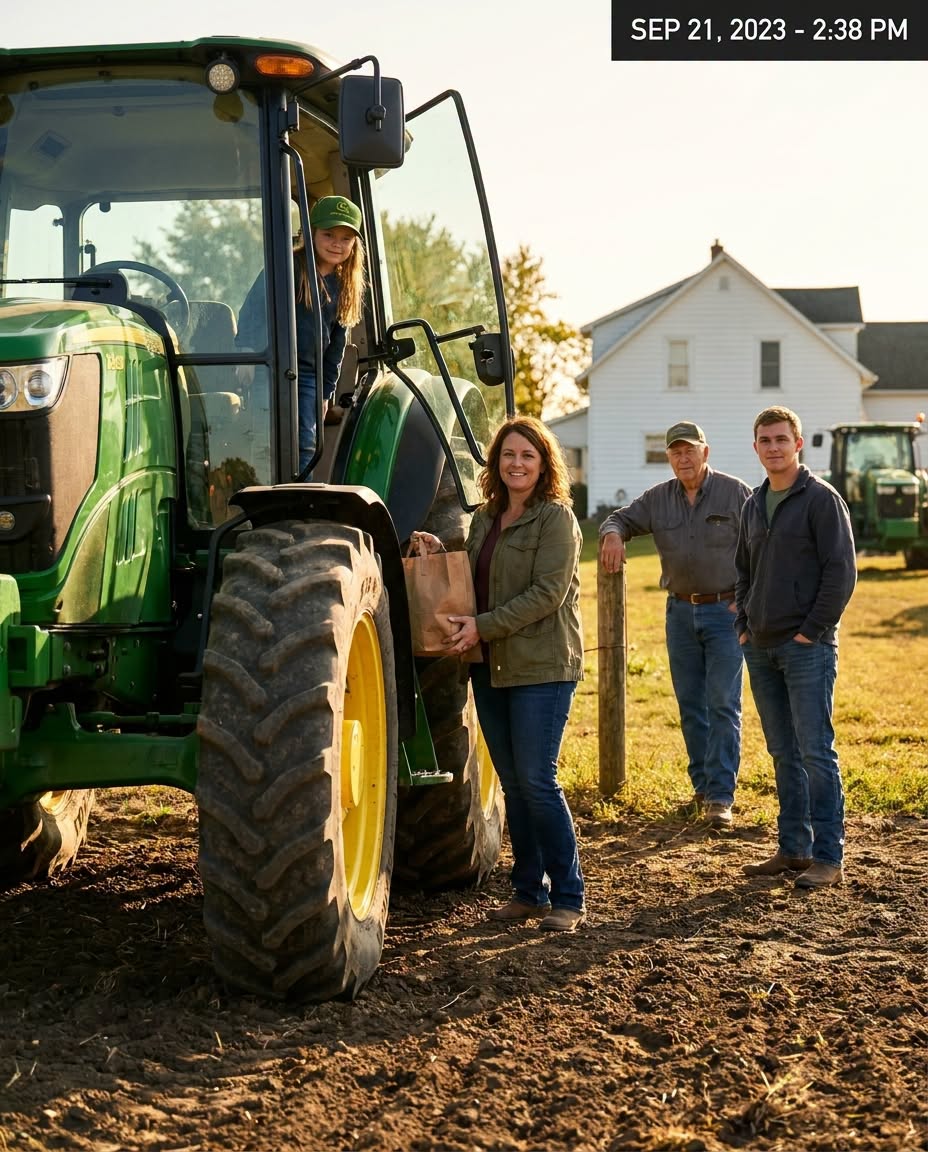
The following Monday, I deposited the buyout check and submitted a full-price cash offer on the Wiebe property. The sellers accepted the next morning. I confirmed with our attorney that the partnership buyout released me from its debts and obligations. On April 22, I signed the closing papers and received two keys: one for the house, one for the barn. I used what remained of the money to buy a worn John Deere tractor for $32,500 and an eight-row planter for $9,000 at a farm auction. After buying seed and other necessities, my financial cushion was dangerously small. Worse, I’d missed the crop insurance deadline. If the summer turned dry or a hailstorm destroyed our corn, I could lose nearly everything. Then I learned why Randy had wanted us out so quickly. His twenty-four-year-old son Luke was coming home from college, and Randy intended to give him our old farmhouse. I felt betrayed, but I wasn’t going to let anger decide my future. Abby and I moved across the gravel road in late April, carrying twenty years of memories into a house that finally belonged to us. On our last trip out, she found her father’s green seed cap hanging behind the kitchen door and put it on. It covered her ears. The first warm morning in May, I climbed onto my tractor, started the engine, and drove into my eighty acres. Across the road, Randy and Scott were preparing their enormous planter. I saw them watching me. Nobody waved. My first day was brutal. The machinery needed repairs, the seed bags felt heavier with every hour, and by sunset I’d planted only twenty acres. Abby rubbed liniment onto my aching shoulders that evening, just as her father used to do. Before dawn the next morning, while I was struggling to load another bag of seed, I heard footsteps on the gravel. I turned around and saw Luke walking across the road. His father was standing beside a pickup in the distance. Luke stopped in front of my tractor, looked at the planter, then looked directly at me. “Aunt Melissa,” he said, “there’s something I need to tell you.”
Luke admitted he hadn’t known his father planned to give us the buyout check at the funeral. He hadn’t asked for our house, and now he felt ashamed that he’d accepted it without considering where Abby and I would go. Then he offered to operate my planter while I hauled the seed. Jeff had taught him to drive that same model when he was eleven. I looked at him standing there, so much like his uncle, and handed him the keys. We accomplished more that morning than I had the entire previous day. Around noon, Scott arrived pulling the partnership’s large seed tender. He filled my planter, unhooked the equipment, and told me to keep it until I’d finished planting. When I thanked him, his eyes filled with tears. He admitted he should have spoken up at the funeral instead of sitting quietly while Randy told me to leave. That weekend, Randy’s wife Lori invited Abby and me to Sunday dinner at our old farmhouse. The family gathered around the familiar kitchen table, and Randy stood before anyone began eating. He admitted the bank had been pressuring him about the partnership’s finances, but his real motivation had been securing a home for Luke. He’d convinced himself the buyout would be a kindness to me. Watching me struggle alone in the field had forced him to confront what he’d done. He apologized and offered to let us move back. I thanked him but declined. I already had a home, eighty acres of my own, and a crop to finish planting. What I wanted was for Abby to remain part of her father’s family. Then Luke brought out something he’d carefully removed from the farmhouse pantry doorway: a strip of wood marked with twelve years of Abby’s height measurements, each one written by her father. The last mark read, “Abby, 12, last Nov.” She held that piece of wood against her chest and hugged Luke so tightly he could barely move. A few days later, we finished planting our field together. As evening fell, Abby and I stood beside the gravel road watching two sets of tractor lights move through the darkness, one on each side. For the first time since Jeff’s death, those lights didn’t make me feel as though everything we’d loved was gone.
That summer, two good July rains saved our corn. In October, the Wiebe eighty produced 141 bushels per acre, a respectable harvest for the dryland field we’d planted late. Randy brought over the family’s combine, and I insisted on paying the normal harvesting rate. With the grain income, I paid off the machinery debt I’d taken on for fertilizer and opened a $5,000 savings account in Abby’s name. I intended to give her the farm when she turned eighteen, just as Jeff had once dreamed. The following November, on her thirteenth birthday, she stood in her socks against the wooden height marker Luke had installed inside our new front door. I placed a book on her head, picked up Jeff’s old carpenter’s pencil, and made another mark. “Abby, 13. Wiebe place.” She stepped away and studied it, then looked through the window toward her father’s fields. She said she wanted to drive the planter herself next spring. I laughed and told her she’d have to grow tall enough to reach the pedals first. She stood on her toes, then reached for her daddy’s green cap hanging beside our back door. It still slipped down over her ears, but not quite as far as it had the year before. Watching her adjust the brim, I finally understood something. The $500,000 hadn’t bought our silence or sent us away. It had given us eighty acres where my daughter could grow up with her father’s memory on one side of the road and a future of her own on the other.