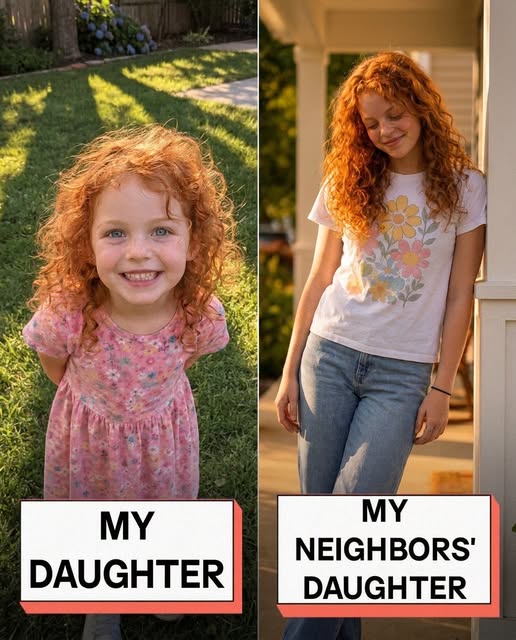
“Margot?” The name escaped my mouth before I had time to stop it. Our new neighbors had walked over to introduce themselves when their fourteen-year-old daughter came down the driveway, and the moment she appeared, every sound around me seemed to disappear. It was not only her eyes or the shape of her face. It was the way she pressed her thumbnail into the side of her index finger, rubbed twice, then folded her hand inward—the exact nervous habit my four-year-old daughter had before she vanished ten years earlier. The girl stepped backward and said her name was Mia. Then her mother, Joan, went pale and whispered, “We knew this day might come.”
Margot disappeared during a Saturday game of hide-and-seek in our backyard. My husband Greg had been counting while I made lunch, and by the time he realized she was not hiding anymore, the back gate was resting against the latch and our daughter was gone. Across the street stood a bus stop she knew because I had ridden that route with her many times. Police searched for weeks, volunteers covered neighborhoods, and her photograph appeared on posters until eventually people stopped promising she would come home. Greg and I moved because remaining in that house became unbearable, but I never stopped scanning playgrounds, airports, and grocery aisles for the face Margot might have grown into. Now Joan explained that, before moving into the neighborhood, she had found an old missing-child article and noticed that Margot’s age, appearance, and disappearance date seemed strangely close to what she knew about Mia’s early history.
Greg wanted proof immediately, but I refused to treat Mia like evidence we could secretly collect. She was fourteen, old enough to understand that four adults were discussing whether the life she knew might have begun as someone else’s tragedy. When I asked whether she wanted genetic testing, her first question was not about biology but about consequences: “If I am Margot, what happens?” I nearly told her she would come home, until I looked around Joan and Thomas’s living room at Mia’s shoes, backpack, family photographs, and the ordinary evidence of a childhood already lived. I told her she would have a say in everything. She agreed to proper testing, and while we waited, Joan gave us Mia’s earliest records. Buried among them was a report about a four-year-old girl found asleep near the end of a bus route on the same afternoon Margot disappeared, able to describe only a yellow house, a bus stop, and a tree with a swing. The child had entered temporary care, later foster care, and eventually became Joan and Thomas’s daughter.
Two days later, the test confirmed it: Mia was biologically ours. Margot had survived. But no court order, DNA result, or family revelation could make the missing decade disappear or transform a fourteen-year-old instantly back into the preschooler we had lost. Joan and Thomas were her legal parents and had raised her through illnesses, birthdays, school mornings, nightmares, and scraped knees. We began working through the records with professionals to understand how the connection between a missing child and a found child had been missed, while keeping Mia’s welfare at the center of every discussion. Greg struggled at first, asking her to remember toys and childhood habits until she finally told him not to call her Margot. I reminded him that she was not failing a test simply because she could not remember us. When relatives later asked when we were “getting her back,” I told them there was nothing to get back. Mia was my daughter, but she was also Joan and Thomas’s daughter, and biology did not erase ten years of parenting.
Months later, Mia sat cross-legged on my living room floor while I opened the memory box I had kept through a decade of unanswered birthdays. She picked up a tiny shoe, laughed at an ugly ruffled dress, and asked what she had been like when she wore it. I corrected myself once and called the child in the story Margot. Mia looked at me and said, “No. You were right the first time.” Then she asked me to keep telling her stories. For ten years I had imagined finding my daughter exactly as I had lost her—four years old, running through a gate, calling me Mom. What returned to my life was harder and more real: a teenager named Mia who loved another mother, had memories that did not include me, and did not owe anyone a choice between families. Once I stopped trying to recover the child I had lost, I finally had room to know the daughter who was standing in front of me.