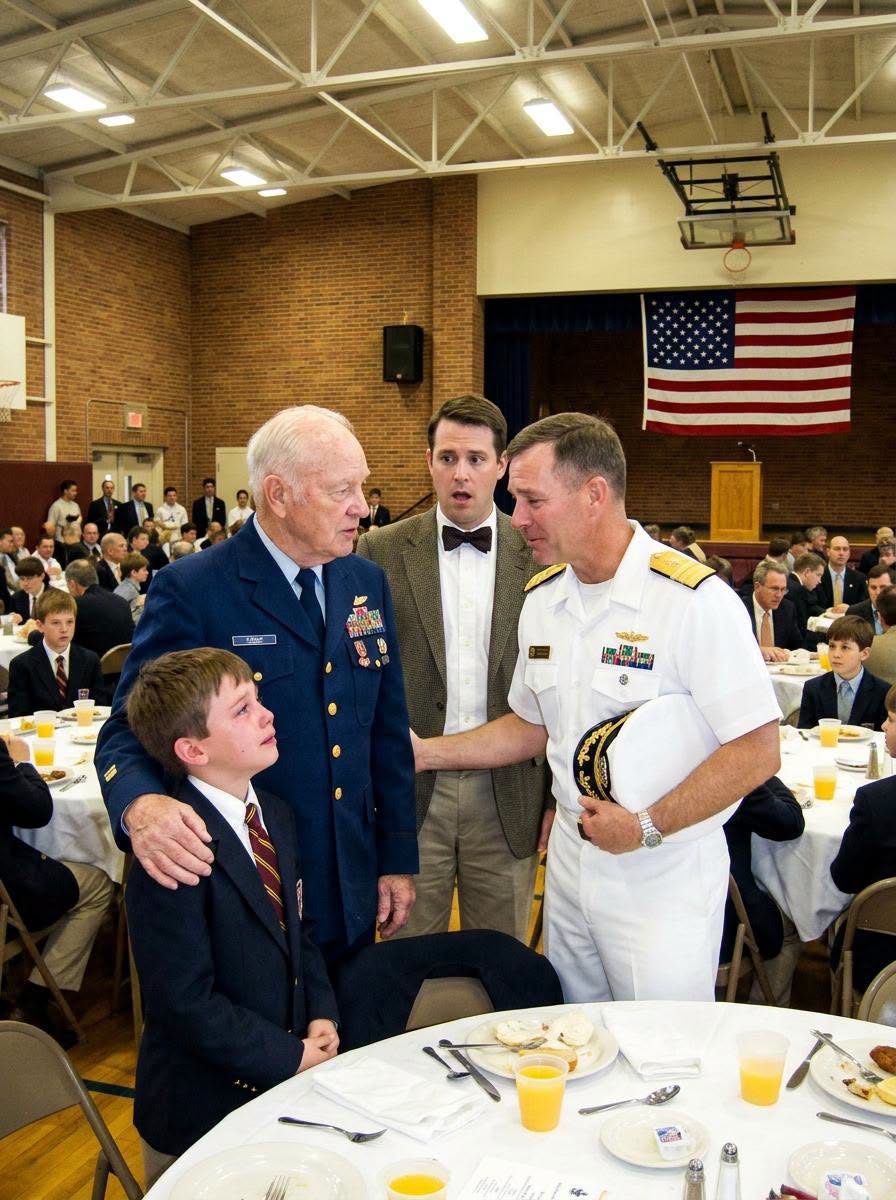
My grandson Caleb is nine years old.
His father, my son Danny, was killed in a combat zone in Afghanistan in 2019. Caleb was two.
He doesn’t remember his dad. He has exactly one printed photograph of the two of them together: Danny in his uniform, holding Caleb on his hip at the airport the day before his last deployment. Caleb keeps it in a plastic sleeve in the front pocket of his school backpack. He’s carried it every single day since kindergarten.
Caleb attends a private academy on a scholarship for the children of fallen service members. It’s a good school. Blazers, ties, old brick buildings, a lot of families with money.
Every spring, the academy holds a Father-Son Breakfast. The fathers come in tailored suits. The boys wear their uniform blazers. There’s a catered breakfast in the gym, a special guest speaker, and formal photos on the lawn afterward.
This year, Caleb came home with a notice from school.
It said that students whose fathers were unable to attend would spend the morning of the breakfast in the library. It ended with a line thanking parents for their cooperation in following the event guidelines.Get Parenting Tips
Caleb didn’t cry. He put the notice on our kitchen counter, and he walked down the hall to his bedroom, and he closed the door very quietly.
That was worse than crying.
His mother, Jess, called the academy the next morning. An administrator told her the breakfast was a father-and-son event, period.
Jess asked if I could go with Caleb instead.
The school said grandfathers “didn’t fit the purpose of the event.”
Jess hung up and cried at the kitchen table for a long time.
I didn’t say anything.
I went to my bedroom, opened the cedar closet, and took down an old garment bag from the top shelf.
I served in the United States Navy from 1963 to 1991. I retired as a Chief Petty Officer. Twenty-eight years. Three carriers. Two wars.
The last time I’d worn my dress blues was the day we buried Danny at Arlington.
I unzipped the bag.
Somehow, the uniform still fit.
On the morning of the breakfast, I shined my shoes until I could see the ceiling light in them. I straightened every ribbon on my chest, one at a time, the way I was taught when I was eighteen years old. Jess helped me fasten the stiff collar at my neck. Her hands were shaking.
When Caleb came out of his bedroom in his blazer, he stopped dead in the hallway.
“Grandpa,” he said. “You look like Daddy.”
I smiled at him.
“That’s because your daddy looked like me, buddy. Go get your school blazer straightened out.”
We drove to the academy together.
The breakfast was in the school gym. Rows of round tables with white tablecloths. A temporary stage at the far end with a wooden podium and an enormous American flag hanging behind it. Almost two hundred fathers and sons.
When we walked through the doors, Caleb reached up and took my hand.
He hadn’t held my hand in public since he was six. He didn’t let go until we sat down.
The conversations around us started to die down as people noticed us. We found an empty table against the back wall.
Less than two minutes later, the headmaster came over.
Dr. Prentiss is young for a headmaster. Spotless suit. Silk bow tie.
“Mr. Halloran,” he said. “I appreciate the sentiment. But this event is for fathers and sons. We made that very clear to your family.”Plan Family Trips
“I’m aware.”
“Then I’ll have to ask you to take Caleb to the library. Our guest speaker is about to begin, and frankly, your uniform is drawing attention we don’t need.”
I looked around the gym. A lot of well-dressed men were staring at us. Some of them looked away quickly when I met their eyes. Some looked uncomfortable.
I turned back to the headmaster.
“Caleb is going to eat his breakfast,” I said. “We’ll leave when he’s finished. Not before.”
Dr. Prentiss pressed his lips into a thin line. Then he walked off, looking around like he was searching for someone to throw us out.
A minute later, the guest speaker was introduced.
Admiral James Carrick. A four-star admiral. Thirty-eight years of active service. He’d commanded carrier strike groups and briefed presidents.
He stepped up to the podium and thanked the academy’s leadership.
Then he began his speech.
And halfway through his second sentence, he stopped talking.
He was staring at the back of the gym.
Straight at our table.
At my old dress blues. At the ribbons on my chest.
The admiral set his notes down on the podium.
Then he stepped down off the stage.
Dr. Prentiss hurried over and whispered something in his ear. The admiral didn’t even slow down.
He walked between the tables, past nearly two hundred fathers and sons, all the way to the back wall.
He stopped in front of Caleb and me.
Caleb stared up at the four stars on his shoulders. He couldn’t say a word.
The admiral looked at my ribbons. Then at my face. Then down at the nameplate on my chest.
“Chief Halloran,” he said quietly. “Pacific deployment. Carrier. 1972.”
I pushed myself up out of the folding chair. My knees aren’t what they used to be.
“Yes, sir. That’s right.”
He looked at me for a very long moment.
“Chief,” he said, “do you happen to remember a nineteen-year-old seaman apprentice who froze during a fuel fire on the hangar deck?”
I studied his face.
And all at once, fifty-four years fell away.
The admiral’s eyes filled with tears.
He turned to face the whole gymnasium. And he put one steady hand on my grandson’s shoulder.
I remembered.
The South China Sea, November 1972. A fuel line ruptured on the hangar deck during refueling, and in seconds the whole aft section was burning. Black smoke so thick you couldn’t see your own hands. Men shouting. Alarms.
And in the middle of it, a skinny kid from Ohio, three months out of boot camp, standing completely frozen next to an aircraft with fire crawling toward him across the deck. He’d dropped his hose. He couldn’t move. He couldn’t even scream.
I grabbed him by the back of his collar and dragged him behind the bulkhead. I got burns up both forearms doing it. I still have the scars.
When we were behind the steel and he was shaking so hard his teeth were rattling, I took his face in both my hands and said the only thing I could think of.
“You don’t get to quit, son. You pick up that hose, and you stand next to me, and we put this out together.”
And he did. He stood next to me for forty minutes, and we put it out.
I never knew his last name. He was transferred off the ship two months later. I’d thought about him once or twice over the years and wondered whether he’d made it.
Now he was standing in front of me with four stars on his shoulders.
The admiral’s voice carried across the entire gym. He didn’t need a microphone.
“Gentlemen,” he said. “Fifty-four years ago, I was a scared kid on the hangar deck of an aircraft carrier, and I froze during a fuel fire. I would have died that day. This man pulled me out of it. He burned his own arms doing it. And then he did something even more important. He told me I didn’t get to quit. He made me pick up the hose.”
He paused. The gym was completely silent.
“I have thought about those words every day of my career. When I was promoted. When I lost sailors. When I sat across from presidents. You don’t get to quit. Everything I am, I owe to Chief Petty Officer Halloran.”
Then he looked down at Caleb.
“And this young man is his grandson. His father, Petty Officer Daniel Halloran, was killed in Afghanistan serving this country. He was the Chief’s son.”
He turned slowly and looked at the headmaster, who was standing frozen beside the stage.
“I’ve been told this boy was supposed to spend this morning in the library. Because his father died for his country. And because his grandfather doesn’t fit the purpose of the event.”
Dr. Prentiss sat down in the nearest chair like his legs had given out.
“Well,” the admiral said. “Let me tell you the purpose of this event, as I understand it. It’s about the men who show up for boys. This man showed up for me in 1972 when I was nobody. He showed up for his country for twenty-eight years. And this morning, he put on a uniform he buried his own son in, so his grandson wouldn’t have to sit in a library alone.”
He kept his hand on Caleb’s shoulder.
“If Caleb Halloran isn’t welcome at this breakfast, then neither am I.”
For a second, nobody moved.
Then a father at a table near the front stood up. A big man in a gray suit. He started clapping.
Then another father stood up. Then a whole table. Then the whole gymnasium was on its feet: two hundred men and boys, clapping and clapping, and some of those fathers in their tailored suits were wiping their eyes.
Caleb pressed himself against my side and held on to my jacket.
The admiral asked us to sit at the head table with him. Caleb sat between the two of us. He ate every bite of his pancakes. The admiral gave his entire speech from that table instead of the podium, and the speech he gave wasn’t the one he’d written. It was about my son. About sacrifice, and about the families that keep paying for it long after the funeral.
At the end, he reached into his pocket and pressed something into Caleb’s palm. A heavy brass challenge coin with four stars on it.
“Your dad earned this,” he told him. “I’m just the one delivering it.”
Caleb sleeps with that coin on his nightstand now, right next to the photo of his father.
Dr. Prentiss came to our house the following week. He apologized to Jess, to Caleb, and to me. He said he’d been so focused on how the event would look that he’d forgotten what it was for. I think he meant it.
The academy changed the policy that summer. The Father-Son Breakfast is now called the Family Breakfast. Any man or woman who shows up for a boy is welcome.Plan Family Trips
And there’s a new tradition. At every breakfast, the first table by the stage is reserved. A small brass plaque in the middle reads: In Honor of Those Who Serve, and the Families They Leave Behind.
Caleb and I sit there every year.
Admiral Carrick retired last fall. He calls me on the first Sunday of every month. We talk about the Navy, and about Danny, and about Caleb’s grades.
Last month, he asked Caleb what he wanted to be when he grew up.
Caleb thought about it very seriously. Then he said, “A sailor. Like Daddy and Grandpa.”
The admiral was quiet for a second.
“Well,” he said, “when you’re ready to apply to the Naval Academy, I’ll write your letter myself. And you remember what your grandfather taught me.”
Caleb grinned.
“You don’t get to quit.”