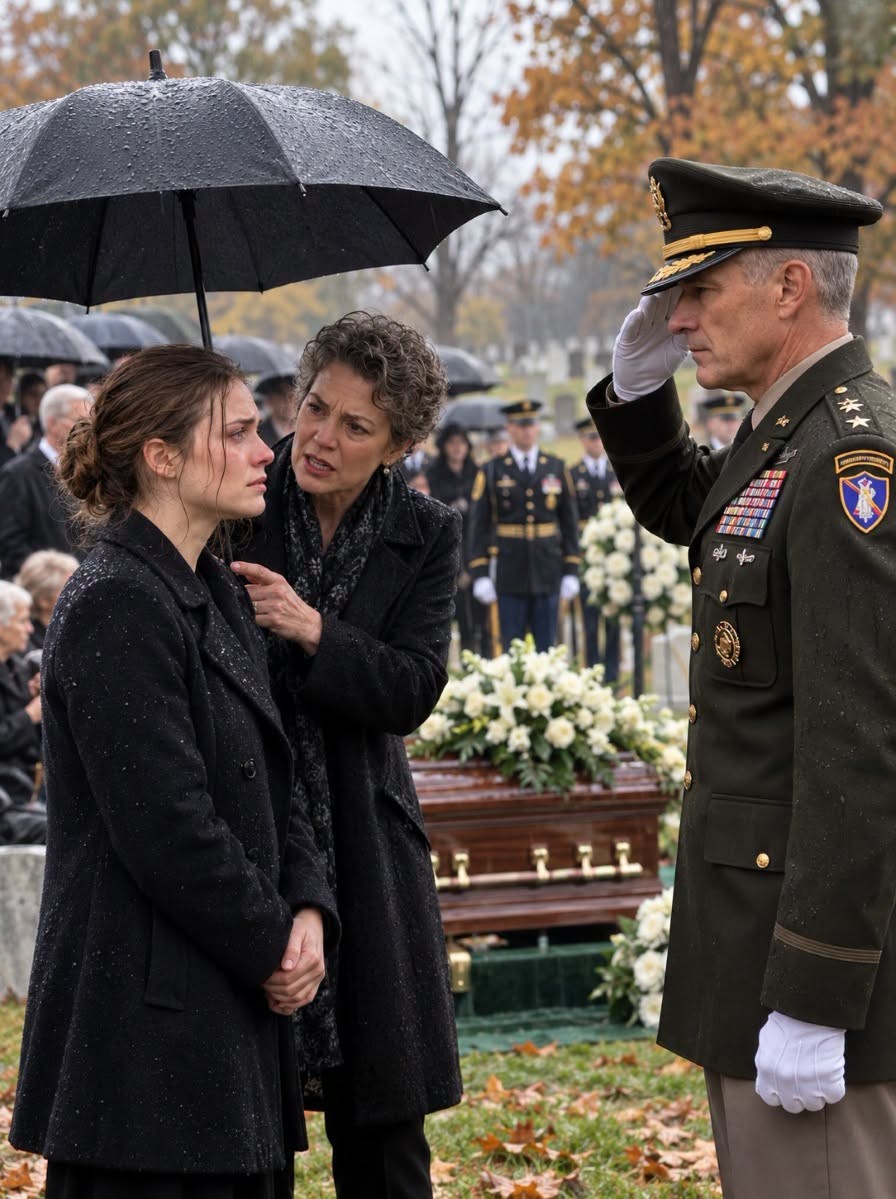
The rain was falling over Arlington National Cemetery when my older sister, Rebecca, stepped in front of me and called me a disgrace in front of our grieving family. I had barely arrived to say goodbye to Grandpa, a retired four-star general who had served his country for 42 years, when she began reminding everyone that I had supposedly abandoned them. For five years, my relatives believed I had walked away from the Navy and disappeared without caring what happened to anyone. I couldn’t defend myself, even as Rebecca listed the family gatherings, holidays, and important moments I had missed. The truth was that I had spent those years on a classified military assignment that prevented me from contacting the people I loved. I had come home hoping to mourn quietly, but then a military sedan pulled up, and the officer who stepped out changed everything.
The four-star general walked past the politicians, senior officers, and influential guests gathered near the chapel. Instead of approaching my sister or offering condolences to my parents, he stopped directly in front of me and delivered a formal salute. “Commander Claire Whitmore,” he said, expressing his condolences on behalf of my team. Rebecca stared in disbelief as he explained that I had never left the military; my assignment had simply required complete secrecy. Before I could answer her questions, another retired officer approached carrying an envelope my grandfather had left behind. Inside was a photograph of us together in my dress uniform and a handwritten letter telling me he had always believed in me. But the final pages revealed something far more painful: someone in our own family had known about my assignment and used my absence to deceive everyone.
After the funeral, my grandfather’s attorney gathered the family in his Old Town office and played a recording Grandpa had prepared before his death. He revealed that Rebecca had received a letter explaining my assignment, along with a power of attorney intended to help manage my finances while I was away. Instead, she had hidden the letter, told everyone I had quit the Navy, and used the legal authority to sell my townhouse for $612,000. After the mortgage was paid, $287,400 went into a business account connected to her husband’s company. Financial records also showed that $214,600 had been transferred from my military pay, while $38,240 from my account had covered our mother’s surgery—a bill Rebecca had claimed she paid herself. Grandpa had uncovered the transactions and amended his $1.9 million estate trust, naming me successor trustee and requiring restitution before Rebecca could receive her inheritance. The evidence left her with nowhere to hide.
I refused to make a decision about criminal charges during the funeral, but I immediately revoked the power of attorney and arranged an enforceable repayment agreement through the attorney. Over the following 14 months, money from Rebecca’s home sale and her husband’s business account was returned, and she began making monthly payments. She also repaid our mother and admitted what she had done. I used approximately $633,000 from my grandfather’s investment accounts to establish a foundation supporting families of service members whose classified work keeps them away from home. Eventually, I returned to the lake house Grandpa had left me, where a new yellow kettle and a handwritten note were waiting in the kitchen. My family slowly began rebuilding its relationships, and even Rebecca joined me on the dock to learn how to fish. Grandpa had spent years protecting my name, but his final gift was something more lasting: the chance to come home and begin again.