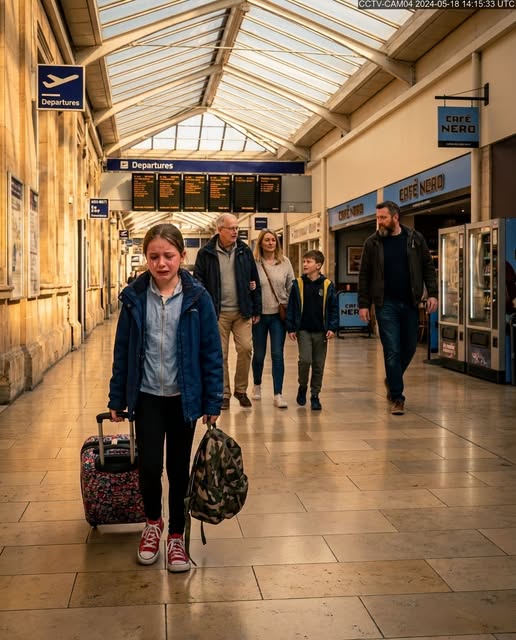
“Mom, Grandma and everyone got on the plane without me.” My nine-year-old daughter’s trembling voice barely rose above the noise of Denver International Airport, where boarding announcements echoed and suitcase wheels rattled across the polished floor. It was 5:42 on a Thursday afternoon, and I was standing outside a conference ballroom in Minneapolis, struggling to understand what Emma had just told me. When I switched our call to video, I saw her sitting alone on a metal bench near Gate B19, clutching her purple backpack against her chest while an airplane pulled away from the jet bridge behind her. Her cheeks were wet, and her yellow sweatshirt looked painfully bright against the gray airport seats. “Aunt Lauren told me to wait here,” she whispered. “She said somebody would come back.” Before I could answer, a message arrived from Lauren explaining that the airline had offered six discounted first-class upgrades, and because seven family members were traveling, they had decided Emma was the easiest person to leave behind. Then my daughter looked straight into the camera and asked a question I will never forget: “Mom, did I do something wrong?”
My name is Rachel Dawson, and I was the director of security operations for a large logistics company, accustomed to managing emergencies, assessing risks, and making difficult decisions under pressure. Yet nothing in my professional life had prepared me for hearing my child ask why her own family had abandoned her. Emma was supposed to be enjoying a weeklong vacation in San Diego with my parents, Frank and Linda, my younger brother Scott, his wife Lauren, and their daughters, Madison and Sophie. I had purchased Emma’s $412 plane ticket, contributed toward the hotel and activities, and entrusted my father with a credit card for her meals, transportation, and emergencies. Before leaving, my mother had promised to watch Emma carefully and treat her exactly like her other grandchildren. Instead, six family members had boarded the plane while my daughter remained at the gate without an approved unaccompanied-minor arrangement or anyone assigned to supervise her. I immediately contacted Denver airport police, the airline, my company’s travel security office, and my attorney, Maya Reynolds. While keeping Emma on video, I directed her to remain where she was until a uniformed officer arrived. Twenty-two agonizing minutes later, Officer Tanaka sat beside her and assured me she was safe. Only then did I begin to feel my breathing return to normal. But the messages kept coming. My mother posted photographs of herself enjoying champagne in first class, my nieces smiling over chocolate cake, and Lauren relaxing in her spacious seat. Beneath one photograph was a cheerful announcement that the family vacation had begun. Another message suggested Emma needed to learn that plans sometimes changed. I saved every photograph, text, and itinerary before booking a $689 flight to Denver. When I finally reached Emma near the airport police office that night, she ran into my arms wearing an oversized sweatshirt an officer had given her. She trembled against me as though she were afraid I might disappear, too. The airline’s operations manager confirmed that her abandonment had not been an innocent seating mistake. No employee had agreed to take responsibility for her. My relatives had simply left her behind.
As Emma slept against my shoulder later that evening, I began examining the financial arrangements I had made for people who apparently considered my generosity an unlimited entitlement. A call to my bank revealed that the first-class upgrades had cost $3,740 and had been charged to the card I provided for Emma’s travel needs without my permission. I froze the account and disputed the charge. Next, I withdrew my payment authorization and corporate discount from the three resort rooms my family had reserved in San Diego. Without my employment benefit, the nightly rate increased from $220 to $815 per room. Finally, I contacted the attorney handling my parents’ purchase of a $485,000 retirement townhouse in Scottsdale. Because they lacked sufficient qualifying income, I had agreed to guarantee their mortgage using my salary and credit history. I notified the attorney that I was withdrawing my support, subject to the lender’s formal approval. The consequences came quickly. My father’s travel card was declined at the rental counter, the resort required my family to arrange and pay for rooms independently, and the townhouse closing was suspended when the lender could no longer rely on my guarantee. My parents faced the possible loss of their $45,000 deposit. They flooded my phone with angry messages, accusing me of destroying their vacation and retirement plans. Meanwhile, Emma was waking from nightmares and refusing to sleep without the lights on. A pediatric examination documented her acute distress, and subsequent therapy addressed separation anxiety triggered by the experience. What finally removed any lingering doubt about my family’s intentions was the airport security footage obtained during the investigation. It showed Lauren speaking to Emma for seventeen seconds before directing her toward the bench. One by one, the others boarded the aircraft. Scott even turned around at the jet bridge, saw Emma sitting alone, hesitated, and continued onto the plane. Investigators also recovered a separate family group chat revealing that the six travelers had discussed leaving her behind and taken a vote. My father had suggested voting so responsibility would be shared, while Lauren had reasoned that I could simply fly to Denver and collect Emma. Even the two other children had been drawn into the decision without understanding its seriousness. Scott later admitted that someone had proposed keeping an adult with Emma in economy, but my mother refused to give up what she described as her first opportunity to fly first class. Six people had chosen their comfort over one little girl’s safety, and the documents showed exactly how deliberately they had done it.Get Parenting Tips
The legal and financial repercussions unfolded over the following year. After reviewing airport surveillance, boarding records, witness statements, and electronic messages, Denver authorities pursued child abandonment and child endangerment allegations. My parents accepted plea agreements involving probation, counseling, and community service, along with $6,280 in restitution related to Emma’s medical care, therapy, and emergency travel. Lauren entered a diversion program that included parenting classes and child-safety training, while Scott received lighter penalties after cooperating with investigators. The airline imposed an eighteen-month travel restriction on my parents and Lauren, and their travel insurance claim was denied. My parents ultimately lost the Scottsdale townhouse transaction, though they were far from destitute; they later sold their Chandler home with more than $300,000 remaining after the mortgage was satisfied and moved into a smaller rental near Tucson. Scott and Lauren separated as the investigation exposed their conflicting accounts. Through Maya, I sent formal no-contact notices, updated Emma’s school pickup authorizations, and made clear that none of those adults had permission to approach or collect my daughter. When they appeared uninvited at my house demanding that I repair their financial problems, I contacted police and refused to let them inside. My priority was no longer preserving appearances or paying whatever amount would restore family harmony. It was helping Emma feel safe again. Her psychologist, Dr. Lisa Kemper, worked with her through the fear that followed her from the airport into school, bedtime, and ordinary moments when I briefly left a room. Gradually, Emma stopped checking every few minutes to see where I was. She began sleeping without the hallway light. For her tenth birthday, she asked to visit the Monterey Bay Aquarium, and together we planned her first flight since Denver. Before boarding, she asked what I would do if an airline offered me a complimentary first-class upgrade. “I’d say no,” I told her. “Not if it meant leaving you.” We sat together in row seventeen, and somewhere over California, she fell asleep with her head on my shoulder. My arm went numb, but I did not move. Months later, my mother sent a letter that finally acknowledged what the others had tried so hard to excuse: they had valued their comfort over Emma’s safety and assumed I would repair the damage. I kept the letter without reopening contact. Scott eventually wrote a separate apology admitting that he had seen Emma alone and boarded anyway because confronting the family felt uncomfortable. I answered him with a single sentence: “Tell the truth even when nobody rewards you for it.” Accountability mattered, but it did not automatically restore access to my child.Track Pregnancy
Two years after that terrible afternoon at Gate B19, Emma and I were collecting our luggage at Phoenix Sky Harbor when she noticed a young boy crying beside a baggage carousel. An airport employee was kneeling beside him, speaking gently into a radio, and Emma stopped to watch. Within minutes, a woman rushed across the terminal calling the boy’s name, and he ran into her arms. Only after seeing them reunited did Emma turn back toward me. “Nobody should leave a kid because a better seat shows up,” she said. I squeezed her hand and agreed. In the years since Denver, our lives had become quieter in ways I once would have considered impossible. I no longer financed my relatives’ emergencies or allowed their demands to determine how I spent my time. Looking through old records, I discovered that I had given my parents, Scott, and Lauren more than $41,000 over five years, often to settle debts they never intended to repay. I redirected those resources toward Emma’s education savings and reduced my business travel so we could enjoy more evenings together. Emma continued therapy, regained her confidence, and learned that setting boundaries did not mean being unkind. My parents occasionally sent letters through their attorney, but I kept them in a box for Emma to consider when she was old enough to make her own decisions. I did not erase the happy memories of birthdays, holidays, and family dinners, nor did I pretend those years had meant nothing. But I could no longer ignore the pattern behind them: whenever someone had to sacrifice comfort, convenience, or attention, my daughter and I were expected to be the ones who yielded. That expectation ended the day six people boarded an airplane and left a nine-year-old alone. As Emma and I walked toward the parking garage, she slipped her hand into mine without hesitation. I thought about the frightened little girl on the airport bench and the confident child beside me now. I had not been able to prevent the betrayal, but I could make certain that her future would not be shaped by it. My family had once taken a vote on whether Emma deserved protection. I would never need one to decide.