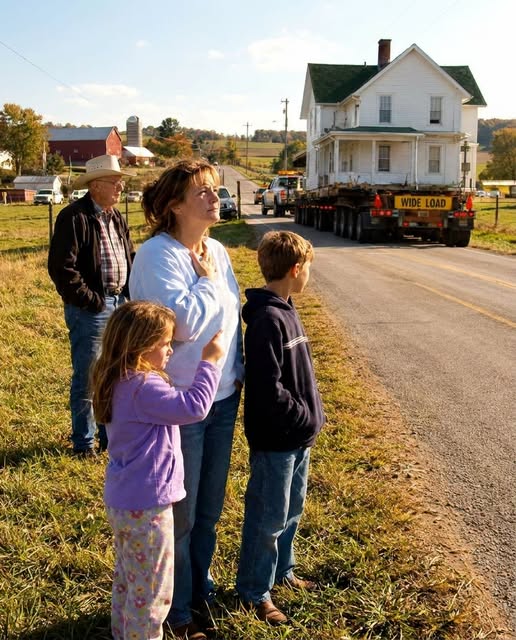
My father-in-law set his coffee cup on my kitchen table, folded his hands, and calmly informed me that the house my husband and I had built belonged to him. Outside, the Nebraska wind pushed against the kitchen windows, while down the hallway, our two children slept in the bedrooms we had finished with our own hands. “That house sits on my ground, Kayla,” Gordon Rasmussen said, as casually as if he were discussing the price of cattle. “Anything on my ground is mine.” I stared at him, trying to understand how a man who had watched us spend years building every wall could say such a thing. On the refrigerator behind him hung my son Cole’s spelling test and my daughter Hailey’s drawing of a horse, ordinary reminders of eleven years spent making this place our home. Gordon explained that he had recently consulted an attorney about his will and wanted us to understand that, because the land was legally his, he believed the house would be treated as part of his property. Then he finished his coffee, stood up, and walked out, leaving me at the table with the terrible realization that the roof sheltering my family might never have been ours in the way we believed.
My name is Kayla Rasmussen, and at thirty-nine, I worked as a paraprofessional at an elementary school in Hemingford, Nebraska, while my husband Jake repaired agricultural machinery at an implement dealership. Eleven years earlier, we had been struggling to make ends meet in a drafty rental house in Alliance when Gordon offered us approximately two acres of his farmland near the shelterbelt. His wife, Ruthann, had smiled warmly as he suggested we build a home there, and we believed the offer was a generous opportunity to establish ourselves without purchasing a building lot. Jake designed a modest twelve-hundred-square-foot, three-bedroom house on graph paper, and my father, Lowell Olson, helped him frame it over two long summers. We borrowed equipment, worked evenings and weekends, spent our savings, and secured a small credit-union loan using Jake’s tools and truck as collateral. I hung drywall until my shoulders ached, while Jake and Dad built the structure on a concrete-block crawl space because a basement was beyond our budget. Banks were unwilling to offer us a conventional mortgage on a house standing on land we did not own, but we pressed forward, believing that family arrangements did not always require complicated legal paperwork. We moved in when Hailey was two, and Ruthann arrived carrying a homemade cherry pie, her eyes filling with tears as our little girl ran laughing across the unfinished floor. The following month, Gordon unexpectedly announced that we would owe him $500 every month for use of the ground. Jake, raised to obey his father and reluctant to challenge him, wrote the first check that evening. We continued paying for eleven years, through medical bills, vehicle repairs, reduced work hours, and countless other financial hardships. One hundred and thirty-two payments amounted to $66,000 for a small corner of pastureland, far beyond what we understood comparable agricultural ground might have earned in rent. Gordon accepted every check without thanks, while Ruthann quietly helped us with groceries and small expenses whenever she could. After she died from a stroke six years earlier, there was no one left to soften his demands. When Gordon finally announced that he considered the house his property, Jake was devastated. A farm-law attorney in Alliance explained that buildings permanently attached to another person’s land can become part of the real estate unless the parties have properly documented a different ownership arrangement. Without a written land lease, building agreement, or other recorded instrument protecting our interest in the structure, establishing our rights could require an expensive legal dispute over the original promises, the parties’ conduct, and the nature of the improvements. Our payment records proved we had paid Gordon regularly, but they did not necessarily establish ownership of the house or a right to remove it. The attorney warned that litigation could take years, cost substantial money, and leave Jake testifying against his own father. I could not bear the thought of tearing apart what remained of their relationship, so we continued paying while I tried to find another solution. By late August, after months of worry, my own father telephoned and asked why I had been crying in the school parking lot. When I finally told him everything, he listened without interruption. Then he offered us two acres beside his windbreak, only three miles away, promising to transfer the land into our names properly. I told him that his kindness did not solve the problem because our house was still sitting on Gordon’s property. My father was silent for a moment before saying something that changed the course of our lives: “Houses move, honey. I watched one go down this road in 1971.”Marriage counseling
The following morning, Jake stood in our kitchen doorway studying the walls he had framed with my father, his hand resting on the woodwork beside the pantry. He told me Lowell had already spoken to him about the land and the possibility of relocating the house. For the first time in months, my husband sounded determined rather than defeated. “Call a house mover, Kay,” he said, his voice breaking slightly. We contacted Arnie Kessler, an experienced building mover from Scottsbluff whose family had transported houses across the Nebraska Panhandle for three generations. After inspecting the structure and crawling beneath the floor to examine the framing, he assured us that our single-story house, built on a block crawl space without a basement, was a suitable candidate for relocation. The estimate for raising it onto steel beams, transporting it, and placing it on a new foundation was $23,800. Once we included permits, utility coordination, foundation work, water connections, and septic installation, the projected cost rose to slightly more than $38,000. Jake and I had saved only $19,000 over nine years, money intended for our children’s futures and unexpected emergencies. My father insisted on covering the difference, refusing to treat it as a loan, while Jake arranged to tell Gordon our decision personally. Their conversation took place in Gordon’s machinery shed on a September afternoon. When Jake returned, he sat alone in his pickup for nearly half an hour before telling me his father had said we were welcome to take our lumber but that the land would remain his. Gordon predicted we would return by Thanksgiving and dismissed the idea that anyone would spend tens of thousands of dollars moving a house merely to avoid paying monthly ground rent. He did not, however, attempt to stop us. With his stated permission to remove the structure, we began coordinating the move with the contractor and local authorities. Over the following six weeks, my father and Jake prepared a new foundation, the county engineer reviewed the three-mile route, and the rural electric cooperative arranged to raise overhead lines where necessary. A particularly troublesome culvert required special attention, while plumbers and electricians disconnected the house from its original utilities. For two weeks, we lived in spare rooms at my father’s place as movers prepared the building for transport. I packed dishes, removed fragile belongings, and secured furniture, but I left the yellow kitchen curtains hanging because Ruthann had helped me sew them during our first winter there. On the evening before the move, we took the children back to inspect the house, now resting three feet above the ground on temporary supports and heavy steel beams. Inside, nine-year-old Cole stood crying beside the pantry doorway. For years, we had marked the children’s heights on its wooden frame, with Hailey’s measurements on one side and Cole’s on the other. Near the bottom was a note in Ruthann’s careful handwriting commemorating Cole’s first birthday. He asked whether his grandfather would keep those marks because they were attached to a house that had stood on his land. His question broke my heart, revealing how deeply the dispute had affected our children despite our attempts to shield them. I knelt beside him and explained that the markings were part of the house itself and would travel with us. Hailey, now thirteen, asked to add one final inscription above the others. Jake handed her a carpenter’s pencil, and she carefully wrote the date followed by the words, “The night before we took our house home.” I stood beside them in that nearly empty kitchen, realizing that we were not abandoning eleven years of family memories. We were taking them with us, right down to the pencil marks on the pantry door.Get Parenting Tips