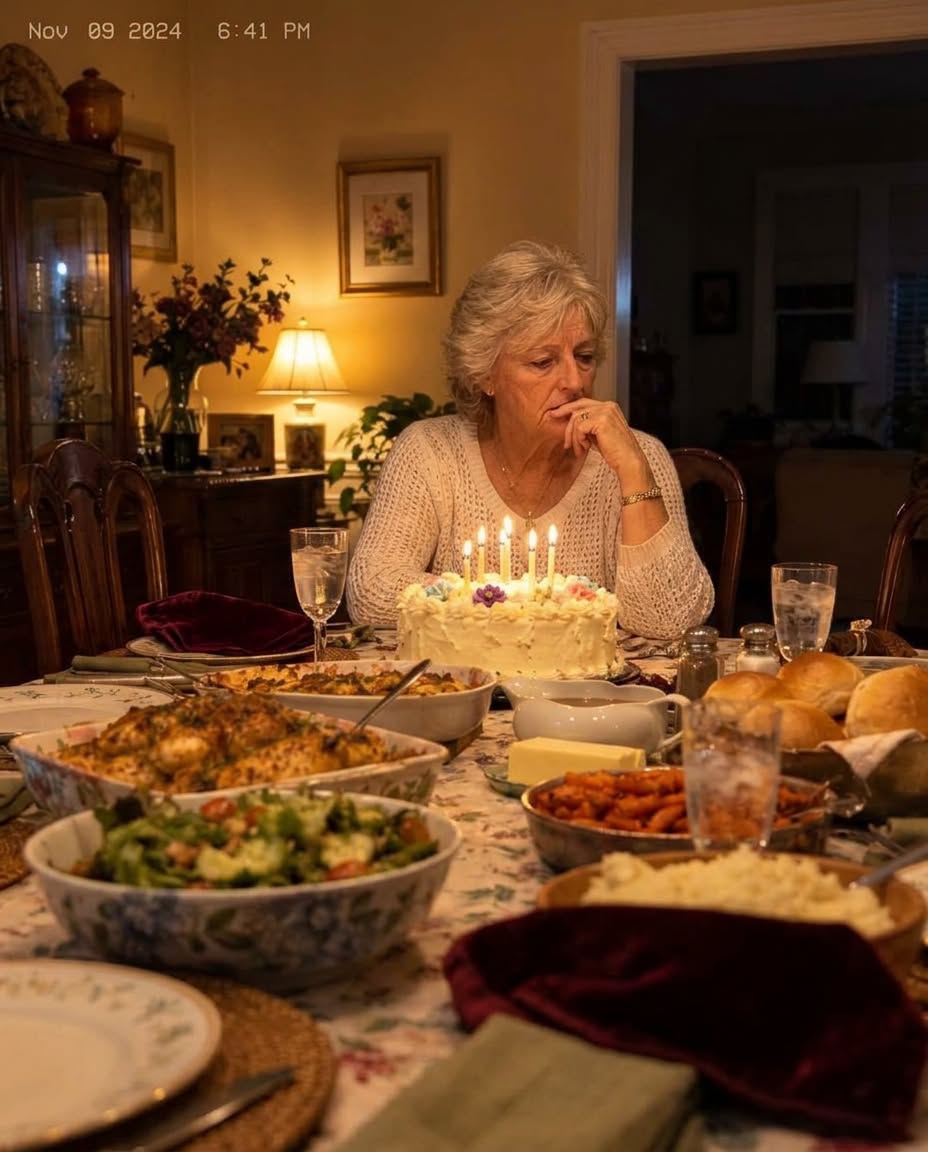
“Ma’am, I need you to come with me.” The young police officer stood beneath my porch light, holding a folded note addressed simply to Mom, while moths fluttered against the yellow bulb above his head. Behind me, my dining room table was set for seven, the candles nearly burned out and the food I’d spent two days preparing cold beneath sheets of aluminum foil. For four hours, I’d waited for my six children to arrive for my sixtieth birthday, calling each of them until every unanswered ring began to feel like another small rejection. Now a uniformed stranger was at my door with a message written in my son Grant’s familiar handwriting: Don’t call anyone. Don’t ask questions. Just listen to him and get in the car. My hands began shaking because Grant was the child who had worried me most, the one whose teenage years had included police visits, late-night telephone calls, and mistakes I still struggled to forget. I asked the officer whether my son was alive, but he looked away and told me Grant would explain everything. Standing there with my birthday dinner untouched behind me, I was certain that the worst phone call of my life had finally come in person.
My name is Linda Henderson, and I live in Fort Wayne, Indiana, in the same modest house where I raised six children. When I married Ray Henderson, I was twenty-three and worked as a receptionist at a dental office. Ray sold farm equipment, had a booming laugh, and said he wanted a house so full of children that nobody would ever have to eat dinner alone. We had six in ten years: Mark, Jason, Caleb, Grant, Sarah, and Eliza. Four boys, two girls, and enough noise to make our little house on Wells Street feel twice its size. The first years were happy in the hectic way large families often are. Ray came home from work and wrestled the boys on the carpet, carried the girls on his shoulders, and made Sunday pancakes shaped like cartoon characters nobody could recognize. But as the children grew older, his enthusiasm faded. He began staying late at work, withdrawing to the basement after dinner, and treating the family’s everyday needs as interruptions. When our youngest, Eliza, was six, he told me he’d fallen in love with a woman he had met online and intended to move to the Philippines. He packed one suitcase and left. Two days earlier, he’d emptied our joint savings account of approximately $14,000. I stood in the hallway listening to his truck pull away while six children waited upstairs, not yet knowing their father wasn’t coming back. With legal assistance, I obtained a divorce and a child-support order requiring Ray to pay $1,100 a month. He made three payments before moving overseas and becoming increasingly difficult to pursue through enforcement channels. By the time Eliza reached adulthood, accumulated unpaid support had grown to more than $160,000, although the enforceability and collectability of those arrears remained separate questions. Whatever the court documents said, I couldn’t buy groceries with money he never sent. I left the dental office for a position in the cafeteria at Northrop High School because the schedule helped me remain available to my children. Eventually, I became cafeteria manager. Three evenings a week, I also worked on medical billing for a local hospital, learning insurance codes, claims procedures, and the persistence needed to resolve rejected payments. I worked long days, often sleeping only a few hours before starting again. When the furnace failed, I refinanced the house. When Caleb needed braces, I borrowed against my retirement savings. When Jason broke his arm playing football, I arranged a hospital payment plan and spent years paying off the balance. I attended games, concerts, parent-teacher meetings, school plays, and weekend activities at the Kingsland Community Center. My children watched me work, worry, repair things, and keep going. Sometimes I was short-tempered. Sometimes there wasn’t enough money for the extras their friends enjoyed. But I tried never to make them feel abandoned. Over time, they grew into adults with lives of their own. Mark became an accountant, married, and had two children. He remained serious and protective, often calling to remind me about property taxes or retirement paperwork. Jason became an electrician, with a booming laugh and a talent for making even an ordinary customer complaint sound hilarious. Caleb became a physical therapist, thoughtful and observant, the child who remembered things I’d said years earlier. Sarah worked as an emergency department nurse at Parkview, fearless when someone needed defending and sometimes too quick to defend them before hearing the entire story. Eliza, my youngest, became a second-grade teacher and still occasionally curled up beside me on the sofa when she came home for the weekend. Then there was Grant. He was ten when Ray left, and of all my children, he seemed to absorb the loss most deeply. Before his father disappeared, Grant was a cheerful little boy who followed him everywhere. Afterward, he became angry and restless, getting into fights, arguing with teachers, and daring anyone to tell him what he couldn’t do. At fifteen, police brought him home after he spray-painted a grocery-store wall. At seventeen, he drove my car without permission and damaged a neighbor’s mailbox. He enrolled in community college twice and left both times before completing a semester. I worried about him constantly. Every late telephone call made my stomach tighten, and whenever he failed to come home when expected, I imagined hospitals, accidents, and police stations. Yet I never stopped telling him that his mistakes didn’t have to decide his future. I wanted him to find something that mattered enough to work for, something that would make him understand he was capable of becoming a dependable man. By the time I turned sixty, Grant was twenty-nine, working irregular jobs and telling me little about his plans. I loved every one of my children, but he was the one whose silence could frighten me fastest. That afternoon, I’d expected all six for dinner at four. I made Mark’s pot roast with the carrots cut lengthwise, Jason’s extra-cheesy scalloped potatoes, Caleb’s green bean casserole, Sarah’s homemade rolls, Eliza’s macaroni salad, and Grant’s chocolate sheet cake with fudge frosting. I set out the ivory china my own mother had given me when I married, washed and ironed the cloth napkins, and placed two white candles at the center of the table. At five, I sent a cheerful message reminding everyone to drive safely. Sarah began typing a response, but the three little dots disappeared without a message appearing. At six, I called Mark, then the others. Every call went to voicemail. At seven, the roast was cold. By eight, I’d stopped checking the oven and begun staring at the empty chairs. At nine, I sat at the head of the table and cried into one of the napkins I’d ironed that morning. I had spent more than two decades making sure my children didn’t experience the loneliness their father had left behind. Now all six seemed to have forgotten me on a day I’d hoped we would celebrate together. When the officer knocked, I could think of only one explanation: something had happened to Grant, and nobody had known how to tell me.Order Takeout
I put on my cardigan, locked the house, and climbed into the back of the police cruiser. The hard plastic seat smelled faintly of disinfectant, and the partition between the front and rear made the ride feel more frightening than reassuring. I kept asking where we were going and whether my children were safe. The officer, who introduced himself as Nate Alvarez, eventually confirmed that nobody in my family had been reported injured, but he refused to explain the note. My phone buzzed while we drove. Mark had texted: Mom, please don’t panic. Just trust us. I stared at the words, furious that he apparently knew something I didn’t. I replied in capital letters asking where everyone was. There was no immediate answer. When Nate turned into the parking lot of the Kingsland Community Center, I recognized the building at once. I’d spent years on its wooden bleachers watching basketball games, volleyball matches, scouting ceremonies, and school celebrations. Through the windows, I could see lights and movement. Parked outside were Mark’s gray Honda, Sarah’s blue Corolla, Jason’s white work truck, Caleb’s Subaru, and Eliza’s Jeep. Nate led me to the entrance and opened the door. The gym lights came on, revealing purple-and-gold balloons, long tables loaded with food, a beautiful three-layer cake, and a banner reading HAPPY 60TH, MOM! Five of my children stood beneath it. Jason began shouting a birthday greeting, then stopped when he saw my face. Mark looked as though he’d been caught stealing, Sarah immediately noticed that something was wrong, and Eliza covered her mouth with both hands. I asked why they’d left me waiting alone for four hours. Their explanation came in fragments. They’d planned a surprise party and had arranged for Grant to pick me up at five. He was supposed to tell me our plans had changed, then bring me to the community center. To avoid accidentally revealing the surprise, the others had kept their phones quiet and trusted his messages saying he was running late. At four thirty, he’d written that he had everything handled. Later messages said he would arrive soon. By eight forty-five, he’d told them someone else would collect me. None had checked directly with me because they were afraid of spoiling the celebration. As they spoke, I felt something worse than disappointment. I wanted to know where Grant was. I demanded an explanation from Nate, but before he could answer, headlights swept across the gym doors. Another police cruiser pulled up, and a tall man in a dark-blue uniform stepped out. It was Grant. His hair had been cut short, his shoes were polished, and the silver badge on his chest caught the overhead lights as he walked inside. A nameplate above his pocket read HENDERSON. For several seconds, nobody spoke. Then Sarah asked whether he had lost his mind. Grant held up his hands and apologized for the scare. Seven months earlier, he explained, he’d applied to become a police officer with the Fort Wayne Police Department. He passed the entrance examination, physical assessments, background review, and other required stages, although his juvenile offenses and troubled teenage years had required careful scrutiny. He’d been honest about the mistakes he’d made and the changes he’d tried to make since then. After receiving permission to continue, he’d begun police academy training, telling the family he was working nights at a warehouse because he didn’t want anyone anticipating his failure. That afternoon had included his formal swearing-in and administrative processing. He’d expected to finish by four, collect me at five, and arrive at the surprise party in uniform. But the required paperwork, equipment arrangements, and other processing took longer than anticipated. Instead of calling me directly, he’d kept sending vague messages to his siblings, convinced he could still preserve the surprise. When he finally realized how late it was, he asked Nate, a fellow officer he knew from training, to bring me to the community center. He’d written the note on the back of a spare form, thinking its mysterious wording would make the surprise more dramatic. He had not imagined that after four hours without hearing from my children, a police officer appearing on my porch would make me fear someone was dead. Sarah, who had delivered terrible news to families in the emergency department, told him plainly how frightening his idea had been. Mark admitted that none of the siblings had thought beyond protecting the surprise. They had made elaborate arrangements for decorations, food, and cake but had neglected the simplest responsibility: letting me know I wasn’t forgotten. I asked Grant why he’d hidden the academy from me for seven months. He looked down at his shoes before answering. He’d heard so many people predict that he would fail, he said, that he’d wanted to accomplish something before allowing anyone to judge him. Teachers, neighbors, and even Ray had spoken as though his future was already settled. The one person who’d continued telling him he could choose another path was me. He wanted to become the kind of man I could be proud of, and he’d hoped the sight of him in uniform would be enough to explain all the months of secrecy. I looked at the badge, then at the grown man wearing it, and remembered a ten-year-old boy waiting near the front window for a father who never returned. I was proud that Grant had worked toward a demanding goal, but I was also hurt that he’d turned my birthday into an ordeal because he was afraid of disappointing me. Then he took another folded paper from his pocket. It was a program for the academy’s upcoming graduation and badge-pinning ceremony, scheduled for the following Friday at the Grand Wayne Center. He showed me a line stating that a family member could participate in the presentation of each graduate’s badge. He’d reserved a place for me in the front row and wanted me to pin his badge on his uniform before the audience. As I held the program, he said he hadn’t joined the department merely to prove he could wear a uniform. He’d wanted a profession that would hold him accountable and give him a chance to help other families when they were frightened. For the first time all evening, I understood how much the surprise had meant to him. My son had spent seven months trying to become someone I could trust, yet in his determination to give me a perfect birthday, he’d repeated the one thing that had wounded our family most: leaving someone he loved afraid and wondering when he would come home.Grief support services