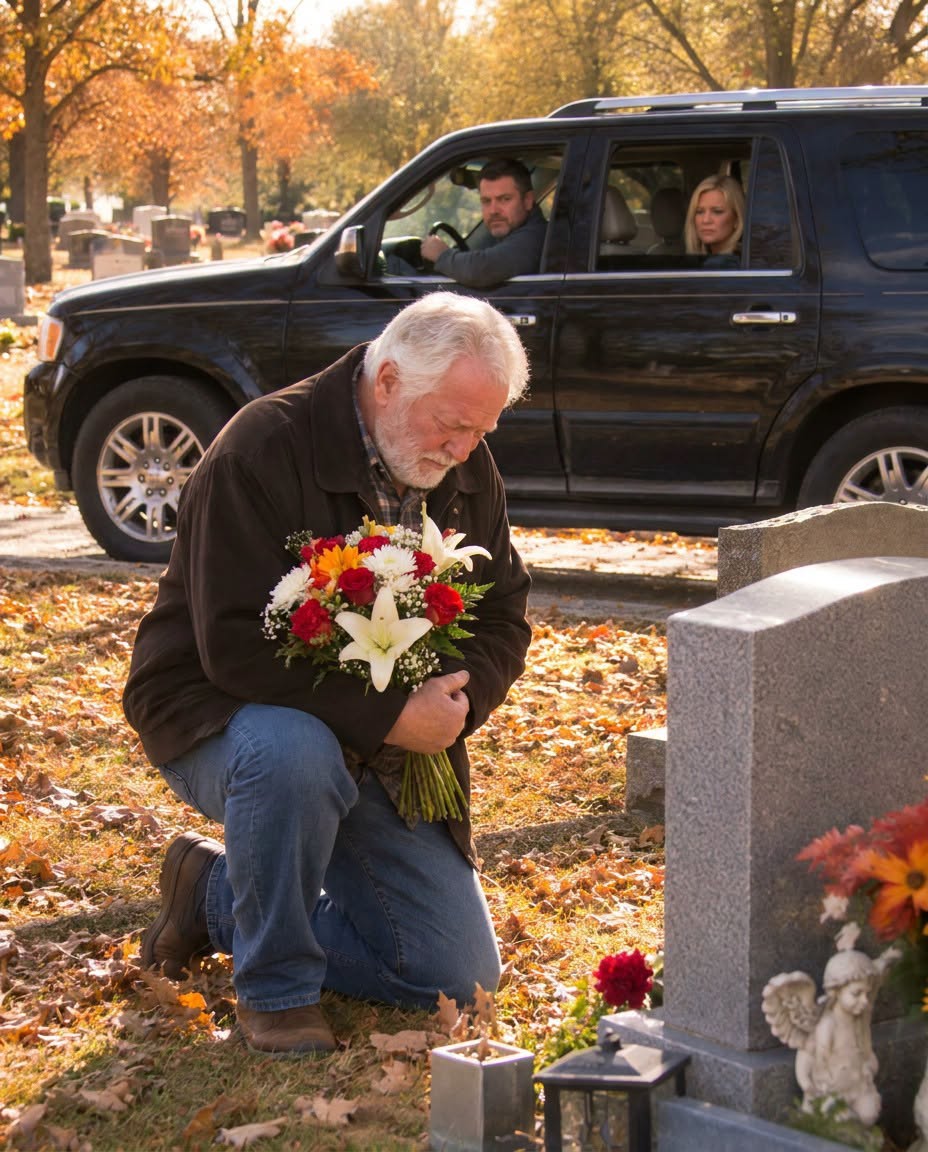
“You’re a burden. Walk home.” The message glowed on my phone as the black Cadillac Escalade disappeared through the cemetery gates, its tires crunching over the gravel until the sound faded into the November wind. I stood beside my wife’s grave holding a bouquet of white roses, my seventy-one-year-old hands stiffening in the thirty-four-degree cold. My son-in-law, Derek, had driven away without me, and thirty seconds later my daughter, Vanessa, sent another message: “Don’t wait, Dad.” I read both texts three times, scarcely believing that the people who had brought me to Marietta from our home in Shaker Heights, Ohio, had deliberately left me stranded 190 miles away. My bad knee throbbed from kneeling beside Eleanor’s headstone, and the bare oak branches rattled above me as I looked down at the inscription I’d chosen for the woman I’d loved for forty-three years. Beloved wife. Devoted mother. Builder of everything that mattered. Derek apparently thought I was a helpless old widower who would eventually beg him for a ride, but he had no idea that I still controlled the logistics company where he worked—or that he was scheduled to be considered for its second-highest executive position just two days later.
My name is Harold Bennett, and I met Eleanor Grace Hollis in 1979 at a diner in Marietta, where she was waitressing while studying accounting at Marietta College. I was twenty-four, driving a delivery truck for a feed company, and she’d brought me cherry pie instead of the apple I’d ordered. When I pointed out the mistake, she told me cherry was better and that I should trust her. She was right. I returned every Tuesday for months, deliberately ordering apple pie just to hear her make the same argument, and eventually proposed marriage on a napkin. We married in 1981 and settled near Cleveland, where I continued driving trucks while Eleanor kept books for a hardware store. In 1988, we borrowed two used Freightliners from a scrapyard owner named Sal Ferraro and started Bennett Freight at our kitchen table. I drove freight between Cleveland, Pittsburgh, Detroit, and Chicago, sometimes spending sixteen hours on the road, while Eleanor handled dispatching, customer accounts, invoices, and collections. She could persuade an overdue customer to settle an invoice without raising her voice, and she understood our finances better than anyone I’d ever met. As the business grew, she managed the books, trained staff, and helped build the relationships that allowed us to purchase more trucks and open additional facilities. Nearly four decades later, Bennett Freight & Logistics operated 640 trucks, four warehouses, and three distribution hubs, employing approximately 1,100 people and serving automotive suppliers, steel producers, and medical-device companies. Its most recent valuation was around $310 million. But when Eleanor was diagnosed with advanced ovarian cancer, I stepped away from daily management. I appointed Gloria Hamm, a former dispatcher who had worked her way up through operations, as chief executive and resigned from the board so I could spend my time with my wife. For four years, I accompanied Eleanor to appointments, cared for her at home, and watched the woman who had once balanced our company’s accounts without a calculator become too weak to walk through the garden she’d planted. Our daughter, Vanessa, assumed I had sold the business when I retired. I didn’t correct her, partly because Eleanor had urged me to keep our ownership arrangements private and partly because I wanted Vanessa and her husband to see me as her father rather than a source of money. Eleanor had never trusted Derek Lawson. He was polished, ambitious, and charming, with expensive suits and a talent for making other people feel that his success was inevitable. He married Vanessa in 2015 and approached me four years later about joining Bennett Freight after his previous employer began downsizing. Gloria and I interviewed him, found him qualified, and hired him as a regional sales manager. He performed well enough to earn promotions, eventually becoming vice president of sales. Yet he never understood that Gloria ran a company Eleanor and I still owned. Six years earlier, when I stepped back, our attorneys had reorganized the business with different classes of shares. Class A represented the economic interests, including shares held through family arrangements and employee-related holdings. Class B carried enhanced voting rights, and I retained all of those shares. Subject to the company’s governing documents and required corporate procedures, they gave me the authority to reshape the board and return to its leadership if necessary. Eleanor had called the structure our emergency brake. She hoped I’d never need it. After she died, I rarely thought about the business at all. I spent my days in our Shaker Heights house, tending her roses and trying to endure the silence. Vanessa visited less often than I wished, while Derek occasionally came to dinner and asked increasingly pointed questions about my property and finances. Three months before the cemetery incident, he suggested transferring my house into Vanessa’s name through a quitclaim deed. He presented it as estate planning, claiming the transfer would avoid probate expenses and protect the property if I later needed long-term care. I told him I had an attorney and was not signing away the home Eleanor and I had bought in 1996. Transferring real estate during life can have serious consequences involving ownership, taxation, creditor exposure, long-term-care planning, and the loss of control, and his casual assurance that nothing would change wasn’t enough. When I refused, his attitude hardened. Vanessa stopped calling regularly, Derek described me as stubborn, and both began suggesting that my age made me incapable of handling important financial decisions. Vanessa even left a voicemail mentioning the possibility of a conservatorship. I listened to it repeatedly, struggling to understand why refusing to give away my house was being treated as evidence of incompetence. Then my Buick developed transmission trouble, leaving me without transportation for the anniversary visit to Eleanor’s grave. I asked Vanessa and Derek to drive me to Marietta, where Eleanor had requested burial beside her parents in Oak Grove Cemetery. Vanessa reluctantly agreed, explaining that Derek was busy preparing for a board meeting at Bennett Freight, where he expected to be appointed chief operating officer. They collected me at six in the morning. Derek spent most of the journey discussing business on his hands-free telephone system, confidently telling colleagues that Gloria’s recommendation would guarantee the promotion. Vanessa barely looked up from her phone. At the cemetery, neither came up the hill with me. I placed the white roses beside Eleanor’s stone and spoke to her about the garden, the loneliness of our kitchen, and the mistakes I’d made planting tomatoes without her advice. I also told her I’d finally opened a letter she’d left in her jewelry box, marked for me to read on the anniversary. In it, she’d warned that guilt over the time I’d spent working might tempt me to purchase Vanessa’s affection with money and property. She reminded me that love shouldn’t require surrendering my dignity. I had been beside the grave for only about twenty minutes when Vanessa called up that they were leaving. I asked for ten more minutes. Derek accused me of seeking attention, and within moments their vehicle was gone.Garden tools
I stood there for another several minutes, uncertain whether they intended to come back, then finally accepted that they had abandoned me. The cold was uncomfortable, but it was the messages that hurt most. My daughter had been in the room during the last days of Eleanor’s illness. She knew how much her mother meant to me, and she knew I had driven to Marietta nearly every month since the funeral. I could understand being impatient about a long journey or worried about returning home late. What I couldn’t understand was leaving an elderly man with a painful knee at an almost deserted cemetery and then telling him to walk home. I took out my phone and called Richard Mercer, the corporate attorney who had advised Bennett Freight for twenty-seven years. He knew our ownership structure and had helped Eleanor and me prepare documents we intended to finalize someday. When I explained what had happened, he immediately asked where I could wait indoors and promised to arrange transportation. I told him I also wanted to revisit those documents and the company’s governance arrangements before Derek’s board meeting. Richard understood the significance of that request. Returning to the chairmanship would require proper shareholder and board action under the corporation’s governing documents, but the voting rights Eleanor and I had retained allowed us to initiate the process. While Richard made arrangements, I walked down to the caretaker’s office near the cemetery gate, where smoke rose from a chimney. Inside, an older man in a wool cap sat beside a stove eating a sandwich and reading the newspaper. He introduced himself as Clarence Dobbs and recognized me immediately. For years, he’d watched me visit Eleanor’s grave carrying white roses. More surprisingly, he had known her in high school. Clarence remembered her as the brightest student in their class, but what stayed with him was that she’d treated him kindly when other children mocked his family’s poverty. He told me stories I’d never heard: how she’d challenged a principal’s arithmetic during an assembly, organized a student protest over the cafeteria food, and once confronted a football player for humiliating a girl in the hallway. Clarence poured me coffee, shared his ham-and-Swiss sandwich, and spoke about Eleanor as though she might walk through the door at any moment. I laughed for the first time in what felt like years. Several hours later, a black Lincoln pulled up outside, and Tony Reyes stepped from the driver’s seat. Tony had been our first employee, hired in 1989 after returning from military service. Eleanor had liked his honesty, and he’d gone from driving one of our first trucks to becoming senior vice president of operations. He managed the fleet, knew many of our drivers by name, and still called me Mr. B. Richard had contacted him, and Tony insisted on driving all the way from Cleveland rather than sending a hired car. I thanked Clarence and climbed into the front passenger seat, where Tony and I had once sat during long business journeys. As we drove north, he asked what had happened. I told him about the proposed house transfer, the suggestions that I couldn’t manage my affairs, the cemetery, and Derek’s message. Tony became quiet. Then, somewhere south of Akron, he pulled onto the shoulder and said he needed to tell me something concerning Derek. For approximately six months, the operations team had questioned a fuel-supply arrangement Derek had negotiated with a Toledo company called Lakeshore Fuel Supply. The contract covered roughly 200 trucks, but its rates appeared to be about eleven cents a gallon higher than comparable arrangements, costing Bennett Freight an estimated $400,000 more annually. Tony had raised concerns because Derek continued renewing the contract despite objections from operations. There were also reports of Derek’s personal relationship with Lakeshore’s owner. A young dispatcher had seen him at the owner’s daughter’s wedding, seated prominently and described as a business partner. Tony had reported the concerns to Gloria, who ordered a confidential audit. He hadn’t seen the final report, but it had recently been completed. I called Gloria from the car. She confirmed that the review had identified approximately $310,000 in payments from Lakeshore to a Delaware limited liability company called DL Consulting Group over fourteen months. The business was associated with Derek’s home address. The payments appeared alongside fuel contracts Derek had overseen, raising serious concerns about undisclosed conflicts of interest and possible improper compensation. Gloria explained that she had already decided to withdraw her recommendation for his promotion and present the findings to the board. I told her she had done exactly the right thing by investigating rather than overlooking the concern because Derek was my son-in-law. We agreed that the company needed to follow a documented process: preserve records, review relevant contracts and bank transfers, give Derek an opportunity to respond, and obtain independent advice about any civil or criminal implications. I also told her I intended to return to the company under the voting rights Eleanor and I had preserved. On the drive home, I looked out at the trucks traveling beside us, some carrying Bennett Freight’s familiar blue-and-white markings and the small red letter B Eleanor had designed years earlier. Derek had wanted my house, insulted my age, and left me at my wife’s grave, but the company’s audit revealed a different concern entirely. The man who believed I was powerless was about to enter a board meeting expecting a promotion, while the company he hoped to help run was examining evidence that he might have profited personally from its contracts.Get Marriage Tips