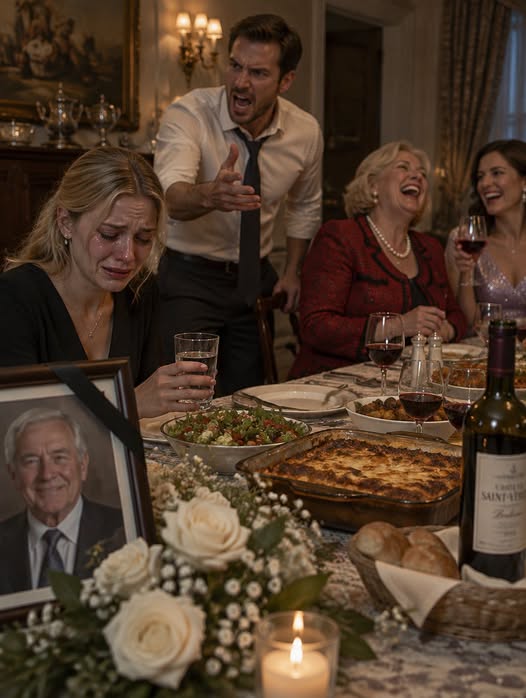
My father Arthur Vance had only been gone for seventy two hours when my husband decided our financial future was completely secure. Arthur built Vance Industrial from a small machine shop in Columbus into a highly successful manufacturing business, and his recent passing left me heartbroken and overwhelmed with funeral arrangements. Instead of sharing my grief, my husband David sat at our kitchen table and announced he had just quit his demanding regional sales management job of twenty two years. He confidently explained that my expected inheritance would easily fund an early retirement for both of us. His presumptuous behavior escalated that same evening when his mother Helen and his sister Rachel came to our home for dinner. Without ever consulting me, David promised to buy his mother a three hundred fifty thousand dollar house in Westerville because she had complained about rising rent. Moments later, he casually offered his sister two hundred thousand dollars to clear her failing business debts. I sat in stunned silence as I watched him distribute massive sums of money from an estate whose value was unknown to us. He treated my father passing away as nothing more than a guaranteed payout, brushing off my concerns by insisting he was simply trying to take care of his family.
The following morning, I received a phone call from Robert Hayes, the longtime attorney for my father, requesting that I come to his downtown Columbus office alone. This private meeting frustrated David, who believed our marriage entitled him to participate in all financial discussions. When I arrived, Robert revealed a completely different financial reality than the endless fortune David had imagined. While my father had indeed sold Vance Industrial for a substantial sum, a large portion of that money had already been allocated to taxes, business obligations, employee benefits, and secret scholarships. The remaining assets were considerable but not limitless. Most importantly, Robert explained that my father had placed all of my inheritance into a protective trust managed by an independent trustee. I was named as the sole beneficiary, and the strict distribution structure meant David had absolutely no legal authority to access the funds or commit those assets to his relatives. Furthermore, Robert disclosed the disturbing fact that David had secretly called the law office weeks before my father even died to ask probing questions about the inheritance process and his financial rights as a spouse.
During that same meeting, Robert handed me a blue folder containing a deeply personal handwritten letter from my father that provided the exact reasoning behind his strict financial arrangements. My father never accused David of being a terrible person, nor did he suggest that I should pursue a divorce. Instead, he gently pointed out a pattern he had observed over my twenty two years of marriage, noting the countless times I had quietly surrendered my own preferences just to avoid arguments. He recounted specific instances where David had volunteered our home for chaotic holiday dinners while I was sick or lent out my vehicle without asking, expecting me to simply accommodate his sudden generosity. My father wrote that I frequently mistook my own passive generosity for genuine permission, and he wanted to ensure his money never became a tool for manipulation. He established the trust to give me the ultimate freedom to share my wealth only when it was truly my own independent choice. Through his careful estate planning, my father was providing me with the necessary structure to finally establish boundaries and protect my own independence.
Returning home that afternoon, I faced the incredibly difficult task of informing David that his grand financial promises were completely impossible to fulfill. When I explained that the estate was locked securely within a trust for my exclusive benefit, he immediately became defensive and deeply frightened. He was forced to admit that he had recklessly resigned from his lucrative career without any backup plan, entirely assuming that I would act as his ultimate financial safety net. I also had to make uncomfortable phone calls to Helen and Rachel to retract the promises David had made, taking the difficult step of disappointing them while firmly refusing to take responsibility for my husband overstepping his boundaries. Rachel acknowledged that David was wrong to offer money he did not possess, and Helen agreed to drop her housing search. Meanwhile, a humbled David had to contact his former employer and beg for his position back, only to find that his resignation had already been processed. He was forced to accept a temporary consulting role at a lower salary, facing the direct consequences of planning a lavish future with money that never belonged to him.
Over the following months, the harsh reality of the situation forced us to confront the deeply rooted communication issues in our marriage, leading us to begin intensive couples counseling. Through counseling, David finally admitted that he enjoyed playing the role of the generous provider for his family, but he had unfairly expected me to fund those promises without ever asking for my consent. He eventually accepted a new management role at a smaller company that required far less travel, and he offered me a sincere apology for treating my father passing away like a convenient retirement opportunity. Nearly a year after the funeral, I returned to my father empty house in Columbus for the final time to hand over the keys to the new buyers, taking only his favorite blue tie from the closet as a cherished keepsake. A profound and lasting change had taken place in how we treated one another daily. David now consistently asked for my input before making any commitments involving our time or finances, and I had finally learned how to clearly express my own needs. My father had given me a lasting gift by forcing me to find my voice.