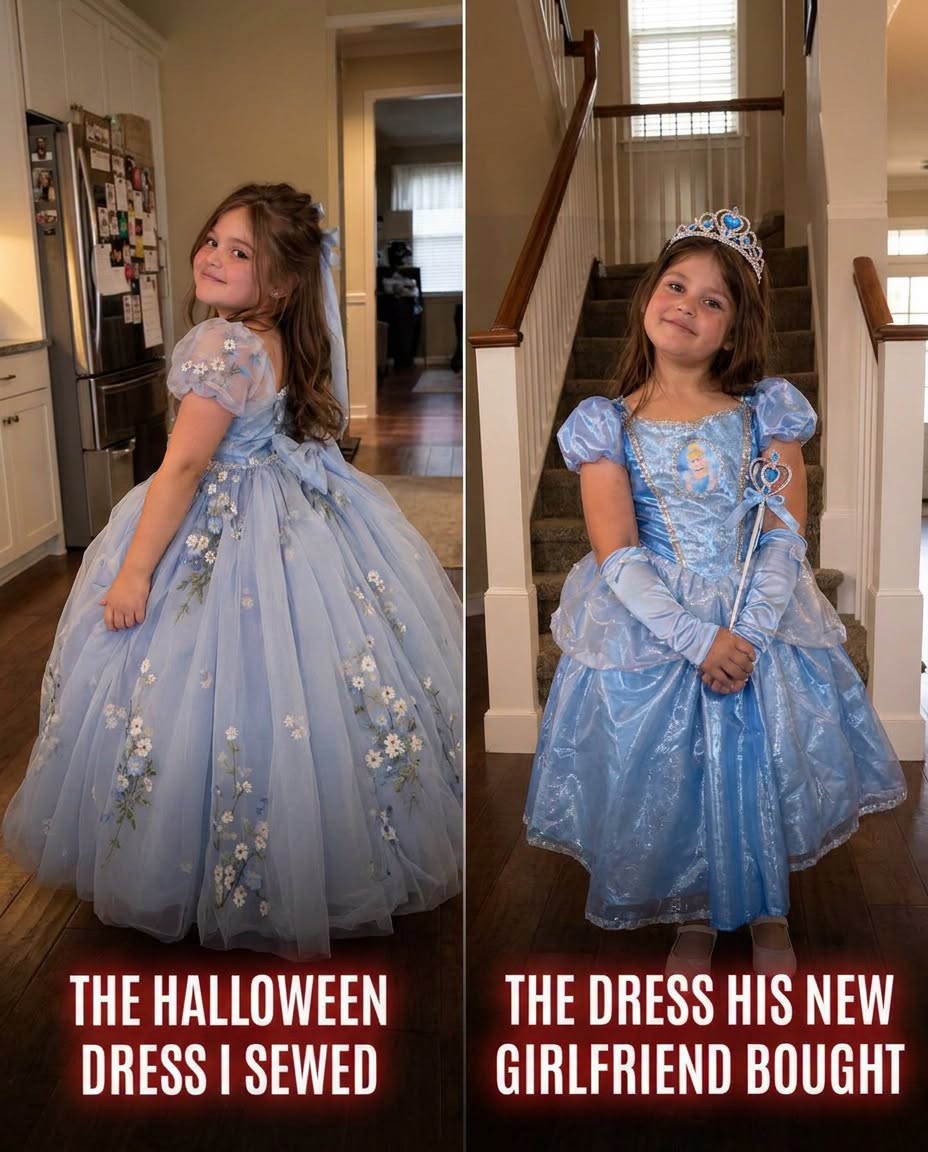
Zach stood in my kitchen holding a glittering princess dress while the pale-blue costume I’d spent three nights sewing hung from the door behind him. The smell of warm fabric still lingered near my sewing machine, and a tiny piece of silver thread clung to my sweater from the hem I’d finished that afternoon. He ran his fingers over the expensive dress’s satin lining, smiled, and announced that his new wife, Stacy, had known our daughter would need something better than anything I could make. “You’ve always been good at making do,” he said, loud enough for Emma to hear from the staircase, “but not so good at buying her a proper costume.” My stomach tightened as he called our ten-year-old downstairs and presented the store-bought outfit, complete with a sparkling tiara. Emma thanked him politely, gathered the dress in her arms, and disappeared upstairs while I stood at the sink pretending to be interested in a loose thread on my sleeve. Five minutes later, Zach lifted his phone to record a thank-you message for Stacy, but when Emma stepped onto the bottom stair, she was wearing the dress I’d made. She carried the expensive costume folded neatly over one arm, and the quiet explanation she gave her father would eventually reveal a problem far more troubling than two adults disagreeing over a Halloween outfit.
Six months earlier, I had still believed Zach and I were building a stable marriage. We’d agreed years before that I would stay home with Emma while he concentrated on his career, and I had organized my life around school runs, sick days, household responsibilities, and all the ordinary work that rarely appears on a résumé. Then he announced that he was leaving me for Stacy, whom he married shortly afterward. Almost overnight, he began describing our arrangement as though I had spent years avoiding employment while he alone supported the family. I was left trying to rebuild my financial independence with an outdated résumé, limited savings, and a daughter who needed stability more than ever. I returned to sewing, a skill I’d always enjoyed, taking small alterations at first and gradually accepting costume orders. The work was inconsistent, but every finished job reminded me that I could earn money from something I knew how to do. When Emma needed school shoes and supplies, I asked Zach to contribute, only to be told that I should learn to manage without him. I didn’t ask again. As Halloween approached, Emma showed me a photograph of a princess dress with a full pale-blue skirt and simple fitted sleeves. “Do you think you could make something like this, Mom?” she asked. I told her I could try, and after completing paying customers’ orders each day, I spent three nights cutting fabric, adjusting seams, and carefully constructing her costume. One sleeve had to be unpicked twice before it sat correctly, and more than once I worked until two in the morning. When Emma finally tried it on, she spun around our kitchen with the skirt floating around her knees and declared that it was exactly what she wanted. Her delight made the exhaustion worthwhile. Then Zach arrived on Halloween, examined my handiwork with barely concealed amusement, and announced that Stacy had bought a superior version. When Emma returned downstairs wearing my dress and Stacy’s tiara, Zach demanded to know why she hadn’t changed into her new costume. Emma calmly explained that she wanted to wear the one I’d made especially for her. She appreciated Stacy’s gift, she said, and planned to keep it at her father’s house, but the handmade dress was the one she wanted for trick-or-treating. Zach reluctantly recorded her thank-you message and left soon afterward. I thought Emma’s decision had settled the matter, and that evening I watched her laugh with friends, admire decorated porches, and collect candy until her pillowcase was nearly half full. She refused to take off the pale-blue dress even after we returned home. I felt proud that she loved something I’d created, but I also worried that she might have chosen it simply to protect my feelings.
Later that night, while I helped Emma remove her tights and tiara, I told her she never had to wear something I’d made just because she was afraid of disappointing me. She looked genuinely puzzled and insisted that she had chosen the dress because she liked it. Then, after a pause, she admitted that Zach had shown her photographs of Stacy’s costume the previous weekend and told her it would be nicer than anything I could produce. Emma had kept that conversation to herself because she’d heard me sewing late into the night and didn’t want me to feel discouraged. She had even defended my abilities when her father questioned whether I could finish the costume properly. I hugged her and assured her that my feelings were not her responsibility, but the conversation stayed with me long after she went to bed. Four days later, another concern surfaced when she came home from school and asked whether she could reuse old notebooks for a class project. Her teacher had requested two notebooks, colored pencils, and a folder, yet Emma had hesitated to give me the supply list because she worried about the expense. When I asked why, she explained that Zach frequently questioned her about our finances during visits, asking whether we had enough groceries, whether I paid the bills, and whether she had everything she needed. He often reminded her that life was easier at his house because he didn’t have to worry about money, adding that I worked so hard because I hadn’t planned properly. Emma confessed that these conversations sometimes made her worry about whether we could afford food, even though our cupboards had never been empty. Then she told me something I had completely missed: she’d chosen the pale-blue princess dress partly because she thought I might already have enough fabric to make it. She genuinely loved the design, but she’d also been calculating how much it would cost me. My ten-year-old daughter had been quietly trying to manage my budget, spare my feelings, and defend me against her father’s criticism, all while pretending everything was normal. I realized then that the Halloween costume had never been the real issue. Zach’s repeated comments were teaching Emma to view our home as financially uncertain and to treat my happiness as something she needed to protect. Before I could decide how to address it, Stacy contacted me unexpectedly, apologizing if the costume had caused trouble. During our conversation, I learned that Zach had told her Emma was disappointed with my sewing and might not have a suitable outfit for Halloween. Stacy had bought the expensive dress believing she was helping. Yet she also remembered Emma proudly showing Zach the original design weeks earlier, explaining that I was making it for her. Zach hadn’t misunderstood our daughter’s wishes; he had deliberately dismissed them. Stacy sounded genuinely upset when I repeated what he’d said in my kitchen, and for the first time I understood that he’d created a competition between us that neither of us had actually wanted. She had bought a gift in good faith, while I had made one with my own hands, and Emma had been left feeling responsible for deciding whose effort mattered more.
The following evening, while Emma was visiting a friend, I called Zach and told him we needed to discuss how his comments were affecting her. He initially dismissed the conversation as another disagreement about Halloween, but I explained that our daughter had begun worrying about groceries, school supplies, and whether I could afford to meet her ordinary needs. He insisted he was entitled to know whether she was being properly cared for, and I agreed without hesitation. As her father, he had every reason to be informed about her welfare, but those concerns needed to come directly to me rather than through repeated questions that made a child anxious. I reminded him that the decision for me to leave paid employment had been one we made together, allowing him to concentrate on his career while I managed our household and cared for Emma. That contribution had been real, even if it hadn’t produced a paycheck. His response was defensive, and he again emphasized how much money he’d earned during our marriage. I refused to turn the conversation into another argument about which of us had sacrificed more. Instead, I described Emma’s reluctance to request school supplies and the way she’d selected her Halloween costume partly to avoid burdening me financially. For once, Zach became quiet. I told him that buying Emma gifts was not a problem and that I had no intention of competing with whatever he and Stacy could afford. What needed to stop was the implication that my home was inadequate and that our daughter should judge which parent could provide more expensive things. I also made it clear that financial contributions and parenting expenses were adult responsibilities, not matters Emma should feel compelled to monitor. Our separation had created practical questions about child support, household expenses, and how we would share costs for Emma’s care, but those questions belonged in discussions between parents and, if necessary, in formal agreements rather than in conversations that made her feel insecure. Zach did not apologize, and he continued insisting that I was overreacting, but he eventually agreed to speak to me directly about any concerns involving Emma’s needs. I ended the call without asking him to acknowledge the value of the years I’d spent raising our daughter. I knew what I’d contributed, and I no longer needed his approval to recognize it. The following weekend, Emma and I sat at the kitchen table and talked openly about money in a way appropriate for her age. I explained that I was building my sewing business, that we followed a budget, and that some purchases required planning, but that providing for her was my responsibility. She could ask for things she needed without apology, and she didn’t have to choose inexpensive options simply to make my life easier. Just as importantly, she didn’t have to prefer my gifts over her father’s or Stacy’s to prove that she loved me. Emma listened carefully before asking whether she was still allowed to like my handmade dress better. I laughed and told her that she could like whichever dress she genuinely preferred. Not long afterward, one of the mothers from Emma’s class asked where we’d bought her Halloween costume. When I explained that I’d made it, she commissioned a dress for her daughter’s winter performance. We agreed on a design, price, and delivery date, and she paid a deposit before I began work. It wasn’t a dramatic financial breakthrough, but it was another paying customer and evidence that my work had value beyond the walls of our home. As more orders came in, I began keeping clearer records of materials, deposits, labor costs, and deadlines, treating the sewing not as a desperate temporary measure but as a small business I could steadily develop. The greatest change, however, appeared in Emma. One afternoon, she came into the dining room carrying a supply list for a science project and handed it to me without asking whether we could afford the items. We reviewed what she needed, decided what we already had, and planned a shopping trip for the weekend. She accepted the answer and ran off to finish her homework, leaving me staring at the list with an unexpected sense of relief.
The pale-blue princess dress still hangs beside my sewing machine, carefully pressed and waiting for Emma to decide whether she’d like to wear it again. Sometimes I notice the sleeve I unpicked twice, the neat stitches along the hem, or the soft way the skirt falls when the afternoon light catches it. I remember how small I felt when Zach examined that dress in my kitchen and compared it unfavorably with something expensive that Stacy had purchased. At the time, I believed the humiliation came from being reminded that I couldn’t provide everything I once could. But the months after our separation taught me that the deeper wound was watching someone dismiss years of care, effort, and invisible work as though they had no value. I had spent much of my marriage making sure our household ran smoothly, and afterward I had to learn how to translate my skills into an income while helping Emma adjust to two homes and a family that no longer looked the way she’d known it. Some evenings were exhausting, and there were still bills that required careful attention. Yet I began to see progress in small, measurable ways: a new sewing order, a deposit paid on time, another satisfied customer, and a daughter who no longer hesitated to tell me when she needed something for school. Emma continued visiting Zach and Stacy, and I encouraged her to enjoy those relationships without feeling guilty. Stacy’s dress remained at their house, and Emma sometimes wore the sparkling tiara with outfits from either home. I found myself appreciating that small combination, because it represented something I’d wanted for her all along: the freedom to accept love and kindness without believing she had to reject someone else. I couldn’t control every comment Zach made or erase the confusion our separation had caused, but I could make our home a place where she didn’t have to monitor my moods, defend my decisions, or calculate whether asking for a notebook would make my life harder. That mattered more than the Halloween disagreement and, eventually, more than proving who had been right about the dress. One evening, while I was cutting fabric for a customer’s order, Emma stopped beside the sewing table and ran her fingers over a piece of pale-blue material left from her costume. She asked whether we could use it for something else someday, perhaps a doll’s dress or a matching ribbon. I told her we could make whatever she liked, and she began talking excitedly about possibilities, without mentioning prices or worrying whether I had enough time. Watching her, I realized how much had changed since Halloween. She was simply a little girl imagining something beautiful, trusting that the adults in her life would handle the practical details. I still wish Zach had treated my work with respect that evening, and I wish Emma hadn’t witnessed his attempt to diminish it. But I no longer look at that dress as evidence of what I couldn’t afford. I see three nights of patient work, a daughter’s delight, and the beginning of a business that is helping me rebuild my life. Most of all, I see a reminder of what Emma needed from me after our family changed: not an expensive costume or proof that I could compete with her father, but a home where she was free to be ten years old, ask for what she needed, and know she never had to take care of me in order to be loved.Study Anatomy