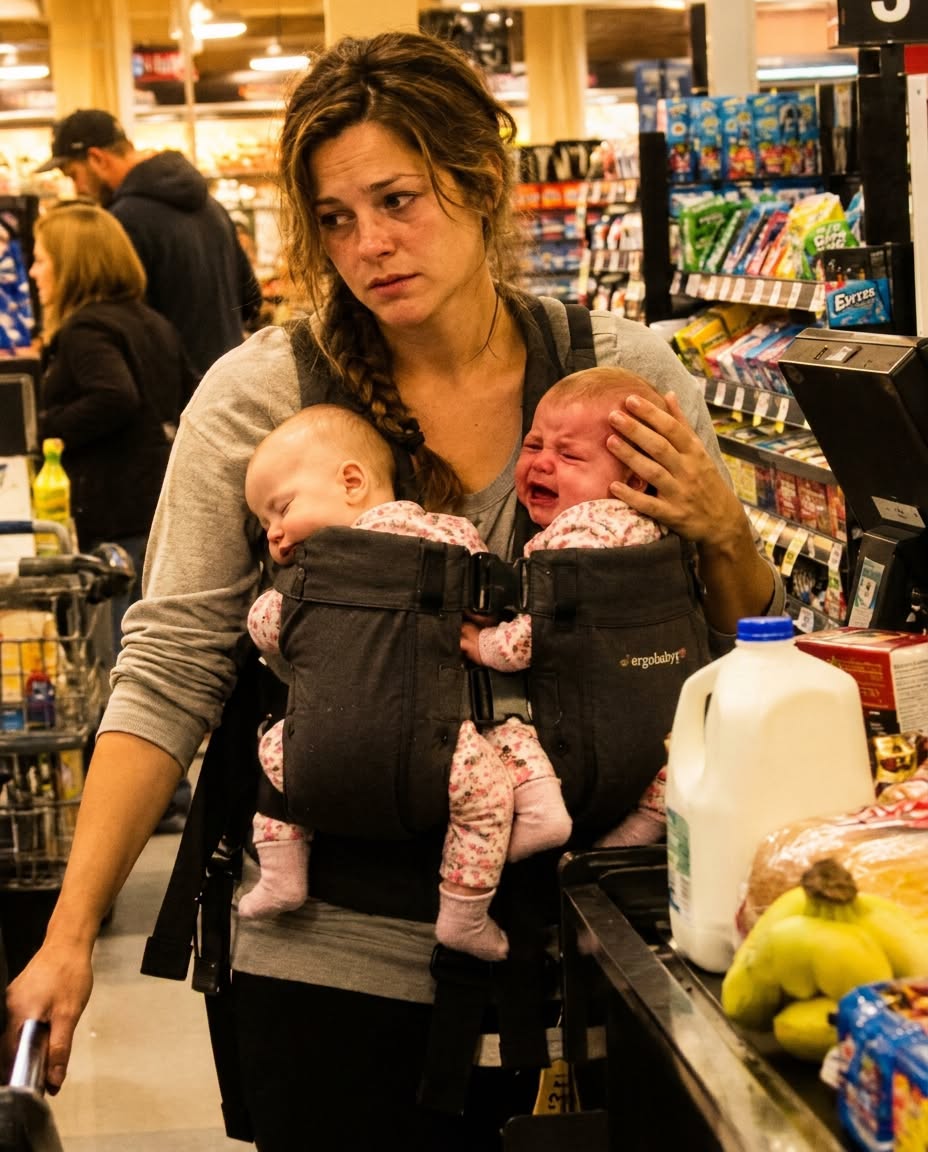
“Can you take the diapers off?” the woman whispered when her card declined for the second time. One of the twin boys strapped against her chest was screaming, a man behind her sighed loudly, and the checkout screen at Hollis Market showed that she was exactly $8.42 short. I had sixty-one dollars in my own checking account, an overdue electric bill waiting at home, and a 2009 Honda that had begun making a grinding noise that morning. Still, my hand moved almost before I thought about it. I pulled out my debit card, covered the difference, and told her to take the diapers and go home. Her eyes filled immediately, but then she noticed the old photograph taped beneath my scanner—a truck driver beside a blue Peterbilt, grinning beneath a baseball cap. She stared at it so hard that all the color left her face. The next morning, my manager called me into his office and handed me an envelope the woman had returned after closing, and inside was $8.42 in coins, a handwritten letter, and the wristwatch my father had been wearing twenty-two years earlier when he died.
My father, Tom Hale, was killed on an icy stretch of Route 9 when I was twelve. The police returned his wallet, keys, wedding ring, and even a half-eaten bag of sunflower seeds, but not the silver watch my mother June had saved nearly a year to buy for their tenth anniversary. She had engraved the back: Tom. Come home to us. Love always, June. After the snow melted, Mom and I walked the ditch beside the crash site looking for it. We never found it, and for two decades she believed some last piece of him had remained buried beneath leaves and road salt. The letter in my manager’s office came from Maya Brooks, the exhausted mother from my checkout line. When Maya was fourteen, she had run away from a dangerous foster home in Kentucky with eleven dollars and no real plan. Late one snowy night she ended up alone in a truck-stop diner, where a driver named Tom bought her pancakes and hot chocolate, listened without interrogating her, and helped contact an aunt in Georgia willing to take her in. He bought Maya a bus ticket to Macon. Then, because he had only four dollars left and worried she might get stranded during the connection, he took off his watch and buckled it around her wrist.
Maya had tried to refuse it. She had seen the engraving and told him his wife had given it to him. Dad laughed and said June would yell for an hour and then understand. Before Maya boarded the bus, she asked why a stranger would do so much for her. Dad gave her the same answer he had given me throughout my childhood: “You can’t fix the whole world, but you can fix the next ten minutes for somebody.” Maya reached her aunt safely and never sold the watch. She wound it every morning for twenty-two years through high school, adulthood, jobs, grief, and eventually a marriage that ended with her husband leaving when their twins were three months old. The day she came into my store, she was waiting to start work as a nursing aide, had almost no money left, and had actually sat on the floor of her rented yellow house considering whether to sell Dad’s watch for diapers. She could not do it. Then I covered her $8.42, she looked down at my register, and saw Tom’s photograph—same cap, same truck, same grin, the watch visible on his wrist. She had spent twenty-two years trying to find the man who saved her. Instead, she found his daughter doing the same small thing for her.
I took the watch home to my mother. The moment June read the engraving, the woman who had remained almost unnaturally composed through my father’s funeral pressed it to her mouth and broke down at our kitchen table. I read Maya’s letter aloud, including the part asking me to tell Mom that Tom had finally come home; it had simply taken him twenty-two years and a frightened girl from Kentucky to get there. Mom put the watch on and immediately made me drive her to Maya’s house. We stopped first for diapers, formula, groceries, and enough food to fill a kitchen that contained little more than saltines and one cooking pot. When Maya opened the door and saw June wearing the watch, she whispered my mother’s name before either of them could speak. Mom hugged her and told her never to apologize for keeping it. “You kept it safe,” she said. “You brought him home.” Over the months that followed, Maya and her twins, Noah and Eli, became part of our lives. Mom began helping with the babies twice a week. Maya started her nursing-home job. Neighbors quietly donated cribs, meals, repairs, and baby clothes. Even the impatient man who had sighed behind her at my register returned with sixty dollars and a note apologizing for the way he had behaved.
The watch still sits on my mother’s wrist every day, scratches and cracked leather intact. Maya’s boys call her Nana June now. As for me, I finally enrolled in the veterinary-assistant program I had dreamed about as a child—the dream Dad apparently told Maya about over pancakes all those years ago. Under register three at Hollis Market, I keep an old pickle jar labeled FOR THE NEXT TEN MINUTES. I add a dollar when I can; coworkers and customers quietly add their own. A few weeks ago Maya came through my line with the twins in a stroller, set down milk, formula, diapers, and marshmallow cookies, and tapped her card. APPROVED. Then she pulled out a sandwich bag filled with coins and dropped it into the jar. “Eight forty-two,” she said. “Every month, as long as I can.” That night I came home and found Mom asleep at the kitchen table with the watch resting beneath her hand. In the silence, I could hear it ticking—steady and patient, just as it had in bus stations, foster homes, nursing homes, and one little yellow house. For twenty-two years I thought my father’s watch had been lost. It hadn’t been lost at all. It had been keeping time somewhere his kindness was still needed.