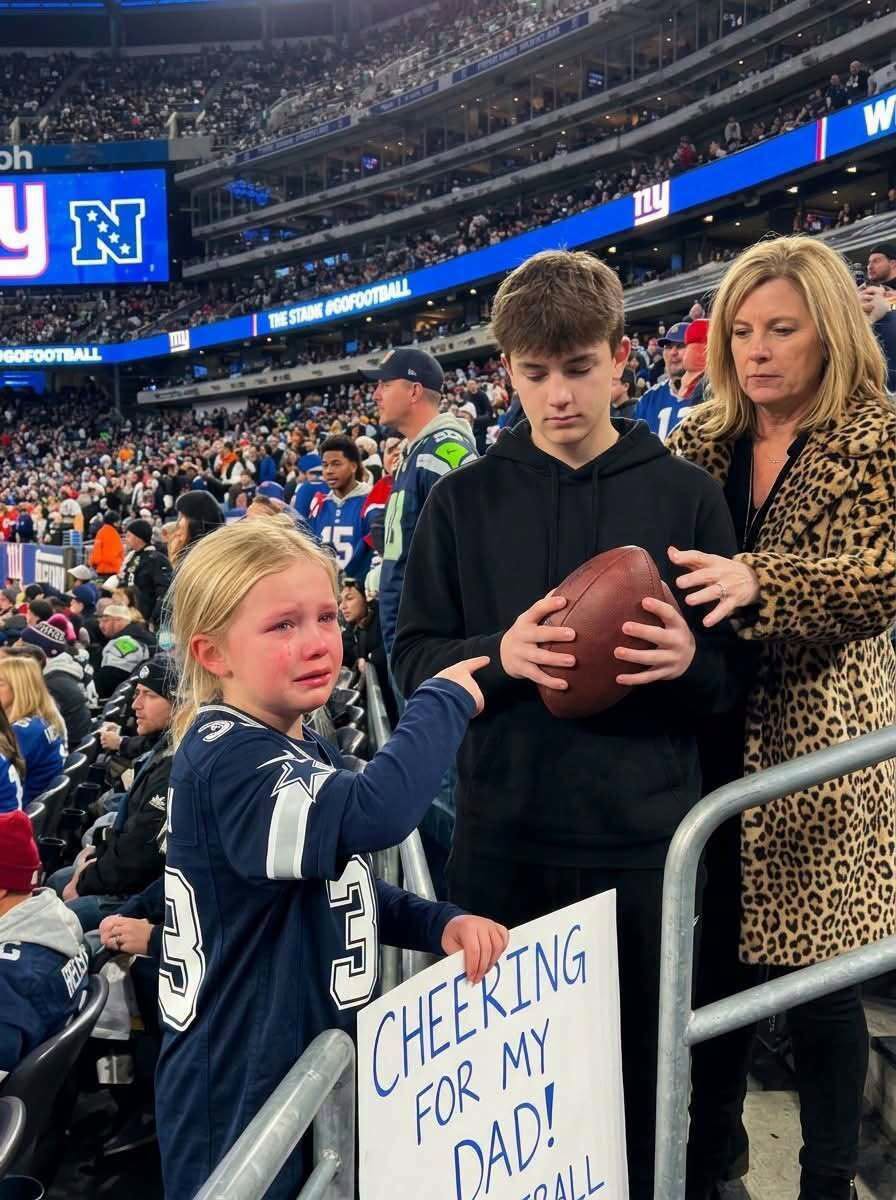
Six months after the accident, football quietly returned when Kelly asked what time “Dad’s team” played, pulled his jersey over her small frame, and watched from the couch every week, cheering the way he’d taught her.
For her eighth birthday, after months of scraping together money, her mother surprised her with tickets to see that team in person. Kelly made a sign the night before, its crooked blue letters explaining that her daddy loved this team, that he was in heaven now, and that she was cheering for both of them. At the stadium, people read her sign and offered soft condolences, and Kelly answered them all the same way: “Thanks. He would’ve loved this.” Their seats were close enough for her to see the players warming up, especially Marcus, the veteran receiver who had been Austin’s favorite.
When Marcus noticed her sign, he slowed, read it twice, pointed directly at her, and tossed a football up toward their section. With the help of a stranger yelling, “FOR THE KID!”, the ball dropped into Kelly’s arms, and for a moment she was pure joy, screaming that her dad would’ve gone crazy.
That joy shattered when the woman beside them calmly reached over, took the ball from Kelly, and handed it to her teenage son, insisting he “deserved it more” because he played football and that girls didn’t really understand the game.
She glanced at Kelly’s sign and said Kelly would forget the whole thing by tomorrow. In front of her grieving eight-year-old, on her birthday, the narrator asked for the ball back, but the woman refused.
The people around them started to bristle, and the real shift came from the field. Marcus was watching their section, pointing from Kelly to the football and back again. He took a sideline microphone and told the stadium he had thrown that ball to the little girl holding the sign, and that the young man holding it knew exactly who it belonged to. Their whole row appeared on the giant screen—Kelly in her dad’s jersey with tear tracks on her face, the woman, and her son Ethan holding the ball.
As an usher and security approached, Ethan finally told his mother to stop, admitted she had taken it from Kelly, and walked the few steps to hand it back himself, apologizing and quietly insisting, “Not like this.” Afterward, an usher led them beneath the stands, where Marcus met Kelly, asked her dad’s name, and told her his own father had taught him football too. He signed the ball “For Kelly and Austin — keep cheering together,” then invited her to stand by the tunnel as the team ran out. She screamed herself hoarse, clutching that ball in her dad’s jersey, crying the good kind of tears her mother had not seen in a long time.
That night at home, Kelly set the signed football in the center of the coffee table and carefully draped Austin’s jersey back over his chair, wondering aloud if her dad saw. Weeks later, she wrote Marcus a thank-you letter, telling him the ball lived beside her dad’s jersey now. Life kept moving in its uneven way, but Sunday football became theirs again. Before every kickoff, Kelly quietly places the jersey over Austin’s chair, with the signed ball on the table where anyone can see it.
One afternoon, while watching a replay, she patted her dad’s empty cushion and told her mother to sit closer because “Dad would’ve explained this whole play to you already.” As Kelly walked her through coverages and safeties with the same animated focus Austin once had, the jersey and the ball sat in the background, and for the first time since he died, the empty space beside them was no longer the only thing in the room.