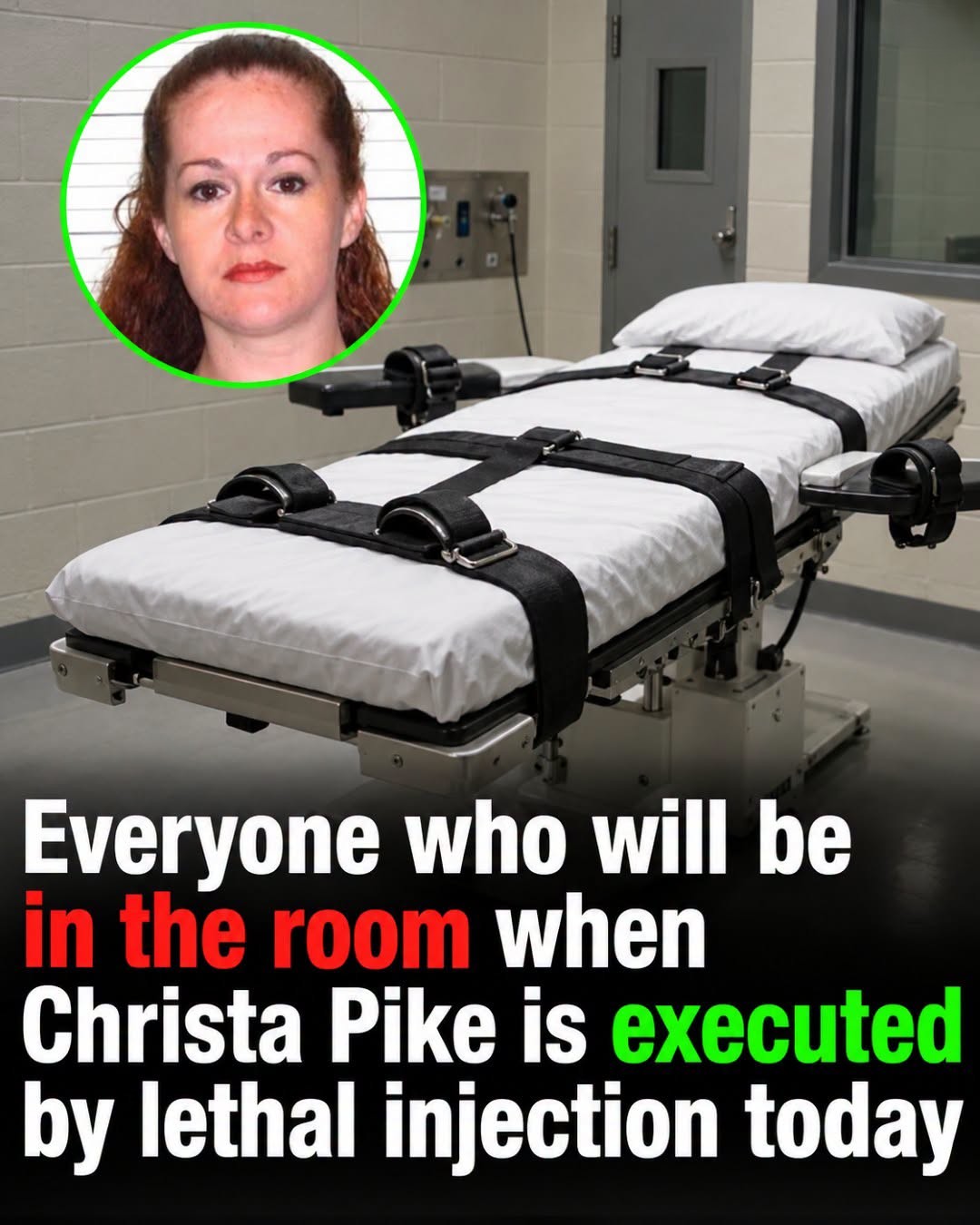
For years, Christa Pike had known that one particular day could eventually arrive.
On September 30, 2026, Tennessee prepared to carry out her death sentence at Riverbend Maximum Security Institution in Nashville.
Pike, 50, had spent more than three decades on death row after being convicted of the 1995 murder of 19-year-old Colleen Slemmer.
If the execution had gone as planned, Pike would have become the first woman executed by Tennessee in more than 200 years.
Instead, what happened inside the execution chamber became an unprecedented event.
## The People Waiting to Watch
Among those who had planned to witness the execution were members of Slemmer’s family.
Colleen’s mother, May Martinez, and her stepfather, Raul Martinez Jr., were among the people who entered the viewing area. They had waited decades for the legal process surrounding Pike’s sentence to reach its conclusion.
Media representatives were also present, including journalists who had been permitted to observe the procedure on behalf of the public.
Pike’s spiritual adviser was another witness inside the chamber.
But before anyone knew how unusual the night would become, the execution itself had already faced a series of delays.
A last-minute court battle temporarily stopped the procedure before the U.S. Supreme Court ultimately allowed Tennessee to proceed.
## Pike’s Final Moments Before the Injection
When Pike was finally brought into the execution chamber, she was strapped to a gurney and given an opportunity to make a final statement.
According to witnesses, she appeared calm and said she was leaving the world with love.
She had previously requested an all-female execution team, and her lawyers later said that request appeared to have been honored.
The execution team then began preparing the lethal injection.
But almost immediately, witnesses noticed that something wasn’t going according to plan.
Pike reportedly complained about severe discomfort in her arm, saying it felt as though it was about to burst.
The curtains were then closed.
## The Witnesses Saw Something No One Expected
The first curtain closure came at approximately 7:46 p.m.
It reopened three minutes later.
Then, at about 8:05 p.m., it closed again.
From behind the curtain, witnesses could still hear Pike breathing.
They also reported hearing loud snoring and other sounds indicating that she remained alive.
The witnesses were eventually escorted out at approximately 8:53 p.m.
According to reports, two doses of pentobarbital had been administered, yet Pike had not died. Her attorneys later said she still had a heartbeat and was breathing after the injections.
Emergency vehicles arrived at the prison, and Pike was transported to a hospital for medical treatment.
The woman who was expected to leave the prison in a hearse instead left in an ambulance.
## A Night That Became Historic for Another Reason
The execution was supposed to be remembered as a historic moment because Tennessee had not executed a woman in more than two centuries.
Instead, it became historic because Pike survived after execution drugs had been administered.
The Death Penalty Information Center reported that no prisoner in the modern death-penalty era was previously known to have survived after lethal-injection drugs had actually entered the person’s body.
The Tennessee Department of Correction said it followed the state’s established execution protocol and that the protocol did not allow for additional procedures beyond those carried out that evening.
Governor Bill Lee subsequently announced that Tennessee would pause executions for the remainder of 2026 and ordered an independent review of what happened.
## What Happens Now?
For the people who had entered the prison expecting to witness the final moments of a decades-old case, the evening ended without the conclusion they had anticipated.
Pike survived the attempted execution and was receiving medical care.
Her attorneys have called for her death sentence to be changed to life imprisonment, while state officials have begun reviewing the execution process.
For Colleen Slemmer’s family, the night brought another complicated chapter to a story that began more than 30 years ago.
For Tennessee, it raised difficult questions about how executions are carried out and what should happen when a lethal-injection procedure fails.
And for Christa Pike, a woman who had spent decades awaiting death, the final hours that were expected to close her story instead opened another uncertain chapter.