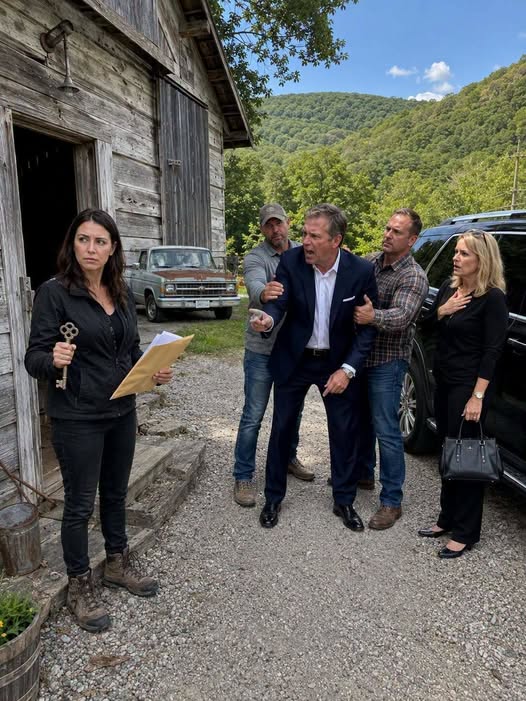
The key, Holloway explained, belonged to an old house in the Appalachian foothills, a property deliberately omitted from the estate Bridget had combed through “slightly indecently” in search of value. My father had insisted it be given to me by hand, and that Bridget and Mason not know about it until I had “gone up there” myself. I told myself I would sell whatever decaying shack awaited me and be done with the mystery, but by dawn, curiosity had outpaced caution. The mountain track ended at exactly the ruin I had imagined—gray boards, peeling paint, sagging porch—until I noticed the modern steel door hidden behind warped slats. The rusted key turned with a heavy click, and instead of stale air I stepped into a climate‑controlled chamber: soundproofed walls, humming server racks, and, behind a metal desk, a woman named Cara who said she had worked with my father for nearly twenty years. She handed me an envelope sealed in dark red wax with his initials. Inside were a USB drive, a small silver key, and a single sentence in his cramped handwriting: “If you are reading this, it means I ran out of time to tell you the truth myself.”
Cara showed me what that truth contained. On the screen unfolded a hidden logistics empire—property deeds, shell companies, transportation licenses, warehouse agreements—spanning multiple states and converging on my father’s name, valued at over eighty million dollars. He had built it quietly from the truck‑fixing life I knew, turning his instinctive grasp of routes and freight into a vast, secret network. He hid it, Cara said, after a partner betrayed him and threatened our family, convincing him that money was dangerous and best kept in the dark. He kept me poor and distant not because he loved me less but because he needed one clean heir, untouched by the network, to inherit and, if necessary, expose it. When Cara opened the directory of vendors, Mason’s company appeared among the paid entities, with years of siphoned funds disguised as legitimate payments. My father had known, had spent years gathering evidence of Mason’s theft and Bridget’s complicity or willful blindness, and had built a case designed to outlast him. The USB held the documentation; the silver key opened a safe deposit box of originals. What he left me was not just a fortune but a choice: how far to let that evidence reach, and what to do about my sister. I confronted Bridget without the drive in my pocket, told her everything, and in the end chose what my father had structured the whole painful distance to make possible: justice for Mason and a hard, conditional mercy for Bridget. With Cara’s help, we dismantled Mason’s scheme, unwound the fraudulent companies, and recovered most of the stolen money; Bridget cooperated, left him, and avoided legal ruin by finally choosing our father’s “clean hands” over her husband’s money. I did not keep the entire eighty million. Instead, we used most of it to build a foundation in my father’s name, repurposing his hidden transportation network to move medical supplies and food into the rural mountain communities he had once driven through in his battered pickup. Bridget works there now, without special treatment, slowly becoming again the sister I once shared a bedroom and a private language with. We no longer need to dissect the years of distance; we understand that my father’s apparent favoritism and rejection were, in fact, a brutal form of protection. I keep the rusted iron key on a chain as the truest symbol of him: a worthless‑looking object that opened the door to everything he had been building in secret, and to the revelation that the man I thought had chosen my sister over me had actually spent his life, and even his reputation in my eyes, to save us both.