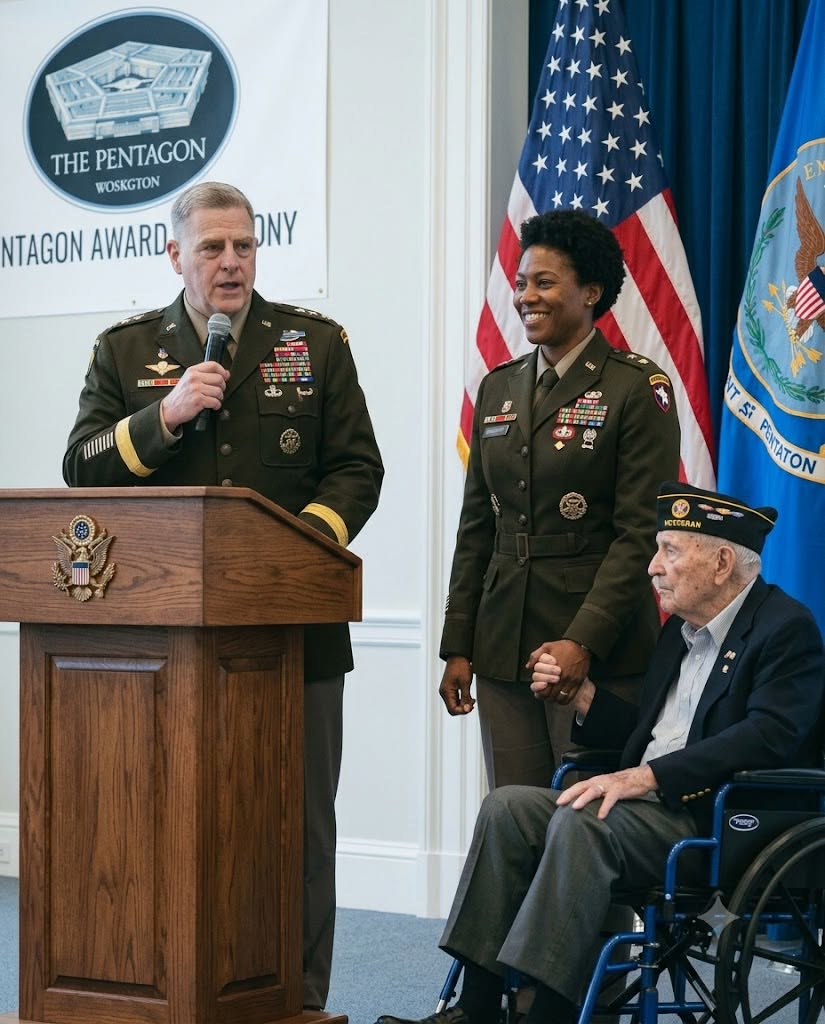
My Family Told Me Not to Wear My Army Uniform to My Grandfather’s Ceremony — Then a Four-Star General Called My Name
My name is Maya Parker, and I am a Staff Sergeant in the United States Army.
When my grandfather turned ninety, our family organized a formal military ceremony to honor his years of service during the Korean War.
I couldn’t have been prouder of him.
Unfortunately, my family didn’t always feel the same way about my own military career.
My older brother, Daniel, was a successful executive, and my father constantly praised his promotions. My younger sister had married into a wealthy family.
Then there was me.
I had chosen the Army.
To my father, that meant I had settled for less.
When I arrived at the ceremony wearing my dress uniform, Daniel immediately noticed.
“You’re actually wearing that?” he asked.
His wife laughed and called the uniform dramatic.
I calmly reminded them that it was a military ceremony.
But my father was even more direct.
He pulled me aside and quietly explained that important people were attending — senators, executives, generals, and donors.
“We don’t need you drawing attention,” he said.
I looked at him.
“Because I’m wearing my uniform?”
He sighed.
“Compared with what Daniel has accomplished, being a career soldier isn’t exactly impressive.”
My mother heard every word.
She said nothing.
That hurt more than my father’s insult.
I walked outside to collect myself.
Then my phone rang.
A military representative told me the Pentagon delegation had arrived.
My family had no idea what was about to happen.
Months earlier, I had been informed that I would receive a major military commendation for my actions during an overseas rescue operation.
I had deliberately kept it quiet.
The ceremony was supposed to be about my grandfather, not me.
So I returned to the ballroom and quietly took my seat.
About an hour later, the lights dimmed.
A four-star general walked onto the stage.
He began by honoring my grandfather’s service and sacrifice.
Then he paused.
“Today,” he announced, “we are honoring not one hero, but two.”
My father slowly turned toward me.
The general looked directly at my section.
“Staff Sergeant Maya Parker, please come forward.”
For a moment, I couldn’t move.
Then I stood.
The general explained that during an overseas rescue mission, I had assumed command after communication with our commanding officer was lost.
I had coordinated the evacuation of injured personnel and helped bring every member of my team home safely.
Then he presented me with a Distinguished Service Commendation.
The room erupted in applause.
But I wasn’t looking at my family.
I was looking at my grandfather.
He was crying.
I walked to him first.
“I knew,” he whispered.
“You knew?”
He nodded.
“I always knew what kind of soldier you were.”
Then the general revealed one more detail.
I had personally requested that my award remain a surprise so the ceremony could focus on my grandfather.
My grandfather squeezed my hand.
“You never took anything away from me,” he said.
Afterward, Daniel approached me.
“I was wrong,” he admitted.
Then my father came over.
“I didn’t understand what you had accomplished,” he said.
I looked at him.
“You didn’t.”
He lowered his eyes.
“I was proud of Daniel because I understood his success. I didn’t understand yours.”
I didn’t need a dramatic apology.
I simply told him:
“You don’t have to understand it. Just don’t call it settling.”
He nodded.
Across the room, my grandfather raised his glass.
“To ninety years,” he said.
Then he looked at me.
“And to the next generation.”
Everyone applauded.
Standing beside him in my uniform, I finally realized something.
For years, my family had measured success through money, promotions, and impressive titles.
But my grandfather had taught me a different definition.
I hadn’t settled.
I had chosen my own path.
And that day, my family finally understood the difference.