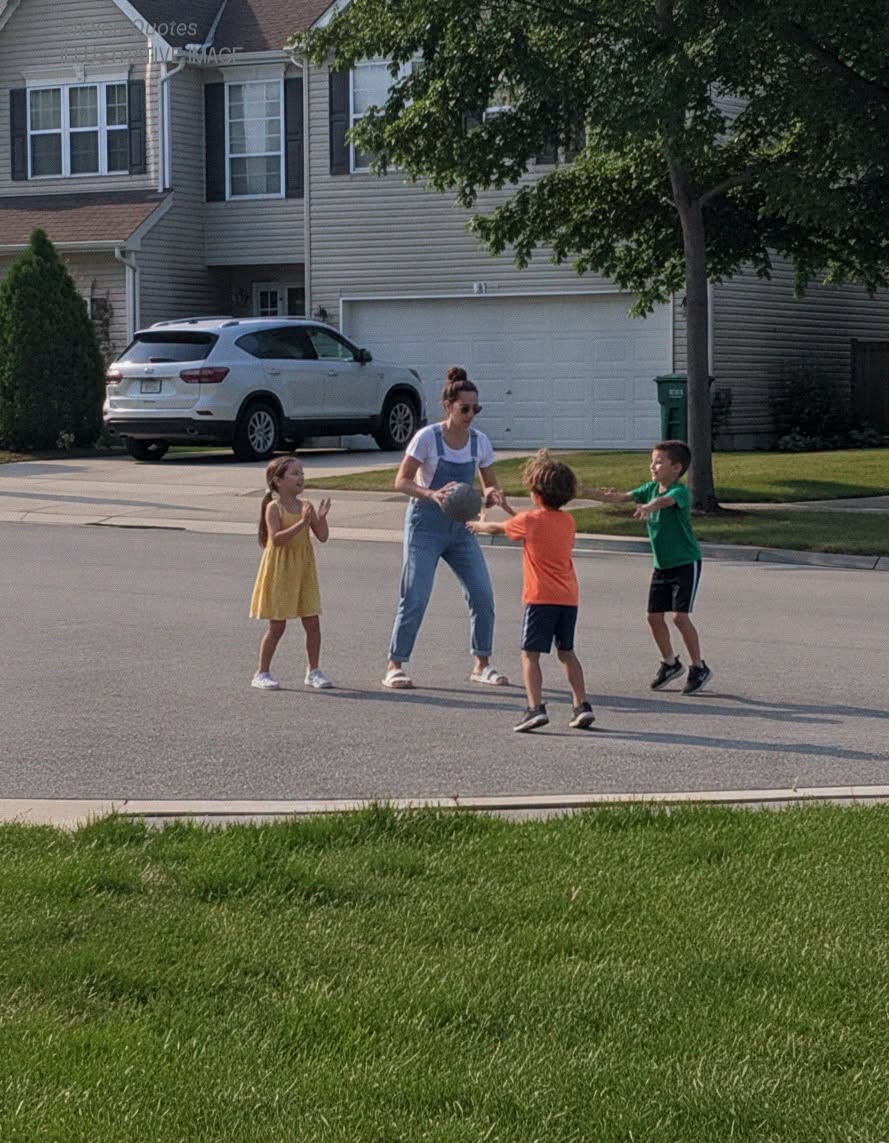
For years, our street had been the kind of neighborhood where children could simply be children.
Every morning, kids rode their bicycles through the cul-de-sac, played basketball, drew pictures with chalk and ran from one house to another. The adults knew each other, shared coffee and occasionally watched the children while they played.
Nobody thought much about the noise.
That changed when Brooke moved into the neighborhood with her husband, Walter.
Brooke practiced yoga every morning between eight and nine. At first, she politely asked everyone to keep things quiet during that hour. Most of us understood. Everyone deserves some peace and privacy in their own home.
But soon, her requests became demands.
She began telling children that they should not play in the street during her yoga practice. Some children even came home believing that their parents had agreed to keep them away from the cul-de-sac every morning.
The parents were confused.
No one had agreed to that.
So one Saturday morning, several families decided to do something unusual.
At exactly eight o’clock, the neighborhood came outside.
There were bicycles, sidewalk chalk, a small basketball hoop and plenty of coffee. The children played normally. Nobody blasted music or intentionally made excessive noise. They were simply using the public street they had used for years.
A few minutes later, Brooke appeared on her porch with her yoga mat.
She looked around in disbelief.
“What is everyone doing here?” she asked.
One neighbor calmly answered that it was Saturday and everyone was enjoying the morning outside.
Brooke immediately realized why they had chosen that particular time.
She accused the neighbors of deliberately harassing her.
But the parents refused to argue with her. They explained that they understood her desire for quiet, but the street was public, and ordinary neighborhood activity could not simply be banned because someone wanted complete silence for an hour.
Then the conversation took an unexpected turn.
Several children admitted that Brooke had told them they were no longer supposed to play there during the morning.
Brooke insisted that they had misunderstood her.
Before the argument could become worse, Walter came outside.
For months, Walter had mostly stayed quiet whenever Brooke became upset. He seemed to avoid confrontation at all costs.
But this time, he asked her directly whether she had told the children they couldn’t play outside.
Brooke tried to explain that she had only asked them to respect her quiet hour.
Walter looked at the children.
“They’re children,” he said.
It was a small sentence, but everyone noticed the difference.
For the first time, Walter was not automatically agreeing with Brooke.
Then something even more surprising happened.
Walter walked over to the sidewalk chalk.
Months earlier, Brooke had complained that children gathering near their porch made her uncomfortable. Walter had taken away an old bucket of chalk that had been sitting outside for years.
Now he picked up a piece of chalk and crouched beside one of the children.
He drew a crooked sun on the pavement.
The child smiled.
Brooke was furious. She felt that Walter was humiliating her in front of the neighbors.
But Walter calmly told her that not every disagreement was an attack against her.
He apologized to the children for taking away their chalk.
Later that morning, he brought the old bucket back and placed it beside his porch, exactly where it had been for years.
The neighborhood thought the problem might finally be over.
It wasn’t.
A few days later, Brooke submitted a formal noise complaint to the neighborhood association. She argued that the children were creating excessive noise between eight and nine in the morning and asked for official quiet hours.
But the association explained that it had no authority to ban normal activities on a public street.
Brooke was angry.
Eventually, Walter came to one neighbor’s house alone. He admitted that the situation had become difficult at home.
He explained that Brooke had experienced a difficult period before they met. She had lived in an apartment where constant noise and fighting had made it difficult for her to sleep. Yoga had become an important part of how she managed her anxiety and started her mornings.
The neighbor understood.
But understanding someone’s pain did not mean allowing them to control everyone around them.
Walter finally admitted that he had spent almost a year apologizing for ordinary things — the television, the porch light, the coffee grinder, the neighbor’s dog and even the children playing outside.
He had believed that if he removed one more source of discomfort, Brooke would finally feel safe.
Instead, there was always another problem.
The neighbor gave Walter simple advice: caring about someone did not mean surrendering every boundary.
Not long afterward, Brooke left to stay with her sister for a few days.
When she eventually returned, something had changed.
One Saturday morning, Brooke put her yoga mat outside.
The children were playing nearby.
At first, everyone expected another confrontation.
Instead, Brooke began doing yoga while the children played around the street.
Later, she explained that her therapist had encouraged her to stop treating ordinary neighborhood sounds as something she had to eliminate. She was learning to tolerate the noise rather than forcing everyone else to change their lives around her.
It wasn’t an instant transformation.
But little by little, things improved.
The children continued playing. Brooke continued practicing yoga. Walter started spending more time outside instead of disappearing whenever Brooke became upset.
The neighbors also made an effort.
When the children became excessively loud right beside Brooke’s yard, their parents asked them to move farther down the street.
Not because Brooke owned the morning.
Simply because being considerate was different from surrendering.
Eventually, Brooke began interacting with the children.
One morning, a little girl asked her if she knew how to do a handstand.
Brooke hesitated.
Then she agreed to teach the children — on the grass, where nobody would get hurt.
Walter watched from his porch.
He didn’t say anything.
But he smiled.
Over the following weeks, the tension slowly disappeared.
The “quiet hours” sign eventually vanished.
At a neighborhood meeting, Brooke even made a reasonable request: she asked parents to remind the children not to leave their bicycles in the middle of the road.
Instead of arguing, everyone agreed.
It was a small moment, but it showed how much had changed.
Brooke no longer expected complete silence.
The neighbors no longer treated every request from her as an attack.
And Walter had finally learned that supporting the person you love doesn’t mean giving up every boundary you have.
The chalk bucket remained on his porch.
The children still played in the circle.
Brooke still practiced yoga every morning.
Sometimes all three happened at the same time.
And perhaps that was the real lesson.
Living in a neighborhood means sharing space with people who have different needs, different routines and different ideas about what makes a home comfortable.
Nobody gets perfect silence.
Nobody gets unlimited noise.
The goal isn’t to make everyone live exactly the way you want.
It’s to find a way to live alongside one another.
That Saturday morning, the neighbors thought they were teaching Brooke a lesson by refusing to leave the street.
But they learned something too.
There is a difference between standing up for yourself and deliberately trying to hurt someone.
And sometimes the strongest response to an unreasonable demand isn’t anger or revenge.
It’s simply refusing to surrender the ordinary parts of life that belong to everyone.