Part 2
The missing girl’s name was Madison Reed, but her family called her Maddie.
Her father, Ethan, was a white American high school history teacher from Portland. Her mother, Sarah, was a white American pediatric dental assistant with tired eyes and a voice that kept breaking on the same sentence: “She was right there.” They had come to Cannon Beach for three nights because Maddie loved tide pools and had saved ten dollars in tooth fairy money for saltwater taffy.
A family trip. Family
A beach rental.
A child’s purple jacket hanging on a kitchen chair.
That was how ordinary the beginning looked.
The Reeds had eaten dinner at a small place near Hemlock Street. They came back after sunset, carrying leftovers, wet shoes, and a sleepy little girl wrapped in a towel because she had insisted on one last look at the water. Ethan put her on the couch while Sarah took bags upstairs. Her grandmother called. A smoke alarm chirped. Someone opened the back door to shake sand from a blanket.
Then Maddie was gone.
Not for long, at first.
That is how panic begins. It gives you a tiny explanation before it takes everything. Maybe she went to the bathroom. Maybe she hid behind the curtains. Maybe she went onto the porch. Maybe she followed the cat that had been prowling near the dunes.
Then came the sandal.
Discover more
Family
Beaches & Islands
dog
Then the open gate.
Then the empty beach. Beaches& Islands
By midnight, volunteers were moving in lines with flashlights. A K9 unit came from Seaside. Coast Guard was notified because tides had turned rough. We checked beach rentals, parking lots, public restrooms, crawl spaces under decks, dunes, alleys, and the rocks where children liked to climb even after signs told them not to.
No bracelet was mentioned at first.
That mattered later.
Her mother had made it with her that afternoon at a beach craft shop. Purple beads. white letters. a plastic dolphin charm. Maddie had refused to take it off, even in the bath. In the first hours of the search, Sarah forgot the bracelet existed because fear does not make a neat inventory. It grabs the largest missing thing and blinds you to the rest.
The dog changed that.
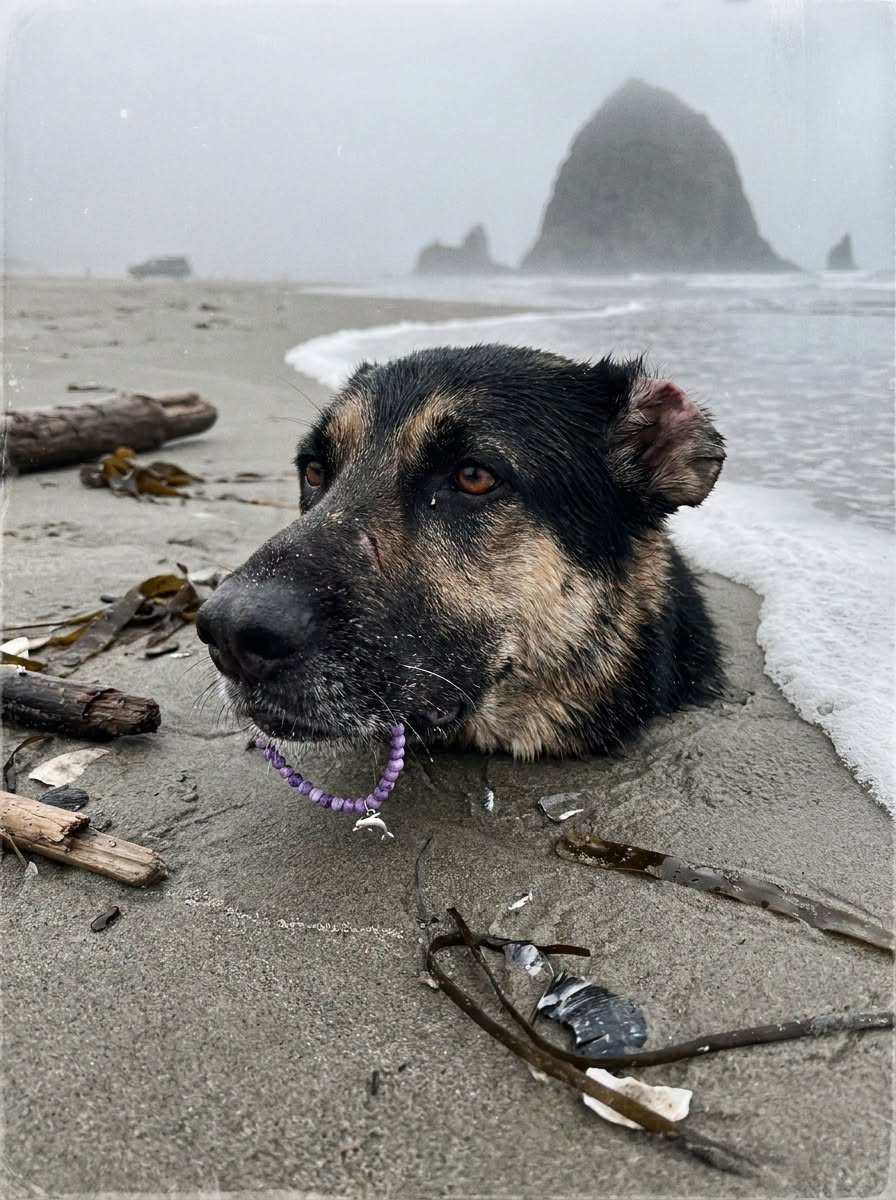
I did not know his name, so I called him Tide in my head.
It was not official. It was not even clever. But when a dog is buried where the ocean can reach him, you give him something stronger than “unknown.” Tide’s body trembled when I dug him free. His front legs buckled. His fur hung in wet ropes against his ribs. Sand poured from the hollow where his body had been packed.
He still would not drop the bracelet. Gems& Jewelry
Officer Luis Ortega arrived first, a Latino American officer in his late thirties, broad-shouldered and calm under pressure. He knelt beside me, saw the purple beads, and went still.
“Is that—”
Discover more
Bracelets
Child’s
Electronic Components
“Yes.”
I did not finish because the dog tried to stand.
His back legs shook.
His front paws spread wide on the sand.
I expected him to collapse into my arms. Instead, he turned north toward the basalt rocks and pulled against my hand.
Not hard.
Enough.
Tide had been buried below the tide line. Water& Marine Sciences
He had held a child’s bracelet in his mouth.
Now he wanted to move.
That was the second seed.
A dog recovering from that kind of fear should seek warmth, water, or escape. Tide sought direction. He took three steps, stopped, looked back at us, and whined.
Luis looked at me.
I looked at the rocks.
The ocean hissed behind us, filling the hole where Tide had almost disappeared. Water& Marine Sciences
“Call search command,” I said.
Then I followed the dog…